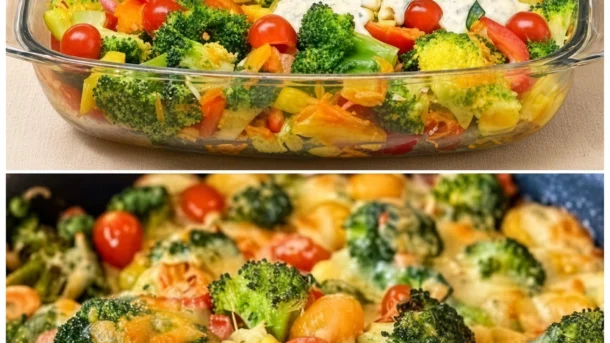
There is a category of food that exists specifically for the days when warmth and comfort are more important than novelty — when what is needed at the table is something that comes out of the oven bubbling at the edges, golden and slightly browned on top, filling the kitchen with a savory, creamy fragrance that makes everyone gravitate toward the oven before it is even done. The Creamy Vegan Veggie Bake is that food. It is a generous, deeply satisfying casserole of tender vegetables — broccoli, cauliflower, sweet potato, and green beans — layered in a rich, garlicky cashew cream sauce that thickens into a glossy, sauce-like consistency in the oven, finished with a golden breadcrumb and nutritional yeast crust that shatters slightly when the serving spoon goes through it to reveal the bubbling cream beneath. It is the kind of dish that a table of eight can gather around, serve in large spoonfuls over rice or alongside crusty bread, and finish entirely without anyone planning to. It is 100% vegan, completely dairy-free, naturally gluten-free if made with gluten-free breadcrumbs, and made from ingredients that are available in every supermarket. It is make-ahead friendly, reheats better than almost any other dish in this collection, and scales effortlessly to double for a larger gathering. It is, simply, one of the best things you can make on a weeknight or a weekend when feeding people well is the entire point.
The technique is the pre-roast then bake method. The most common failure of a vegetable bake or gratin is a filling that is either undercooked (hard vegetables swimming in liquid sauce) or overcooked (mushy vegetables in a broken, watery sauce), because the vegetables and the sauce have incompatible cooking timelines: the sauce needs to cook for long enough to thicken and develop flavor, but the vegetables need to be tender without becoming structureless. The pre-roast then bake method solves this by decoupling the two problems. In the pre-roast stage, the vegetables are cut into bite-sized pieces, tossed in a small amount of oil, salt, and smoked paprika, and roasted at 200°C (390°F) on a high-sided baking sheet for 20 minutes — long enough to drive out a significant portion of their water content (water that would otherwise dilute and thin the sauce during baking), develop some initial caramelization and flavor at their surfaces, and bring them to approximately 70–75% done. In the bake stage, these pre-roasted, partially-caramelized, partially-dried vegetables are combined with the cashew cream sauce in the baking dish and baked together for a further 25–30 minutes — just long enough for the sauce to thicken and bubble and for the breadcrumb crust to turn deeply golden. Because the vegetables entered the oven already partially cooked and already with their excess water driven off, they finish perfectly tender at exactly the same moment the sauce finishes thickening. The pre-roast also means that the vegetables have developed their own flavor before the sauce coats them, so each piece of broccoli or sweet potato has its own caramelized note inside the cream, rather than being simply boiled and sauce-coated. The pre-roast then bake method is, genuinely, the difference between a competent vegetable bake and an exceptional one.
This recipe serves 6 generously from a standard 30×22cm (12×9 inch) baking dish.
Recipe Information
| Prep Time | Cook Time | Total Time | Servings | Calories |
|---|---|---|---|---|
| 20 mins | 50 mins | 70 mins | 6 | ~490 kcal |
Ingredients
For the Pre-Roasted Vegetables
- 1 medium head of broccoli (approximately 350g / 12oz), cut into medium florets
- ½ medium head of cauliflower (approximately 300g / 10oz), cut into medium florets
- 1 large sweet potato (approximately 350g / 12oz), peeled and cut into 2cm (¾ inch) cubes
- 200g (7oz) green beans, trimmed and cut in half (added raw in the second bake stage rather than pre-roasted, as green beans cook more quickly and benefit from less initial roasting)
- 2 tbsp neutral oil
- ½ tsp fine salt
- ½ tsp smoked paprika
For the Cashew Cream Sauce
- 1½ cups (200g) raw cashews, soaked in cold water for at least 4 hours or in boiling water for 30 minutes, then drained (the soaking is essential — unsoaked cashews produce a gritty sauce; fully soaked cashews blend to complete silkiness)
- 1¾ cups (420ml) vegetable stock, warm (warm stock blends more smoothly into the cashews than cold)
- 4 cloves garlic, roughly chopped
- 3 tbsp nutritional yeast
- 1 tbsp lemon juice (fresh)
- 1 tsp Dijon mustard (adds a sharp background note that prevents the sauce from tasting flat; the mustard itself is not detectable in the finished sauce)
- 1 tsp onion powder
- ½ tsp fine salt, plus more to taste
- ½ tsp white pepper or black pepper
- Pinch of nutmeg (optional — a traditional gratin note that works well in a creamy white sauce)
For the Golden Breadcrumb Crust
- ¾ cup (75g) panko breadcrumbs (panko produces a significantly lighter, crispier crust than regular breadcrumbs; use certified gluten-free panko if needed)
- 2 tbsp nutritional yeast
- 1 tbsp neutral oil or melted vegan butter
- ½ tsp garlic powder
- ¼ tsp smoked paprika
- Pinch of fine salt
For Serving
- Fresh flat-leaf parsley or fresh chives, finely chopped
- Steamed rice, quinoa, or crusty bread
- Optional: extra lemon wedges for squeezing at the table
Instructions
- Soak the cashews. If not already done, soak the cashews now — cold water for 4+ hours, or boiling water for a minimum of 30 minutes (30 minutes in boiling water is sufficient but 1 hour produces a silkier result). Drain completely before blending.
- Pre-roast the vegetables. Preheat the oven to 200°C (390°F). On a large rimmed baking sheet, combine the broccoli florets, cauliflower florets, and sweet potato cubes. Drizzle with the 2 tablespoons of oil, sprinkle with the ½ teaspoon salt and ½ teaspoon smoked paprika, and toss to coat evenly. Spread in a single layer — do not crowd. Roast for 20 minutes until the edges are beginning to caramelize and the vegetables are about three-quarters cooked through. Remove from the oven and set aside. Leave the oven on.
- Make the cashew cream sauce. Combine the drained cashews, warm vegetable stock, garlic, nutritional yeast, lemon juice, Dijon mustard, onion powder, salt, pepper, and nutmeg (if using) in a high-powered blender. Blend on high speed for 60–90 seconds until completely smooth and creamy — there should be no gritty texture remaining. Taste and adjust seasoning: add more salt if needed, more lemon juice for brightness, more nutritional yeast for a deeper savory note. The sauce should be well-seasoned at this stage as it will dilute slightly when it coats the vegetables.
- Make the breadcrumb crust. In a small bowl, combine the panko breadcrumbs, nutritional yeast, oil or melted vegan butter, garlic powder, smoked paprika, and salt. Toss with your fingers until the breadcrumbs are evenly coated and the mixture looks slightly damp and clumped. Set aside.
- Assemble the bake. Lightly grease a 30×22cm (12×9 inch) baking dish with oil or vegan butter. Arrange the pre-roasted vegetables in the dish. Add the raw green bean pieces, distributing them evenly throughout the other vegetables. Pour the cashew cream sauce over the vegetables, ensuring every piece is coated — use a spatula to press the vegetables gently into the sauce. The sauce should come about halfway up the vegetables; if the dish seems too dry, add 2–3 tablespoons of extra vegetable stock. Scatter the breadcrumb mixture evenly over the entire surface.
- Bake. Place the dish in the 200°C (390°F) oven (the same temperature as the vegetable pre-roast). Bake uncovered for 25–30 minutes until the breadcrumb crust is deeply golden-brown, the sauce is visibly bubbling at the edges of the dish, and the vegetables are completely tender when pierced with a knife. If the breadcrumbs are browning too quickly before the sauce is bubbling, tent loosely with foil for the final 10 minutes. Do not cover tightly — steam trapped under tight foil will make the crust soggy.
- Rest and serve. Remove from the oven and allow to rest for 5 minutes — the sauce continues to thicken slightly as it cools from its hottest point, and the rested dish holds its structure better when served. Scatter generously with fresh parsley or chives. Serve directly from the baking dish in large spoonfuls over steamed rice or alongside crusty bread.
Pro Tips
- Blend the sauce for a full 60–90 seconds — the silkiness of a cashew cream sauce is directly proportional to blend time. At 30 seconds, the sauce has a slightly grainy texture; at 90 seconds, it is completely smooth and glossy. A high-powered blender produces the best result; a standard blender can achieve the same but may need 2–3 minutes of blending with a rest in between to prevent overheating.
- Taste the sauce before it goes on the vegetables — the cashew cream sauce is the flavor backbone of the entire dish, and it should taste distinctly well-seasoned and complex at this stage. A sauce that tastes mild or flat before baking will taste mild and flat after baking. Season assertively; the vegetables and breadcrumbs absorb seasoning from the sauce, so a strongly seasoned sauce produces a well-seasoned finished dish.
- Do not skip the pre-roast — the 20-minute pre-roast is not an optional step but the structural foundation of the technique. Vegetables added raw to the sauce produce a watery, broken, underseasoned result that no amount of oven time fully fixes. The pre-roast drives out water, adds flavor, and brings the vegetables to the right point for the final bake to finish them perfectly.
- For a make-ahead version, assemble the dish completely through step 5 (without the breadcrumbs), cover with plastic wrap, and refrigerate for up to 24 hours. Remove from the refrigerator 20 minutes before baking, add the breadcrumb topping, and bake as directed, adding 5–8 minutes to the baking time to compensate for the cold start.
The Gratin: French Technique, Universal Comfort
The word “gratin” comes from the French verb gratter — to scrape — and refers specifically to the browned, crusted surface that forms on top of a baked dish, and to the action of scraping that crust from the sides of the dish when serving (the most coveted part, as every experienced cook knows). As a culinary technique, the gratin originated in French cuisine — specifically in the Dauphiné region of southeastern France, where gratin dauphinois (potatoes baked in cream and garlic) has been documented since at least the eighteenth century and remains one of the most recognizable dishes in the French regional canon. The technique’s principle — layering ingredients in a dish, coating them in a cream or béchamel sauce, covering the surface with cheese or breadcrumbs, and baking until the top forms a golden, slightly crispy crust while the interior bubbles and thickens — traveled from French professional kitchens into the broader European cooking tradition during the nineteenth and early twentieth centuries, appearing in Italian cuisine as gratinato, in British cooking as a gratin or bake (the words are used interchangeably in English), and in American cooking as a casserole, a term that refers both to the dish and to the cooking vessel. The cream-and-crust structure of the gratin is so fundamentally satisfying — the contrast of the crispy top against the rich, yielding interior — that it appears, independently or through influence, in the cooking of almost every culture with an oven and a preference for dairy-enriched sauces. The cashew cream that replaces the dairy cream in this vegan version honors the technique entirely: the same contrast, the same bubbling edges, the same golden crust, the same communal serving from a shared dish — the French lineage fully intact, the animals entirely absent.
Flavor Variations
- Mediterranean Vegan Veggie Bake: Replace the broccoli and cauliflower with chunks of zucchini, eggplant (aubergine), and cherry tomatoes (the tomatoes go in raw, not pre-roasted — they burst during the bake and add acidity to the sauce). Add 1 teaspoon of dried oregano and ½ teaspoon of dried basil to the cashew cream sauce, and 50g of pitted kalamata olives scattered through the assembled dish. Replace the breadcrumb crust with a scattering of pine nuts and a drizzle of olive oil for a Mediterranean-style golden top.
- Curried Vegan Veggie Bake: Add 2 teaspoons of mild curry powder, 1 teaspoon of ground turmeric, and ½ teaspoon of ground cumin to the cashew cream sauce in place of the mustard and nutmeg. Use a combination of sweet potato, chickpeas (drained, from a can — added raw into the assembly), cauliflower, and spinach (added raw, it wilts into the sauce during baking). Top with a mixture of panko breadcrumbs and 2 tablespoons of desiccated coconut. Serve over basmati rice with mango chutney alongside.
- Mushroom and Thyme Vegan Veggie Bake: Replace all the vegetables with a combination of 500g mixed mushrooms (cremini, portobello, shiitake — cut into large pieces and pre-roasted as directed) and 2 large leeks (sliced into 2cm rounds and added raw). Add 1 tablespoon of fresh thyme leaves and 1 tablespoon of soy sauce to the cashew cream sauce for an earthier, more deeply savory profile. The mushroom version is particularly good with buttered crusty sourdough alongside and a glass of red wine.
Nutritional Highlights (Per Serving — Based on 6 Servings)
| Calories | Protein | Carbs | Fiber | Fat |
|---|---|---|---|---|
| ~490 kcal | 14g | 52g | 9g | 26g |
Storage
- Refrigerator: The fully baked veggie bake keeps covered in the refrigerator for up to 4 days. The breadcrumb crust softens in the refrigerator but re-crisps beautifully on reheating.
- Reheating: For best results, reheat individual portions in a 180°C (355°F) oven for 15–20 minutes (covered with foil to prevent further browning, then uncovered for the last 5 minutes to restore the crust). Alternatively, microwave portions for 2–3 minutes on high, then place under the grill/broiler for 2–3 minutes to restore the crust. The bake reheats very well — many people find the second-day version even more flavorful as the sauce has had time to deepen.
- Freezer: The assembled, baked dish (without the breadcrumb topping) freezes well. Allow to cool completely, cover tightly, and freeze for up to 2 months. Thaw overnight in the refrigerator, add the fresh breadcrumb topping, and bake at 180°C (355°F) for 25–30 minutes until heated through and the crust is golden.
- Make-ahead (assembled, unbaked): Assemble through step 5 (without breadcrumbs), cover, and refrigerate for up to 24 hours. Add breadcrumbs and bake from cold as directed, adding 5–8 minutes to the baking time.
Frequently Asked Questions
Can I use a different nut instead of cashews for the sauce?
Cashews are the best choice for this sauce because their neutral flavor and high fat content produce the creamiest, most convincingly dairy-like result. Blanched almonds are the closest substitute — soak and blend in the same way; the sauce will be slightly less rich and slightly more nutty in flavor. Sunflower seeds (soaked 4 hours, drained) produce a nut-free version with a slightly earthier flavor and a slightly greener color from the seed’s natural pigments. Silken tofu (300g blended directly, no soaking needed) produces a sauce that is lighter in both flavor and texture than cashew cream but works well as a lower-fat alternative.
My sauce is grainy — what went wrong?
Grainy sauce means either the cashews were insufficiently soaked (they need at least 4 hours in cold water, or 30 minutes in actively boiling water — not just hot water) or the blending time was insufficient (blend for a full 60–90 seconds on the highest speed). If the sauce is grainy after blending, try blending for a further 60 seconds, adding 2–3 tablespoons of hot water to help the blending. If the sauce is still not smooth, pass it through a fine-mesh sieve before using — this removes any remaining gritty particles and produces a smooth sauce regardless of blender power.
Can I make this nut-free?
Yes — replace the cashew cream sauce with an oat milk béchamel: melt 3 tablespoons of vegan butter in a saucepan over medium heat, whisk in 3 tablespoons of flour, and cook for 1 minute. Gradually whisk in 500ml of oat milk, add the same seasonings (garlic, nutritional yeast, mustard, lemon juice, salt, pepper), and cook over medium heat for 5–7 minutes, stirring constantly, until the sauce is thick enough to coat the back of a spoon. Use in place of the cashew cream. The oat milk béchamel produces a slightly lighter, more neutral-tasting sauce that is excellent in its own right and completely nut-free.
What vegetables work best in this bake?
The pre-roast then bake method works with virtually any vegetable that can be cut into chunks — the key is grouping vegetables by cooking speed. Fast-cooking vegetables (spinach, cherry tomatoes, corn) go in raw at the assembly stage. Medium-cooking vegetables (broccoli, cauliflower, zucchini, green beans, mushrooms) are pre-roasted for 20 minutes. Slow-cooking vegetables (sweet potato, butternut squash, celeriac, turnip) are pre-roasted for 25–30 minutes before assembly. Avoid very high-water vegetables (cucumber, lettuce) which become too watery regardless of pre-roasting.
Tried this recipe? Leave a comment below and let us know how it turned out! Tag us on Instagram and Facebook — we love seeing your plant-powered creations. Looking for more addictive vegan snack and appetizer recipes? Browse all recipes on Easy Vegan Recipes — new recipes posted every single week!