Easy Vegan Sourdough Bread with a Crackly Golden Crust, Open Tangy Crumb and Just Four Ingredients — The Most Rewarding Plant-Based Loaf You Will Make All Week
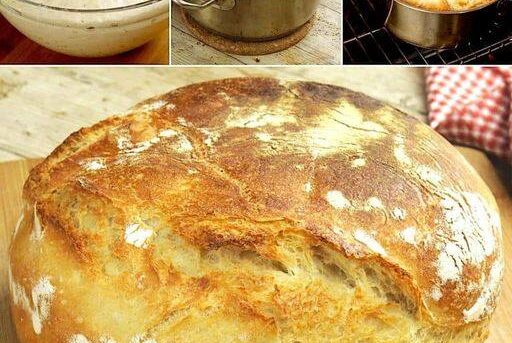
A crackly, deeply golden crust, a soft, chewy, open crumb, and that gentle tang that only sourdough has: this Easy Vegan Sourdough Bread is made with just four ingredients, flour, water, salt, and sourdough starter, so it is naturally vegan, with no commercial yeast, no dairy, and no eggs.
Here is a surprise for new bakers. Traditional sourdough bread is already vegan. The classic loaf contains nothing but flour, water, salt, and a live starter, which is a fermented mixture of flour and water. This recipe walks you through the whole process in plain steps, so that you can get a bakery-style loaf from your home oven, even if it is your first one.
Sourdough takes time, but very little effort. Most of the work happens while you are doing something else. You mix the dough in a few minutes, give it a few gentle folds over a couple of hours, let it rise until puffy, shape it, and then let it rest in the fridge overnight. That slow, cold rest develops the flavor and makes the dough easier to handle and score. In the morning, you bake it in a hot Dutch oven, which traps steam and gives you a crisp, blistered crust and a tall loaf.
You will need an active, bubbly sourdough starter. If you do not have one, you can make your own from flour and water in about a week, or ask a friend or a local bakery for a spoonful. A starter is ready when it doubles in size within 4–8 hours of feeding and passes the float test (a spoonful floats in water). Make sure the starter has been fed with plain flour and water only, since some commercial starters add other ingredients.
This recipe uses mostly bread flour, with a little whole wheat for flavor, at about 75% hydration, which is a good level for a beginner. The timings in the recipe are a guide, because sourdough runs on the temperature of your kitchen. In a warm kitchen, the dough rises faster. In a cool one, it takes longer. Watch the dough, not the clock.
This recipe is dairy-free, egg-free, and nut-free. It contains wheat and gluten. Please check your flour label.
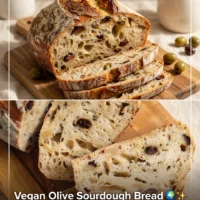
If you like mix-ins, try our Vegan Olive Sourdough Bread once you have mastered this basic loaf.
100g (½ cup) active sourdough starter, fed 4–8 hours earlier and bubbly
10g (2 tsp) fine sea salt
For Shaping and Baking
Rice flour or all-purpose flour, for dusting
Extra flour for the banneton or bowl
Equipment
Large mixing bowl
Kitchen scale (strongly recommended)
Dutch oven with a lid (5–6 quart)
Banneton or a bowl lined with a floured tea towel
Sharp knife or razor blade for scoring
Parchment paper
Instructions
Mix the dough (evening or morning). In a large bowl, whisk the starter into the warm water until mostly dissolved. Add both flours and mix with your hand or a spatula until no dry flour remains. The dough will be shaggy. Cover and rest for 30–60 minutes.
Add the salt. Sprinkle the salt over the dough and add a splash of water. Squeeze and fold the dough with wet hands for about 1 minute, until the salt is mixed in. Cover.
Stretch and fold. Over the next 2 hours, do 3 or 4 sets of stretch and folds, 30 minutes apart. With wet hands, grab one side of the dough, stretch it up, and fold it over the center. Rotate the bowl and repeat 4 times. The dough will become smoother and stronger each time.
Bulk rise. Cover and let the dough rise at room temperature (72–78°F / 22–26°C) until it has grown by about 50% and looks puffy and jiggly with bubbles at the edges. This usually takes 4–6 hours in total. Do not let it double.
Pre-shape. Scrape the dough onto a lightly floured surface. Fold the edges into the center to form a round, then flip it seam-side down. Rest for 20–30 minutes, uncovered.
Final shape. Flour the top and flip the dough over. Pull the bottom edge up to the center, fold in the sides, and roll the dough toward you into a tight round (boule) or an oval (batard). Keep surface tension by dragging the dough towards you.
Cold proof. Place the dough seam-side up in a well-floured banneton. Cover and refrigerate for 12–16 hours (overnight).
Preheat. Place your Dutch oven with its lid in the oven and preheat to 475°F (245°C) for 45 minutes.
Score. Turn the cold dough onto parchment paper. Dust the top lightly with flour. Score with a sharp knife or razor in a single curved slash about ½ inch deep.
Bake covered. Carefully lower the dough on the parchment into the hot Dutch oven. Cover and bake for 20 minutes.
Bake uncovered. Remove the lid. Reduce the heat to 450°F (230°C). Bake for 20–25 minutes more, until the crust is a deep golden brown.
Cool. Move the loaf to a wire rack and cool for at least 1 hour before slicing. The crumb is still setting, and cutting early makes it gummy.
Pro Tips for the Best Sourdough Bread
Use a starter at its peak, bubbly and doubled, for a good rise.
Weigh your ingredients. Cups vary, and scales do not.
Watch the dough, not the clock. Sourdough depends on temperature.
Do not let the bulk rise go too long. Over-fermented dough turns slack and flat.
Flour your banneton well so the dough does not stick.
Preheat the Dutch oven fully.
Cold dough is easier to score.
Let the loaf cool for at least an hour before cutting.
A Few Notes on Ingredients
Bread flour has more protein and makes a chewier loaf. All-purpose flour works but may need a bit less water. Whole wheat adds flavor and feeds the starter. Use filtered or dechlorinated water if your tap water is heavily chlorinated. Fine sea salt dissolves best. Your starter should be fed with plain flour and water only.
Flavor Variations
Olive Sourdough: Add olives and herbs.
Seeded Sourdough: Add sunflower and sesame seeds.
Rosemary Garlic Sourdough: Add rosemary and roasted garlic.
Whole Wheat Sourdough: Use 30% whole wheat flour.
Cinnamon Raisin Sourdough: Add raisins and cinnamon.
Sourdough Rolls: Divide the dough into 8 pieces and bake for 25 minutes.
Nutritional Highlights (Per Slice)
Calories
Protein
Carbs
Fiber
Fat
~150 kcal
5g
30g
1g
0.5g
Values are estimates.
Storage
Counter: Store cut-side down on a board or in a bread bag for up to 3 days.
Freezer: Slice and freeze for up to 3 months. Toast from frozen.
Re-crisping: Warm in a 350°F (175°C) oven for 5–10 minutes.
Starter: Keep it fed and refrigerated between bakes.
Frequently Asked Questions
Is sourdough bread vegan?
Traditional sourdough is. It contains only flour, water, salt, and starter. Check store-bought loaves for added ingredients.
Do I need a Dutch oven?
It gives the best crust. You can also bake on a preheated baking stone with a tray of hot water beneath.
Why is my loaf flat?
The starter may not have been active enough, or the dough was over-fermented. Check the starter and shorten the bulk rise.
Why is my crumb dense?
The dough may have been under-fermented, or it was not shaped tightly enough.
How sour will it be?
A longer cold proof makes it more tangy.
How is this different from your olive sourdough?
This is a plain basic sourdough loaf. Our Vegan Olive Sourdough Bread adds olives to the dough.
Tried this recipe? Leave a comment below and let us know how it turned out! Tag us on Instagram and Facebook — we love seeing your plant-powered creations. Browse all recipes on Easy Vegan Recipes — new recipes posted every single week!
We use cookies on our website to give you the most relevant experience by remembering your preferences and repeat visits. By clicking “Accept”, you consent to the use of ALL the cookies.
This website uses cookies to improve your experience while you navigate through the website. Out of these, the cookies that are categorized as necessary are stored on your browser as they are essential for the working of basic functionalities of the website. We also use third-party cookies that help us analyze and understand how you use this website. These cookies will be stored in your browser only with your consent. You also have the option to opt-out of these cookies. But opting out of some of these cookies may affect your browsing experience.
Necessary cookies are absolutely essential for the website to function properly. These cookies ensure basic functionalities and security features of the website, anonymously.
Cookie
Duration
Description
cookielawinfo-checkbox-analytics
11 months
This cookie is set by GDPR Cookie Consent plugin. The cookie is used to store the user consent for the cookies in the category "Analytics".
cookielawinfo-checkbox-functional
11 months
The cookie is set by GDPR cookie consent to record the user consent for the cookies in the category "Functional".
cookielawinfo-checkbox-necessary
11 months
This cookie is set by GDPR Cookie Consent plugin. The cookies is used to store the user consent for the cookies in the category "Necessary".
cookielawinfo-checkbox-others
11 months
This cookie is set by GDPR Cookie Consent plugin. The cookie is used to store the user consent for the cookies in the category "Other.
cookielawinfo-checkbox-performance
11 months
This cookie is set by GDPR Cookie Consent plugin. The cookie is used to store the user consent for the cookies in the category "Performance".
viewed_cookie_policy
11 months
The cookie is set by the GDPR Cookie Consent plugin and is used to store whether or not user has consented to the use of cookies. It does not store any personal data.
Functional cookies help to perform certain functionalities like sharing the content of the website on social media platforms, collect feedbacks, and other third-party features.
Performance cookies are used to understand and analyze the key performance indexes of the website which helps in delivering a better user experience for the visitors.
Analytical cookies are used to understand how visitors interact with the website. These cookies help provide information on metrics the number of visitors, bounce rate, traffic source, etc.
Advertisement cookies are used to provide visitors with relevant ads and marketing campaigns. These cookies track visitors across websites and collect information to provide customized ads.






Would this recipe work as well using only whole wheat flour (omitting bread flour)?
Yes it will work.