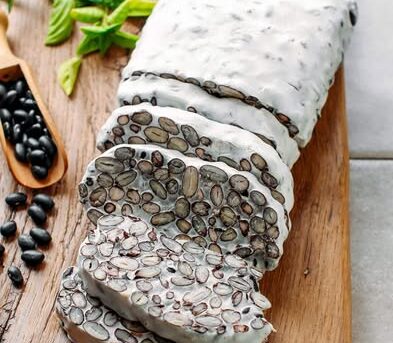
Firm, nutty, and held together by a white cake of natural fermentation: homemade black bean tempeh needs just three ingredients, dried black beans, a splash of vinegar, and tempeh starter, plus a warm place and a little patience. It is gluten-free, soy-free, and tastes deeper and earthier than the soy tempeh at the store. Slice it, pan-fry it, bake it, or crumble it into tacos, and you will see why home tempeh makers get hooked.
Tempeh is a fermented food from Indonesia. It is made when a mold called Rhizopus oligosporus grows through cooked beans, binding them into a solid block of white mycelium. Most store-bought tempeh is made from soybeans, but you can make it from other legumes. Black beans are a great choice, since they hold their shape, have a rich flavor, and give a cake with beautiful dark beans suspended in white, as you can see in the photo.
This is a fermentation recipe, so it is a little different from most recipes on this site. It is not hard, but it does need attention to a few details, and the safety steps are not optional. Read the whole recipe before you begin.
The three ingredients are: dried black beans, white vinegar, and tempeh starter (a powder of Rhizopus spores, sold online and at some natural food stores). Water is also used for soaking and cooking, and you will need a way to keep the beans warm for 1–2 days.
The key steps are:
- Soak and cook the beans until just tender, not mushy. Overcooked beans will not hold together.
- Dry the beans well. Surface water encourages the wrong kinds of bacteria and can stop the tempeh from forming.
- Add vinegar. The acid makes the beans less welcoming to unwanted bacteria, while the tempeh mold tolerates it.
- Cool the beans before adding the starter. Hot beans kill the spores.
- Pack the beans into perforated bags, in a thin layer, and keep them at 86–91°F (30–33°C) for 24–48 hours. The mold needs air, which is why the bags have holes.
Within a day, you will see white fuzz spreading across the beans. The mold produces its own heat as it grows, so watch the temperature during the second day. When the beans are completely bound in white mycelium and the cake lifts out in one firm piece, it is done.
Food safety: please read this section carefully. A good tempeh smells fresh, mushroomy, or like yeast, and is white, sometimes with gray or black speckles. Those dark patches are the mold’s spores and are normal. Throw the tempeh away if you see pink, orange, yellow, green, or blue mold, if it is slimy or wet, or if it smells of ammonia, rot, or anything sharp or unpleasant. If you are unsure, throw it out. Always cook tempeh before eating, by steaming, simmering, pan-frying, or baking, and do not eat it raw. Keep your hands, bowls, and bags clean. This recipe is not a substitute for guidance from a food safety authority, and people who are pregnant, immunocompromised, or otherwise at higher risk from foodborne illness should be especially careful with home fermentation.
Allergen note: this recipe is vegan, gluten-free, soy-free, nut-free, and dairy-free as written. Black beans are legumes, and some people who react to one legume react to others. Some tempeh starters may be made on grain or other bases, so check the label if you have allergies.
Recipe Information
| Prep Time | Soak Time | Cook Time | Ferment Time | Makes | Calories |
|---|---|---|---|---|---|
| 20 mins | 8–12 hours | 30 mins | 24–48 hours | about 1 lb (450g) tempeh, 2 cakes, 6 servings | ~190 kcal per 3 oz (85g) serving, uncooked |
Ingredients
The 3 Ingredients
- 2 cups (400g) dried black beans
- 2 tbsp white vinegar (distilled white vinegar, 5% acidity)
- ½ tsp tempeh starter (Rhizopus oligosporus), check the package for the amount for your batch size
Also Needed
- Water, for soaking and cooking
- 2 large zip-top freezer bags or a perforated container
- A clean towel or paper towels
- A thermometer (an instant-read or a probe thermometer)
- A warm spot, such as an oven with the light on, a yogurt maker, a proofing box, or a dehydrator
Instructions
- Wash everything. Wash your hands, bowls, spoons, and work surfaces with hot, soapy water before you begin.
- Soak the beans. Rinse the beans, then cover them with at least 3 inches of cold water. Soak for 8–12 hours or overnight. Drain and rinse.
- Cook the beans. Place the soaked beans in a pot, cover with fresh water, and bring to a boil. Skim any foam. Simmer for 20–30 minutes, until the beans are just tender, with a little bite. They should not be soft or split. Do not add salt, since salt can interfere with the mold.
- Drain and dry. Drain well and spread the beans on a clean towel or a baking sheet lined with paper towels. Pat dry, and let them air-dry for 10–15 minutes, until the surface looks dry and matte, not wet or shiny. Stir occasionally.
- Cool. Let the beans cool until they feel lukewarm or cooler, below 95°F (35°C). Hot beans will kill the starter.
- Add the vinegar. Transfer the beans to a large, clean, dry bowl. Add the vinegar and stir well.
- Add the starter. Sprinkle the tempeh starter over the beans and stir for a full 2 minutes, until evenly mixed. The starter is a tiny amount, so make sure it reaches all the beans.
- Prepare the bags. Use a clean skewer or a toothpick to poke holes in two zip-top freezer bags, about every ½ inch (1.5 cm) on both sides. The holes let in air.
- Pack. Divide the beans between the bags. Press them into a flat layer about 1 inch (2.5 cm) thick, filling the corners. Seal the bags. Flat, even layers ferment evenly.
- Incubate. Place the bags in a warm spot at 86–91°F (30–33°C). Use a thermometer to check. Keep the bags in a single layer, not stacked. Leave for 24–48 hours.
- Watch the temperature. After about 12–18 hours, the tempeh starts producing its own heat. Check the temperature inside the incubator. If it goes above 95°F (35°C), open the oven door or move the bags to a cooler place, so the mold does not overheat.
- Check the tempeh. The tempeh is ready when white mycelium covers the beans completely and binds them into a firm cake that lifts out in one piece. This usually takes 24–36 hours. Some gray or black speckles are normal. Look carefully for any signs of spoilage, as described above.
- Cool and cook. Remove the tempeh from the bags and refrigerate it right away for at least 1 hour, which firms it up and stops the fermentation. Cook it before eating.
How to Cook Black Bean Tempeh
Always cook the tempeh before eating it.
- Steam: Steam slices for 10 minutes to remove any bitterness and make the tempeh milder.
- Pan-fry: Slice ¼-inch thick, and fry in 1 tablespoon of oil over medium heat for 3–4 minutes per side, until golden and crisp.
- Bake: Toss slices in oil and soy sauce or tamari (use tamari to stay gluten-free) and bake at 400°F (200°C) for 20–25 minutes, flipping once.
- Crumble: Break into crumbs and sauté with chili powder, cumin, and garlic for tacos, chili, or pasta sauce.
- Marinate: Marinate for 30 minutes in tamari, maple syrup, garlic, and lime before cooking.
Pro Tips for Making Tempeh
- Keep everything clean. This is the best protection against unwanted bacteria.
- Do not overcook the beans. They should have a little bite.
- Dry the beans well before adding the starter. Surface moisture is the most common cause of failure.
- Do not add salt to the beans before fermenting.
- Add the starter when the beans have cooled, since heat kills the starter.
- Mix the starter very well, since a small amount has to reach every bean.
- Pack the beans in a thin, even layer so the heat is released.
- Use a thermometer. Guessing the temperature is the second most common cause of failure.
- Make plenty of holes. The mold needs oxygen.
- Do not open the bags more than needed in the first day.
A Few Notes on Ingredients
Dried black beans are best, since canned beans are too soft and wet. Distilled white vinegar is standard for tempeh, and it makes the beans slightly acidic, which helps keep unwanted bacteria away. Tempeh starter is available online, usually labeled “tempeh starter” or “Rhizopus.” Store it in the freezer for the longest shelf life. You can also use a small piece of store-bought, unpasteurized tempeh as a starter, but a proper starter is more reliable. Check the starter’s ingredient list if you have allergies.
Troubleshooting
- No mold after 24 hours: The temperature may be too low. Check the thermometer. Give it up to another 12–24 hours.
- Patchy mold: The beans may have been too wet, the layer too thick, or the starter not evenly mixed.
- Grey or black patches: These are usually normal spores. Check the smell, and make sure the tempeh is firm and smells fresh.
- Ammonia smell, slime, or colored mold (pink, orange, green, blue, yellow): Throw it out.
- Cake falls apart: The beans were overcooked, or fermentation was cut short.
- Overheated: If the beans look wet or smell of ammonia, the temperature went too high. Throw it out and start again.
Nutritional Highlights (Per 3 oz / 85g Serving, Uncooked)
| Calories | Protein | Carbs | Fiber | Fat |
|---|---|---|---|---|
| ~190 kcal | 11g | 33g | 9g | 1g |
Values are rough estimates based on cooked black beans and will vary. Cooking oil is extra.
Storage
- Refrigerator: Store in an airtight container for up to 5 days.
- Freezer: Slice or leave whole, wrap well, and freeze for up to 3 months. Thaw in the fridge before cooking.
- Steamed tempeh: Keeps for up to 3 days in the fridge.
- Signs of spoilage: Discard tempeh that smells of ammonia or sourness, or develops slime or colored mold.
Frequently Asked Questions
What is tempeh starter?
It is a powder containing the spores of Rhizopus oligosporus, the mold that ferments the beans. You can buy it online.
Is the black or gray on my tempeh safe?
Gray or black speckles are usually the mold’s spores and are normal. Pink, orange, green, blue, or yellow mold, slime, or an ammonia smell are signs of spoilage. Throw it out.
Can I use canned beans?
No. Canned beans are too soft and wet to work well. Use dried beans.
Can I use other beans?
Yes. Chickpeas, lentils, and other beans can be used with the same method. Cook times vary.
Can I eat tempeh raw?
No. Always cook it first.
How is this different from your other tempeh recipes?
This is a recipe for making the tempeh itself from black beans. Our other tempeh recipes, such as the Vegan Tempeh Sandwich and the Maple Curry Tempeh, show how to cook with tempeh once you have it.
Tried this recipe? Leave a comment below and let us know how it turned out! Tag us on Instagram and Facebook — we love seeing your plant-powered creations. Browse all recipes on Easy Vegan Recipes — new recipes posted every single week!