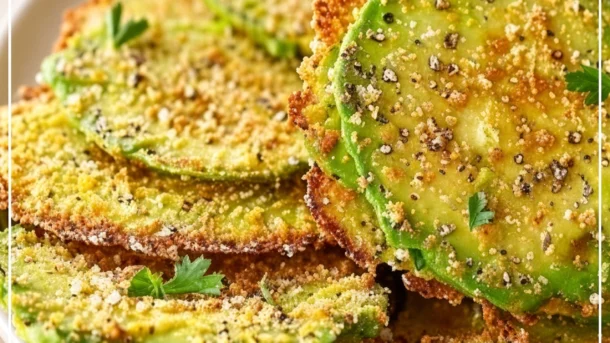
There is a particular kind of culinary surprise that comes from transforming an ingredient so thoroughly that it becomes something entirely different from what it started as — different in texture, different in how it behaves in your hand, different in how you eat it — while keeping its essential flavor intact. Crispy Avocado Chips are that kind of surprise. They begin as ripe but firm avocado, sliced into thick wedges, and they finish as something that has an audible, shatteringly crisp coating on the outside and a warm, buttery, almost liquid-soft avocado center that contrasts so completely with the exterior that the first bite is genuinely unexpected. They are baked — not fried — in a 230°C (445°F) oven on a wire rack, coated in a seasoned panko and nutritional yeast shell that turns deeply golden and genuinely crunchy while the avocado inside becomes warm and soft without collapsing or turning gray. They are served immediately with a bowl of smoky chipotle dipping sauce alongside, and they represent one of those rare recipes where the method does something that feels slightly miraculous: it takes an ingredient that most people use cold and creamy and makes it hot and crispy while keeping what makes avocado great — the richness, the butteriness, the depth of flavor — entirely intact. They are vegan, dairy-free, and ready in under 30 minutes. They are an extraordinary snack, an outstanding appetizer, and one of the most interesting things you can do with an avocado.
The technique is the freeze-firm and cornstarch anchor method. The fundamental problem with baking avocado under a coating is that avocado flesh, once sliced and exposed to air and heat, has essentially no structural integrity — it is 70–80% fat and water by weight, it begins oxidizing (browning) immediately on cutting, and under oven heat it softens rapidly toward a liquid state that cannot support an exterior coating, causing the coating to detach from the surface as the avocado contracts inward and the outer shell becomes a hollow crispy case with a collapsed, mushy interior. The freeze-firm and cornstarch anchor method addresses this in two stages. Stage one — the freeze-firm: sliced avocado wedges are placed on a parchment-lined tray and placed in the freezer for exactly 20 minutes. This freezing time is calibrated precisely: 20 minutes is enough to firm the outer layer of the avocado (reducing its tackiness and making it handle-able without deforming) and to lower its interior temperature significantly (slowing its softening rate in the oven’s early heat), but not long enough to freeze the avocado solid (which would cause the cell walls to rupture and produce a mushy, watery texture on thawing). Stage two — the cornstarch anchor: before dipping in the batter, each partially-frozen wedge is dusted lightly with cornstarch. Cornstarch creates a thin, dry, slightly rough surface on the avocado that the liquid batter adheres to immediately and firmly rather than beading and sliding off a cold, slick avocado surface. The combination of the firmed wedge (structural integrity during coating) and the cornstarch anchor (batter adhesion) allows the double-coat batter-and-panko shell to form a complete, sealed crust around the avocado that stays attached through the full baking time, producing a finished chip with the exterior genuinely separate from the warm interior rather than fused and soggy against it.
This recipe makes approximately 16–20 chips from 2 large avocados — enough for 4 people as a snack or starter.
Recipe Information
Prep Time
Cook Time
Total Time
Servings
Calories
20 mins (+ 20 min freeze)
15–18 mins
~55 mins
4
~320 kcal
Ingredients
For the Avocado Chips
2 large ripe but firm avocados — ripe enough to have full flavor (the flesh should yield slightly to gentle pressure at the stem end) but firm enough that they hold their shape when sliced and do not feel soft or mushy; slightly under-ripe avocados are better for this recipe than over-ripe ones
2 tbsp cornstarch (cornflour) — for the anchor dusting stage; not optional
For the Batter
½ cup (120ml) plant milk, unsweetened (oat milk or soy milk — both work equally well; oat milk is slightly thicker)
1–2 tsp chipotle paste (or 1–2 teaspoons of adobo sauce from a can of chipotle in adobo, or ½–1 teaspoon chipotle powder — start with less and taste; the sauce should be smoky and warm without overwhelming heat)
1 tsp lime juice (fresh)
½ tsp garlic powder
½ tsp smoked paprika
Pinch of fine salt
1–2 tbsp plant milk to thin to dipping consistency if needed
For Serving
Fresh lime wedges for squeezing
Fresh coriander (cilantro), roughly torn
Flaky sea salt
Instructions
Make the dipping sauce. In a small bowl, whisk together the vegan mayo, chipotle paste, lime juice, garlic powder, smoked paprika, and salt. Taste and adjust — add more chipotle for heat and smokiness, more lime for brightness, more salt if needed. Thin to a smooth, pourable dipping consistency with plant milk if needed. Cover and refrigerate until serving. (Making the sauce first means it can develop flavor while the avocados are prepared.)
Slice the avocados. Halve each avocado, remove the pit, and peel. Slice each half into 3–4 thick wedges (approximately 2–2.5cm / about 1 inch wide at the thickest point) — the thickness is important; thinner wedges dry out too quickly in the oven and the center loses its creamy quality, while wedges this size maintain a warm, buttery interior. You should get 12–16 wedges total from 2 large avocados.
Freeze-firm the wedges — Stage 1. Line a tray or plate with parchment paper. Lay the avocado wedges on the parchment in a single layer, not touching. Place in the freezer for exactly 20 minutes. Set a timer. Do not freeze for significantly longer than 20 minutes — over-freezing ruptures the cell walls and produces a watery, soft result on baking.
Set up the wire rack. While the avocados firm in the freezer, preheat the oven to 230°C (445°F). Place a wire cooling rack inside a rimmed baking sheet. Spray or brush the rack lightly with oil.
Prepare the batter and coating. In a wide, shallow bowl, whisk together all batter ingredients until completely smooth. In a second wide, shallow bowl, combine all coating ingredients and toss to mix evenly.
Cornstarch anchor — Stage 2. Remove the avocado wedges from the freezer. Working quickly (keep the remaining wedges in the freezer while you work on batches), dust each wedge lightly but completely on all sides with the 2 tablespoons of cornstarch, tapping off any excess. The cornstarch coating should be thin and even — a light, dry dusting, not a thick layer.
Double-coat the wedges. Dip one cornstarch-dusted wedge into the batter, turning to coat all sides, then lift and let the excess drip for 2 seconds. Press firmly into the coating on all sides. Set on a plate. Repeat with all wedges for the first coat. Then go back to the first wedge and repeat the process — batter, then coating — for a second complete coat on each wedge. Place finished double-coated wedges directly onto the prepared wire rack as you go, spaced apart and not touching.
Bake. Bake at 230°C (445°F) for 15–18 minutes without turning, until the coating is deeply golden-brown and visibly set and hard. The high temperature is important — a cooler oven produces a pale, soft coating rather than the golden, crisp crust this method requires. Check at 15 minutes: the coating should look dry, golden-amber, and hard-set. If it looks pale or soft, give 2–3 more minutes.
Serve immediately. Remove from the oven and allow to rest on the rack for just 1–2 minutes (avocado chips are best eaten very soon after baking — the interior begins to soften further as it cools). Arrange on a serving board or plate, scatter with fresh coriander and flaky sea salt, add lime wedges alongside, and serve with the chipotle dipping sauce.
Pro Tips
Use firm avocados, not soft ones — the ideal avocado for this recipe is one that is flavorful and ripe but still offers slight resistance when gently pressed. A soft, over-ripe avocado will collapse inside the coating during baking regardless of the freeze-firm step. If your avocados are very ripe, extend the freeze time to 25–30 minutes, accepting that the texture will be slightly less creamy than the ideal.
Work quickly during coating — the partially-frozen avocado wedges are firmer and easier to handle cold, but they warm quickly at room temperature. Work in small batches (4–5 wedges at a time), keeping the rest in the freezer, to ensure each wedge is coated while still firm rather than after it has softened.
The baking temperature cannot be reduced — 230°C (445°F) is the specific temperature at which the panko coating sets quickly enough to form a structural shell before the avocado interior has softened beyond its ideal point. A lower temperature means longer baking time, which means a softer, less creamy interior by the time the coating is done. Trust the high heat.
Serve directly from the rack — transferring the chips to a plate immediately on removing from the oven traps steam between the base of the chip and the plate surface, softening the bottom of the coating. Serving directly from the rack for the first 1–2 minutes, or onto a board rather than a flat plate, keeps the underside crust from steaming against the surface.
Avocado: From Aztec Luxury to Global Staple
The avocado (Persea americana) has one of the most remarkable origin stories of any ingredient in modern cooking — a story that runs from pre-Columbian Mesoamerica to a 21st-century global commodity worth billions of dollars annually, with a fascinating detour through nearly going extinct. Avocados were cultivated in Mexico and Central America for at least 5,000 years before European contact; the Aztec name ahuacatl entered Spanish as aguacate and eventually English as “avocado” by the late 17th century. The fruit spread throughout the Caribbean and into Florida as part of Spanish colonial agriculture after the 16th century, but remained largely unknown in Europe and difficult to transport in any form that preserved its quality — avocados ripen after picking and have an extremely short usable window, which made them effectively impossible to ship to distant markets before refrigerated transport. The fruit’s rise to global ubiquity is almost entirely a late-20th-century story, driven by three converging factors: the development of the Hass avocado variety (patented in 1935 by California mail carrier Rudolph Hass, who grew the tree from a seedling in his backyard — the Hass is now the source of approximately 80% of avocados eaten worldwide), improvements in refrigerated sea freight, and a deliberate, decades-long marketing campaign by the California Avocado Commission beginning in the 1980s to overcome American consumer resistance to the fruit’s high fat content at a time when dietary fat was understood as categorically harmful. The campaign worked: American avocado consumption increased by over 1,000% between 1985 and 2020. The ecological and social implications of that scale of production — concentrated overwhelmingly in Mexico’s Michoacán state, where avocado farming has reshaped land use, water availability, and organized crime involvement in agricultural supply chains — have made the avocado simultaneously the defining ingredient of a generation of plant-based eating and a genuinely complicated object in the ethics of food sourcing. The avocado chip on this plate sits at the end of a 5,000-year journey from Aztec cultivation to Hass patent to global fruit bowl.
Flavor Variations
Lime and Chilli Avocado Chips: Add the finely grated zest of 1 lime and ½ teaspoon of chilli flakes to the coating mixture. Add 1 teaspoon of lime juice to the batter. Serve with a simple vegan sour cream dip (vegan sour cream, lime juice, fresh coriander, salt) rather than the chipotle mayo. The lime and chilli variation is lighter and brighter, excellent for summer gatherings.
Everything Bagel Avocado Chips: Replace the coating with a mixture of ½ cup panko, 3 tablespoons nutritional yeast, and 4 tablespoons everything bagel seasoning (sesame seeds, poppy seeds, dried garlic, dried onion, flaky salt). The everything bagel coating gives each chip a visually striking, seed-studded crust with the familiar savory-sesame flavor. Serve with vegan cream cheese thinned with a splash of lemon juice and oat milk as the dip.
Tandoori Avocado Chips: Add 1½ teaspoons of tandoori spice blend (or a mixture of cumin, coriander, turmeric, garam masala, smoked paprika, and a pinch of chilli) to both the batter and the coating in place of the existing spices. The tandoori-spiced chips turn a warm reddish-gold color in the oven and have a fragrant, warmly spiced exterior that contrasts beautifully with the buttery avocado interior. Serve with a vegan mint-coriander raita (vegan yogurt, fresh mint, fresh coriander, garlic, lemon, salt) for dipping.
Nutritional Highlights (Per Serving — Based on 4 Servings, ~4–5 Chips Each)
Calories
Protein
Carbs
Fiber
Fat
~320 kcal
6g
32g
7g
19g
Storage
Best eaten immediately — Crispy Avocado Chips are at their best in the first 5–8 minutes out of the oven, when the coating is at peak crispness and the interior is warm and creamy. As with all baked coated items, they soften as they cool; the avocado interior also continues to oxidize (brown) after cutting, which is aesthetically noticeable in leftovers even if the flavor remains good.
Reheating: Already-baked chips that have cooled can be re-crisped in a 200°C (390°F) oven for 6–8 minutes on the wire rack, or in an air fryer at 190°C (375°F) for 4–5 minutes. The interior will be softer on the second bake but the coating re-crisps well. Do not microwave.
Make-ahead (coated, unbaked): Double-coated chips can be placed on the wire rack, covered loosely, and refrigerated for up to 2 hours before baking. Do not freeze the coated chips — the extended freezing time needed to properly freeze them causes the avocado cell walls to rupture, ruining the interior texture. Bake directly from the refrigerator, adding 2 minutes to the baking time.
Leftover avocado: Any avocado that was cut but not coated can be mashed with lemon juice, salt, and garlic for an immediate guacamole — the lemon juice slows oxidation and extends the window before browning begins.
Frequently Asked Questions
Why do my chips come out hollow — the avocado has shrunk inside the coating?
A hollow chip means the avocado was either over-frozen (extended freezing ruptures cell walls, causing the flesh to expel water and contract sharply in the oven) or it was a very ripe/soft avocado that did not benefit sufficiently from the 20-minute freeze. Use firm-ripe avocados and keep the freeze time to exactly 20 minutes. A small amount of shrinkage is normal and cosmetic — the interior should still be warm and creamy even if there is a small air gap; significant hollow chips indicate over-freezing or over-ripe fruit.
Can I fry these instead of baking?
Yes — shallow frying at 180°C (355°F) in 2–3cm of neutral oil produces an outstanding result with a more uniformly golden, deeply crispy coating. Fry for 2–3 minutes per side until golden-brown, then transfer to a wire rack (not paper towels — paper towels trap steam against the bottom of the coating). The fried version is richer and even crispier than the baked version. The freeze-firm and cornstarch anchor method is exactly the same; only the cooking method changes.
Can I use frozen avocado?
Pre-frozen commercial avocado (the kind sold in bags in the freezer section) is not suitable for this recipe — commercial avocado is frozen at much lower temperatures for much longer periods, which causes significant cell wall damage and produces a very soft, watery texture that cannot hold a coating. Fresh avocado frozen for exactly 20 minutes as directed is the correct technique; the timing is part of the method.
My coating won’t stick to the avocado — it slides right off?
Coating that slides off is almost always caused by skipping the cornstarch anchor step. The surface of avocado flesh — especially cold from the freezer — is slick with fat, and liquid batter beads on it rather than adhering. The cornstarch dusting creates a dry, micro-rough surface that the batter bonds to immediately. Without it, even a double-dip produces poor adhesion. Make sure the cornstarch coating is applied to every surface of every wedge before the batter.
Tried this recipe? Leave a comment below and let us know how it turned out! Tag us on Instagram and Facebook — we love seeing your plant-powered creations. Looking for more addictive vegan snack and appetizer recipes? Browse all recipes on Easy Vegan Recipes — new recipes posted every single week!
We use cookies on our website to give you the most relevant experience by remembering your preferences and repeat visits. By clicking “Accept”, you consent to the use of ALL the cookies.
This website uses cookies to improve your experience while you navigate through the website. Out of these, the cookies that are categorized as necessary are stored on your browser as they are essential for the working of basic functionalities of the website. We also use third-party cookies that help us analyze and understand how you use this website. These cookies will be stored in your browser only with your consent. You also have the option to opt-out of these cookies. But opting out of some of these cookies may affect your browsing experience.
Necessary cookies are absolutely essential for the website to function properly. These cookies ensure basic functionalities and security features of the website, anonymously.
Cookie
Duration
Description
cookielawinfo-checkbox-analytics
11 months
This cookie is set by GDPR Cookie Consent plugin. The cookie is used to store the user consent for the cookies in the category "Analytics".
cookielawinfo-checkbox-functional
11 months
The cookie is set by GDPR cookie consent to record the user consent for the cookies in the category "Functional".
cookielawinfo-checkbox-necessary
11 months
This cookie is set by GDPR Cookie Consent plugin. The cookies is used to store the user consent for the cookies in the category "Necessary".
cookielawinfo-checkbox-others
11 months
This cookie is set by GDPR Cookie Consent plugin. The cookie is used to store the user consent for the cookies in the category "Other.
cookielawinfo-checkbox-performance
11 months
This cookie is set by GDPR Cookie Consent plugin. The cookie is used to store the user consent for the cookies in the category "Performance".
viewed_cookie_policy
11 months
The cookie is set by the GDPR Cookie Consent plugin and is used to store whether or not user has consented to the use of cookies. It does not store any personal data.
Functional cookies help to perform certain functionalities like sharing the content of the website on social media platforms, collect feedbacks, and other third-party features.
Performance cookies are used to understand and analyze the key performance indexes of the website which helps in delivering a better user experience for the visitors.
Analytical cookies are used to understand how visitors interact with the website. These cookies help provide information on metrics the number of visitors, bounce rate, traffic source, etc.
Advertisement cookies are used to provide visitors with relevant ads and marketing campaigns. These cookies track visitors across websites and collect information to provide customized ads.