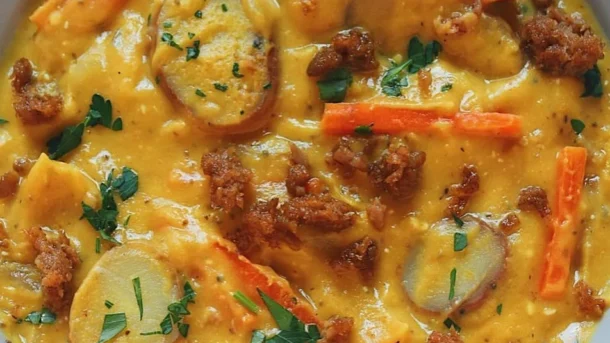
Smoky browned vegan sausage, tender potatoes, and tangy sauerkraut simmered in a rich, paprika-scented broth with caraway and bay leaf: this Hearty Vegan Sausage and Sauerkraut Soup is a bold, cozy, Eastern European-inspired bowl for cold days. It is ready in about 50 minutes in one pot.
Sauerkraut soups are a staple across Poland, Germany, and Eastern Europe, where tangy fermented cabbage is simmered into rustic, filling soups that warm you through. Traditional versions are made with smoked pork or sausage. This plant-based version keeps all the sour, smoky, savory flavor with no meat, using sliced vegan smoked sausage, smoked paprika, tomato paste, and a splash of soy sauce for depth.
The method is simple. Onion, carrot, and garlic are sautéed, then caraway seeds, smoked paprika, and marjoram are toasted in the oil. Tomato paste and potatoes go in with vegetable broth, and sauerkraut and a little of its brine add that signature tangy bite. Sliced vegan sausage is browned separately and stirred in at the end so it stays meaty and a little crisp at the edges.
Serve it with rye bread, a spoonful of plant-based sour cream, and fresh dill. The flavors deepen overnight, so it is even better the next day. If it tastes too sour, add a little extra potato or a pinch of sugar. If it tastes flat, add more brine.
This recipe is dairy-free and egg-free. It contains soy and gluten if your vegan sausage does, since most are made from wheat gluten or soy. Please check labels on your vegan sausage, sauerkraut, and broth. Use a gluten-free sausage for a gluten-free soup.
Recipe Information
Prep Time
Cook Time
Total Time
Servings
Calories
15 mins
35 mins
50 mins
6
~330 kcal each
Ingredients
For the Soup
2 tbsp olive oil, divided
1 large onion, diced
2 carrots, diced
4 garlic cloves, minced
1 tbsp tomato paste
1½ tsp smoked paprika
1 tsp caraway seeds, lightly crushed
1 tsp dried marjoram
½ tsp black pepper
1½ lb (680g) Yukon Gold potatoes, peeled and diced into ¾-inch cubes
6 cups (1.4L) vegetable broth
2 bay leaves
1 tbsp soy sauce or tamari
2 cups (about 300g) sauerkraut, drained, with ¼ cup of brine reserved
1 package (about 12 oz / 340g) vegan smoked sausage, sliced into ½-inch rounds
1 tsp salt, plus more to taste
To Serve
Fresh dill
Rye bread
Plant-based sour cream
Extra sauerkraut brine
Instructions
Cook the vegetables. Heat 1 tablespoon of oil in a large pot over medium heat. Cook the onion and carrots for 6–7 minutes until soft. Add the garlic and cook for 1 minute.
Toast the spices. Stir in the tomato paste, paprika, caraway, marjoram, and pepper. Cook for 1–2 minutes until fragrant.
Add the potatoes and liquids. Add the potatoes, broth, bay leaves, and soy sauce. Bring to a boil, then reduce to a simmer, cover, and cook for 12 minutes.
Add the sauerkraut. Stir in the sauerkraut and ¼ cup of its brine. Simmer for another 10 minutes, until the potatoes are tender.
Brown the sausage. While the soup simmers, heat the remaining oil in a skillet over medium-high heat. Cook the sausage rounds for 3–4 minutes per side until browned and crisp at the edges.
Combine. Stir the sausage into the soup. Remove the bay leaves. Taste and adjust the salt, pepper, and brine.
Serve. Ladle into bowls. Top with dill and a spoonful of plant-based sour cream, and serve with rye bread.
Pro Tips for the Best Sauerkraut Soup
Taste the soup before adding salt. Sauerkraut and broth are already salty.
Rinse the sauerkraut briefly if it is very sour, or use less brine.
Brown the sausage separately for the best texture.
Toast the caraway for a deeper flavor.
Use waxy potatoes so they hold their shape.
Add the brine gradually. It controls how tangy the soup is.
Let the soup rest for 10 minutes before serving.
Add a splash of broth when reheating.
A Few Notes on Ingredients
Sauerkraut is fermented cabbage. Look for jarred or refrigerated sauerkraut with just cabbage and salt. Cooking sauerkraut in a hot soup is traditional. Most vegan smoked sausages are made from wheat gluten or soy, and flavors vary, so choose one you enjoy. If you cannot find vegan sausage, use sliced smoked tofu, tempeh, or browned mushrooms. Caraway adds the classic Central European flavor.
Flavor Variations
Mushroom Version: Use browned mushrooms instead of sausage.
Creamy Version: Stir in a splash of plant cream.
Bean Version: Add white beans.
Spicy Version: Add red pepper flakes.
Smoky Version: Add extra smoked paprika.
Slow Cooker Version: Cook on low for 6 hours, then add the sausage at the end.
Nutritional Highlights (Per Serving)
Calories
Protein
Carbs
Fiber
Fat
~330 kcal
15g
38g
7g
12g
Storage
Refrigerator: Store for up to 5 days. The flavor improves the next day.
Freezer: Freeze for up to 3 months. Potatoes may soften.
Reheating: Warm on the stove with a splash of broth.
Make ahead: Make the soup a day ahead.
Frequently Asked Questions
Is sauerkraut vegan?
Usually yes, since it is just cabbage and salt. Check the label.
Is the soup very sour?
It is tangy. Reduce the brine or rinse the sauerkraut for a milder soup.
Can I use a different sausage?
Yes. Any vegan smoked sausage works, or use smoked tofu or mushrooms.
Can I make it gluten-free?
Yes. Use a gluten-free vegan sausage and check the broth.
Can I freeze it?
Yes, though the potatoes may soften.
How is this different from your other cabbage and potato soups?
This is a tangy sauerkraut soup with smoked vegan sausage and caraway. Our Vegan Cabbage Soup is a light dill and white bean soup with fresh cabbage, and our Vegan Creamy Potato Sausage Soup is a creamy, smooth potato soup.
Tried this recipe? Leave a comment below and let us know how it turned out! Tag us on Instagram and Facebook — we love seeing your plant-powered creations. Browse all recipes on Easy Vegan Recipes — new recipes posted every single week!
This is not a delicate soup. It is not a purée designed to be sipped from a shallow bowl with a swirl of cream on top. This vegan sausage and butternut squash soup is a proper, hearty, autumn-and-winter meal — thick, smoky, deeply savoury, with chunks of golden butternut squash and slices of vegan sausage that give every spoonful something substantial to get hold of. The squash brings natural sweetness and body; the sausages bring smokiness and the satisfying chew of something that feels like actual dinner rather than a starter that happens to be warm. Together, with a base of softened onion, garlic, and smoked paprika, and a stock that is given time to reduce and concentrate, the result is one of those soups that is better than you expect from its ingredient list and exactly what the weather demands. It is 100% plant-based, dairy-free, and egg-free. It serves 6. It is on the table in 45 minutes from a cold start. It is the kind of soup you make on a Sunday and eat three times during the week because it improves with every day in the refrigerator.
The technique is the sear-first-and-bloom method. Soups that are made by combining all their ingredients in a pot and simmering until done have a characteristic flavour: thin, one-dimensional, lacking depth — the flavour of individual ingredients that have been cooked together but have not truly combined into something greater than their parts. The sear-first-and-bloom method addresses this by building flavour at every stage before the liquid is added, rather than relying on the simmer to do the work. Step one — sear the sausages first: the vegan sausages are sliced and seared in the soup pot in a small amount of oil before anything else, until they are deeply golden on all cut surfaces; this Maillard browning on the sausage surface creates flavour compounds that dissolve into the soup when the liquid is added, giving the broth a depth and complexity that no amount of simmering can produce if the sausages go in raw. The seared sausage slices are removed and set aside — they will be added back to the soup in the final stage to prevent them from becoming too soft during the long simmer. Step two — bloom the aromatics and spices: the onion and garlic are softened in the sausage-flavoured fat remaining in the pot; the tomato paste is added and cooked for 3–4 minutes until it deepens to a dark brick-red (this Maillard-equivalent step for tomato paste concentrates and transforms its flavour from raw and acidic to deep and savoury); the smoked paprika, cumin, and dried thyme are stirred into the fat and cooked for 60 seconds, which causes the fat-soluble flavour compounds in the spices to dissolve into the oil rather than remaining locked in the dry spice powder — a process called blooming that dramatically increases the flavour intensity and colour the spices contribute to the soup. Step three — the squash goes in after the bloom: the butternut squash is added to the flavoured base, stirred to coat in the spice-and-tomato-infused fat, and then the stock is added; this brief coating step ensures the squash absorbs the base flavours from the first minute of simmering rather than cooking in a neutral liquid.
This recipe serves 6.
Recipe Information
Prep Time
Cook Time
Total Time
Servings
Calories
15 mins
30 mins
45 mins
6
~390 kcal
Ingredients
For the Soup
6 good-quality vegan sausages — the brand matters here; choose a sausage with a smoky, savoury flavour and a firm enough texture to hold its shape when sliced and simmered; Cumberland-style or Italian-style vegan sausages work well; avoid sausages that are very soft or crumbly as they will disintegrate during the simmer
1 large butternut squash (approximately 1kg / 2.2lbs) — peeled, deseeded, and cut into 2cm cubes; the cubes should be consistent in size for even cooking; pre-cut supermarket butternut squash is convenient and works equally well
2 medium onions, finely diced
5 cloves garlic, finely minced
2 sticks celery, finely sliced
2 medium carrots, diced to approximately 1cm
2 tbsp tomato paste (tomato purée) — bloomed in the oil before the liquid is added; do not skip this step
2 tsp smoked paprika — the smokiness of the paprika is central to the flavour profile of this soup; sweet paprika can be used but produces a less characterful result
1 tsp ground cumin
1 tsp dried thyme — or 3–4 sprigs of fresh thyme, leaves stripped
½ tsp chilli flakes — optional; adds background warmth without making the soup spicy
1.5 litres (6 cups) good-quality vegan vegetable stock — the stock is the backbone of the soup’s flavour; use a good-quality stock cube or liquid stock; a thin, weak stock produces a thin, weak soup
1 × 400g tin cannellini beans or butter beans — drained and rinsed; adds protein, creaminess, and body to the soup without needing to blend it
2 tbsp olive oil — for searing and softening
Salt and freshly cracked black pepper — to taste
1 tsp balsamic vinegar or red wine vinegar — added at the very end; a small amount of acid brightens and lifts the finished soup
To Serve
Fresh flat-leaf parsley, roughly chopped
Chilli flakes — for scattering over
Good crusty bread — for dipping
Extra virgin olive oil — for drizzling over each bowl
Instructions
Sear the sausages — sear-first stage. Slice each vegan sausage into rounds approximately 1.5–2cm thick. Heat 1 tablespoon of olive oil in a large, heavy-based pot or Dutch oven over medium-high heat. When the oil is shimmering, add the sausage slices in a single layer — work in batches if necessary; do not crowd the pot. Sear for 2–3 minutes per side without moving until each side is deeply golden-brown. Remove the sausage slices to a plate and set aside. Do not wipe the pot — the fat and fond (the browned residue on the base of the pot) remaining in the pot after searing is the foundation of the soup’s depth of flavour.
Soften the aromatics. Reduce the heat to medium. Add the remaining tablespoon of olive oil to the pot. Add the diced onion, celery, and carrot and cook, stirring occasionally, for 7–8 minutes until the onion is soft, translucent, and beginning to colour at the edges. Add the minced garlic and cook for a further 2 minutes.
Bloom the tomato paste and spices — bloom stage. Push the vegetables to the edges of the pot. Add the tomato paste to the centre and cook, stirring and spreading it around the base of the pot, for 3–4 minutes until it has darkened from bright red to a deep brick-red colour. Add the smoked paprika, cumin, dried thyme, and chilli flakes if using, and stir everything together, cooking for 60 seconds until the spices are fragrant and fully incorporated into the fat and tomato paste.
Add the squash and coat. Add the butternut squash cubes to the pot and stir to coat thoroughly in the spiced tomato base. Cook for 2 minutes, stirring occasionally, so the squash begins to absorb the base flavours before the stock is added.
Add the stock and simmer. Pour in the vegetable stock and stir well, scraping up any fond from the base of the pot. Increase the heat to bring the soup to a brisk simmer. Reduce to a steady simmer (not a rolling boil — a vigorous boil clouds the soup and can make the squash break down unevenly) and cook for 18–20 minutes until the butternut squash is completely tender when pierced with a knife — it should offer no resistance.
Partially blend — optional. For a soup with more body and creaminess while still maintaining chunks of squash, use a ladle to remove approximately one-third of the soup (aiming for squash-heavy ladlefuls) and blend until smooth in a blender or with a stick blender in a separate jug. Stir the blended portion back into the pot. This partial blend thickens the soup significantly without making it a purée. Skip this step entirely if you prefer a purely chunky soup.
Add the beans and sausages. Add the drained cannellini beans to the pot. Return the seared sausage slices to the pot. Stir gently and simmer for a further 5 minutes until the beans are heated through and the sausages have warmed and absorbed some of the broth.
Finish and season. Remove from the heat. Add the balsamic vinegar, stir through, and taste. Adjust salt and black pepper generously — this soup needs confident seasoning. If the soup feels too thick, add a splash of additional stock or water to loosen.
Serve. Ladle into bowls. Scatter with fresh parsley and chilli flakes. Drizzle with extra virgin olive oil. Serve immediately with crusty bread.
Pro Tips
Sear the sausages before anything else, in the soup pot — the browned fond that remains in the pot after searing the sausages is the single greatest flavour contribution in this recipe; cooking the onions and aromatics directly in that fond dissolves it into the vegetable base, distributing its depth throughout the entire soup; if the sausages are added raw with the stock they contribute almost none of this flavour; 5 minutes of searing returns hours of slow-cooked depth.
Bloom the tomato paste until it darkens — raw tomato paste added to a soup and immediately covered with stock tastes raw, bright, and slightly acidic, because its natural sugars and amino acids have not had the sustained dry heat needed to undergo Maillard browning; 3–4 minutes of cooking in a hot, relatively dry pot transforms those same sugars and amino acids into the complex, savoury, concentrated flavour compounds that give a soup its backbone; do not rush this step and do not add stock until the paste is visibly darker.
Add sausages back in the final 5 minutes only — vegan sausages that simmer in the soup for the full 20-minute cooking time become soft, pale, and waterlogged, losing both their texture and the caramelised flavour developed during searing; returning them to the pot only for the final 5 minutes preserves their texture and allows them to warm through and absorb the soup’s flavour without deteriorating.
Season at the end, not throughout — the vegetable stock reduces slightly during the 20-minute simmer, concentrating its salt; seasoning aggressively at the beginning produces an over-salted final soup; taste and season only after the soup has finished cooking and any final adjustments (blending, adding beans, thinning with water) have been made.
Butternut Squash: A New World Vegetable Conquers the Old World Kitchen
Butternut squash (Cucurbita moschata) is a member of the Cucurbitaceae family — the same botanical family that includes cucumbers, melons, and all the other squashes and pumpkins — and like every member of that family, it is native to the Americas. The domestication of Cucurbita species in the Americas is among the oldest agricultural achievements in the world: archaeological evidence from the Oaxaca Valley in Mexico places the cultivation of Cucurbita pepo (a close relative) at approximately 8,000–10,000 BCE, making squash one of the oldest cultivated crops on earth and a central component of the “Three Sisters” agricultural system developed by Indigenous peoples across North and Central America — the polyculture of maize, beans, and squash that formed the nutritional and agricultural foundation of many pre-Columbian civilisations. Butternut squash specifically is a relatively modern variety: it was developed in the United States in the 1940s by Charles Leggett of Stow, Massachusetts, who crossed a gooseneck squash with a Hubbard squash to produce the butternut — notable for its smooth, easy-to-peel skin, its sweet, dense flesh, its long shelf life, and its consistent performance in cooking across a wide range of methods. The butternut’s global spread from Leggett’s Massachusetts garden to supermarket shelves in every country where this recipe might be made is a story that took less than 80 years — a remarkably rapid adoption driven by the vegetable’s practical virtues (easy preparation, long storage, versatile flavour) and by the shift in the 1970s–1990s toward a more internationally diverse food culture in the United Kingdom and across Europe, where the butternut squash found particular favour in autumn and winter cooking. The natural sweetness of butternut squash — a product of its high sugar content relative to most vegetables — makes it one of the ideal partners for smoky, savoury flavours like the sausage and smoked paprika in this soup: the sweetness and the smokiness calibrate each other, and the squash’s creamy, dense flesh gives a soup exactly the body it needs without requiring cream or a roux.
Flavor Variations
Spicy Nduja-Style Vegan Sausage and Squash Soup: Use a spicy vegan sausage (a chorizo-style or spicy Italian-style vegan sausage) and add 1–2 teaspoons of harissa paste to the pot when blooming the tomato paste. Increase the chilli flakes to 1 teaspoon. The heat of the spicy sausage and harissa against the sweetness of the butternut squash is one of the best flavour combinations in winter soup cookery. Finish with a swirl of vegan yogurt over each bowl to temper the heat.
Tuscan White Bean and Sausage Soup: Reduce the butternut squash to 500g and add one tin of chopped tomatoes alongside the stock. Replace the cannellini beans with borlotti beans. Add a parmesan rind (or a piece of nutritional-yeast-rubbed vegetable broth rind) to the pot with the stock for extra depth. Add 100g of shredded cavolo nero or kale in the final 5 minutes of simmering. The Tuscan version is denser, more tomato-forward, and deeply reminiscent of ribollita — the classic Tuscan bread-and-bean soup.
Curried Butternut Squash and Sausage Soup: Replace the smoked paprika, cumin, and thyme with 2 tablespoons of medium curry powder or a combination of 1 tsp turmeric, 1 tsp ground coriander, 1 tsp ground cumin, and ½ tsp garam masala. Add one 400ml tin of coconut milk alongside the stock for creaminess. Finish with fresh coriander and a squeeze of lime. The curried version is fragrant, warming, and works best with a mild vegan sausage that carries the curry spicing rather than competing with it.
Nutritional Highlights (Per Serving — Based on 6 Servings)
Calories
Protein
Carbs
Fiber
Fat
~390 kcal
16g
42g
9g
17g
Storage
Refrigerator: This soup improves significantly with time in the refrigerator as the flavours continue to develop and the starch from the squash thickens the broth. Store in a sealed container for up to 5 days — it is better on day three than on day one. Reheat gently on the hob over medium heat, adding a splash of water or stock if it has thickened too much on standing.
Freezer: This soup freezes exceptionally well. Allow to cool completely, transfer to freezer-safe containers or zip-lock bags in single-serving portions, and freeze for up to 3 months. Defrost overnight in the refrigerator and reheat on the hob. The sausage texture softens slightly after freezing and thawing but remains pleasant. The squash may break down further on reheating, creating a naturally thicker soup — add extra stock as needed.
Batch cooking: This soup is ideal for batch cooking — make a double quantity in the largest pot you own; the active time is almost identical and you produce 12 servings that can be divided between the refrigerator (5 days) and the freezer (3 months). A double batch is one of the most efficient uses of 45 minutes in a vegan kitchen.
Reheating from frozen: Transfer frozen soup to the refrigerator the night before needed. Reheat in a pot over medium heat, stirring occasionally, adding stock or water to adjust consistency. Do not boil aggressively — gentle reheating preserves the sausage texture and prevents the squash from breaking down into a purée.
Frequently Asked Questions
Which vegan sausages work best in this recipe?
The key properties to look for are: a firm enough texture to hold its shape when sliced and simmered (very soft or crumbly sausages disintegrate); a smoky, savoury flavour that contributes to the soup rather than disappearing into it; and a skin that can be removed if necessary (some vegan sausage skins become tough after searing — slice the sausage before searing to avoid this). Cumberland-style and Italian herb-style vegan sausages from brands such as Richmond, Heck, and Linda McCartney all work well. If your preferred brand is softer, reduce the simmering time after adding the sausages back to 2–3 minutes.
Can I use pumpkin instead of butternut squash?
Yes — any dense, sweet winter squash works in this soup. Pumpkin, kabocha, Red Kuri, and Delicata squash are all good substitutes and cook in approximately the same time as butternut. Avoid watery summer squashes (courgette, yellow squash) — they don’t provide the body or sweetness that butternut contributes.
Can I make this soup in a slow cooker?
Yes — sear the sausages and bloom the aromatics and spices on the hob as directed (this step cannot be done in a slow cooker), then transfer everything to the slow cooker. Cook on high for 3–4 hours or low for 6–8 hours until the squash is tender. Add the beans and sausage slices in the final 30 minutes. The slow cooker version develops an exceptionally deep, long-cooked flavour but the sausage texture is softer than the hob version.
My soup tastes thin and flat — how do I fix it?
If the soup tastes thin, the most effective fixes are: partial blending (scoop out and blend a third of the soup and stir back in — this immediately thickens and adds body); reduction (simmer with the lid off for 10 minutes to concentrate the broth); additional seasoning (flat soup is usually under-seasoned — add salt, black pepper, and an extra teaspoon of smoked paprika); or a tablespoon of soy sauce (adds immediate umami depth without a noticeable soy flavour). A combination of all four usually rescues even the flattest pot of soup.
Tried this recipe? Leave a comment below and let us know how it turned out! Tag us on Instagram and Facebook — we love seeing your plant-powered creations. Looking for more addictive vegan snack and appetizer recipes? Browse all recipes on Easy Vegan Recipes — new recipes posted every single week!
We use cookies on our website to give you the most relevant experience by remembering your preferences and repeat visits. By clicking “Accept”, you consent to the use of ALL the cookies.
This website uses cookies to improve your experience while you navigate through the website. Out of these, the cookies that are categorized as necessary are stored on your browser as they are essential for the working of basic functionalities of the website. We also use third-party cookies that help us analyze and understand how you use this website. These cookies will be stored in your browser only with your consent. You also have the option to opt-out of these cookies. But opting out of some of these cookies may affect your browsing experience.
Necessary cookies are absolutely essential for the website to function properly. These cookies ensure basic functionalities and security features of the website, anonymously.
Cookie
Duration
Description
cookielawinfo-checkbox-analytics
11 months
This cookie is set by GDPR Cookie Consent plugin. The cookie is used to store the user consent for the cookies in the category "Analytics".
cookielawinfo-checkbox-functional
11 months
The cookie is set by GDPR cookie consent to record the user consent for the cookies in the category "Functional".
cookielawinfo-checkbox-necessary
11 months
This cookie is set by GDPR Cookie Consent plugin. The cookies is used to store the user consent for the cookies in the category "Necessary".
cookielawinfo-checkbox-others
11 months
This cookie is set by GDPR Cookie Consent plugin. The cookie is used to store the user consent for the cookies in the category "Other.
cookielawinfo-checkbox-performance
11 months
This cookie is set by GDPR Cookie Consent plugin. The cookie is used to store the user consent for the cookies in the category "Performance".
viewed_cookie_policy
11 months
The cookie is set by the GDPR Cookie Consent plugin and is used to store whether or not user has consented to the use of cookies. It does not store any personal data.
Functional cookies help to perform certain functionalities like sharing the content of the website on social media platforms, collect feedbacks, and other third-party features.
Performance cookies are used to understand and analyze the key performance indexes of the website which helps in delivering a better user experience for the visitors.
Analytical cookies are used to understand how visitors interact with the website. These cookies help provide information on metrics the number of visitors, bounce rate, traffic source, etc.
Advertisement cookies are used to provide visitors with relevant ads and marketing campaigns. These cookies track visitors across websites and collect information to provide customized ads.