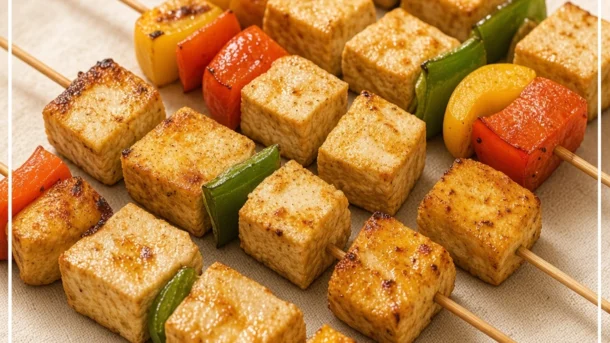
The single most important thing that separates a truly excellent tofu skewer from a merely acceptable one is not the marinade, not the sauce, not the vegetables threaded alongside, and not even the heat source — it is the texture of the tofu before any of those things are applied. Tofu that goes onto a skewer without proper preparation is soft, wet, and resistant to color: it steams rather than sears, produces no browning, absorbs marinade only at its surface, and slips off the skewer rather than gripping it. Tofu that has been properly prepared before skewering is firm, almost meaty in its resistance when you bite through it, absorbs marinade all the way through to the center, develops a dramatically caramelized, golden-to-charred crust on the grill or griddle, and holds its position on the skewer with the same confidence as a piece of meat. The difference between those two outcomes is a technique, and this recipe teaches it fully. Vegan Tofu Skewers made this way — pressed, frozen, thawed, marinated in a deeply savory soy-ginger-smoked paprika marinade, and cooked hot on whichever heat source is available — are genuinely extraordinary food: smoky at the surface, tender in the center, coated in a glaze that caramelizes and chars at the edges, and served with a bright, acidic peanut-herb dipping sauce that cuts through the richness and makes each bite complete. They work on a charcoal grill for maximum smokiness, on a gas grill for convenience, under a broiler/grill for year-round indoor cooking, or in a hot cast-iron griddle pan for apartment kitchens with no outdoor space. The technique scales: make 4 skewers for a weeknight dinner or 24 for a summer party. This is the tofu skewer recipe worth knowing.
The technique is the freeze-thaw texture reset method. Tofu, in its standard firm or extra-firm form, is a gel — a network of protein strands with water locked in the spaces between them. When tofu is frozen, the water inside those protein-space pockets crystallizes and expands, rupturing the delicate protein network and forcing channels to open throughout the tofu structure. When the frozen tofu thaws, the ice melts out of those channels — and with it drains much of the water that was trapped inside the protein network, leaving behind a tofu that is dramatically more porous, sponge-like, and open in structure than anything pressing alone can achieve. Where pressed tofu removes surface and sub-surface water, the freeze-thaw method transforms the interior architecture of the tofu itself: the finished thawed tofu has a distinctly chewier, more fibrous, more meat-like texture — it pulls apart slightly along grain lines rather than crumbling; it holds together firmly on a skewer rather than breaking; and, most importantly, the open channels left by the departed ice crystals act as literal pathways for marinade to travel into the very center of each piece, producing a tofu that is marinated all the way through rather than only at the surface. No other technique produces the same depth of flavor penetration. The freeze-thaw method requires planning — the tofu needs a minimum of 8 hours in the freezer and 4 hours to thaw — but it requires no active work time, and the results justify the overnight planning entirely. For a same-day option, the recipe includes a pressing-only variation with modified technique notes; it is good. But the freeze-thaw method is the one worth knowing.
This recipe makes 8 substantial skewers — enough for 4 as a main, 6–8 as part of a spread.
Recipe Information
| Prep Time | Cook Time | Total Time | Servings | Calories |
|---|---|---|---|---|
| 20 mins | 12–15 mins | 35 mins (+ 8 hr freeze + 4 hr thaw + 1 hr marinate) | 4 (main) | ~385 kcal |
Ingredients
For the Tofu Skewers
- 2 blocks (2 × 400g / 14oz) extra-firm tofu (freeze-thaw method requires extra-firm only — silken or firm tofu does not survive the freeze-thaw process intact; drain each block but do not press before freezing)
- 2 medium red bell peppers, cut into 3cm (1¼ inch) chunks
- 2 medium zucchini (courgette), cut into 2cm (¾ inch) rounds
- 1 large red onion, cut into wedges and layers separated (approximately 3cm pieces)
- 16 wooden or metal skewers (if using wooden, soak in cold water for at least 30 minutes before threading to prevent burning on the grill)
For the Marinade
- 4 tbsp soy sauce or tamari (tamari is gluten-free; soy sauce is slightly saltier and more pungent — both work)
- 2 tbsp toasted sesame oil
- 2 tbsp maple syrup or agave nectar
- 1 tbsp rice vinegar or apple cider vinegar
- 1 tbsp neutral oil (for the oil base of the marinade)
- 4 cloves garlic, very finely minced or pressed
- 1 tbsp fresh ginger, finely grated (do not substitute ground ginger — fresh ginger produces a bright, floral heat; ground ginger is earthier and less vibrant)
- 1½ tsp smoked paprika (not sweet or hot paprika — smoked specifically, for the barbecue depth that is the keynote of the marinade)
- 1 tsp ground cumin
- ½ tsp black pepper
- ¼ tsp cayenne pepper (optional — adds warmth without strongly changing the flavor profile; increase to ½ tsp for a spicier result)
For the Peanut Dipping Sauce
- 4 tbsp smooth natural peanut butter (not sweetened commercial peanut butter, which is too sweet here)
- 2 tbsp soy sauce or tamari
- 1 tbsp lime juice (fresh)
- 1 tbsp maple syrup
- 1 tsp sriracha or sambal oelek
- 1 tsp toasted sesame oil
- 3–5 tbsp warm water (to thin to a pourable dipping consistency — add one tablespoon at a time until the sauce flows smoothly off a spoon)
For Serving
- Fresh coriander (cilantro) leaves
- Sliced spring onions (scallions)
- Sesame seeds, toasted
- Lime wedges
- Steamed jasmine rice or flatbread
Instructions
- Freeze the tofu (night before or up to 3 days ahead). Remove the tofu blocks from their packaging and drain off the liquid. Do not press. Wrap each block loosely in a single layer of parchment paper and place on a flat surface in the freezer. Freeze for a minimum of 8 hours — overnight is ideal. The tofu will turn pale yellow and become completely solid. It can stay frozen for up to 3 months.
- Thaw the tofu. Remove the frozen tofu blocks from the freezer and place them in a colander in the sink or on a plate. Leave to thaw at room temperature for 3–4 hours, or thaw overnight in the refrigerator (this takes 8–12 hours but can be planned the evening before cooking day). Do not microwave to thaw — microwave thawing produces uneven texture. As the tofu thaws, a significant amount of water drains from it — this is the water that was expelled through the freeze-thaw process, and its departure is exactly what you want.
- Press and dry the thawed tofu. Once fully thawed, press each tofu block between two flat plates or cutting boards weighted with a heavy object for 15–20 minutes, then pat firmly dry with paper towels. The thawed, pressed, dried tofu should feel noticeably denser and chewier than standard pressed tofu — this is the texture reset. Cut each block into 3cm (1¼ inch) cubes — approximately 24 cubes per block, 48 cubes total.
- Marinate. Whisk all marinade ingredients together in a large bowl or shallow dish until evenly combined. Add the tofu cubes and toss gently to coat every surface thoroughly. Add the vegetable pieces and toss to coat those too. Cover and refrigerate for a minimum of 1 hour; 2–4 hours is better; overnight is best. The freeze-thaw tofu will visibly absorb the marinade — the cubes will deepen in color from pale to amber as the marinade enters the open channels throughout the interior.
- Make the peanut dipping sauce. Whisk together the peanut butter, soy sauce, lime juice, maple syrup, sriracha, and sesame oil in a small bowl. Add warm water one tablespoon at a time, whisking, until the sauce is smooth, glossy, and pourable but not watery. Taste and adjust: more lime for brightness, more sriracha for heat, more maple for sweetness. Set aside.
- Thread the skewers. Thread the marinated tofu and vegetables onto the skewers, alternating tofu with vegetables — a typical skewer sequence: red pepper, tofu, zucchini, tofu, red onion, tofu, red pepper. Do not pack the pieces too tightly — leave a small gap between each so the heat circulates around every surface. Brush any remaining marinade over the threaded skewers.
- Cook the skewers (grill, broiler, or griddle pan). Choose your method:
— Charcoal or gas grill: Cook over medium-high direct heat, turning every 3–4 minutes, for a total of 12–15 minutes until the tofu and vegetables are deeply charred at the edges, caramelized all over, and cooked through. Brush with any remaining marinade during cooking.
— Oven broiler/grill: Place the skewers on a foil-lined baking sheet on the highest oven rack under the pre-heated broiler/grill on high. Cook for 6–7 minutes per side (12–14 minutes total), watching carefully for char at the edges without burning.
— Cast-iron griddle pan: Heat the pan over high heat until smoking. Cook the skewers in batches (do not crowd), turning every 2–3 minutes, for 10–12 minutes total until deeply colored with grill marks on all sides. - Rest and serve. Remove the skewers from the heat and allow to rest for 2 minutes — this allows the caramelized exterior to set slightly. Serve immediately on a platter over steamed rice or alongside flatbread, garnished generously with fresh coriander, spring onions, and sesame seeds, with lime wedges and the peanut dipping sauce on the side.
Pro Tips
- Do not skip the overnight freeze — a same-day pressed tofu skewer is good; a freeze-thaw tofu skewer is in a different category of texture and flavor. If you discover this recipe the morning of the day you want to make it, freeze the tofu immediately and plan for the following evening instead. The 12-hour investment in texture is the recipe’s most important step.
- Get the cooking surface genuinely hot before the skewers go on — a hot surface is what produces the caramelized crust that makes the skewer. A surface that is merely warm steams the tofu and produces a pale, soft exterior. The griddle pan or grill should be visibly smoking before the first skewer touches it; the sizzle when the skewer makes contact should be immediate and aggressive.
- Baste throughout cooking — the marinade brushed on during cooking reduces and caramelizes onto the surface of the tofu, building layers of flavor with each brush. Keep the remaining marinade in a small bowl near the grill and brush each skewer at every turn. By the final turn, the surface of the tofu should be dark, sticky, and glossy.
- For a grill-marks presentation without an outdoor grill, a cast-iron grill pan (ridged) on the highest heat produces clean, defined grill marks that are visually striking on the plate; a flat griddle produces an even, all-over sear without marks but with equivalent or superior caramelization.
Tofu and the Soybean: A Two-Thousand-Year Culinary Journey
Tofu is, by any measure, one of the oldest processed foods in continuous production in human history — a food technology developed in Han Dynasty China approximately two thousand years ago and refined so effectively in the centuries that followed that its basic method (soaking soybeans, grinding them into milk, heating the milk, adding a coagulant to precipitate the protein into curds, pressing the curds into blocks) has remained essentially unchanged from the second century BCE to the present day. The invention of tofu is sometimes credited by Chinese culinary historians to Liu An, the Prince of Huainan, who is said to have developed the method as part of his pursuit of Daoist alchemy and longevity practices around 164 BCE — though the historical evidence for this attribution is disputed and the true origins are almost certainly more diffuse, developed by multiple practitioners of soybean processing across different regions. What is well-documented is the spread: tofu traveled from China to Korea, and from Korea to Japan in approximately the 7th or 8th century CE (Japanese records reference tofu in the Nara period, around 750 CE, initially as a luxury food served at Buddhist temple banquets, where it was valued as a source of protein compatible with Buddhist vegetarian dietary requirements). In Japan, the production and refinement of tofu became an entire cultural and culinary tradition, producing dozens of regional varieties — silken, firm, extra-firm, freeze-dried kōri-dōfu, deep-fried abura-age — each with specific culinary applications that Japanese cooks mapped out over a thousand years of systematic cooking. The western world’s encounter with tofu was sporadic until the late 20th century, when the combination of growing vegetarian and vegan movements, Asian immigration, and increasing interest in plant-based protein sources brought tofu from specialty Asian grocery stores into mainstream supermarkets across Europe, North America, and Australia. Today, tofu is one of the most widely available plant proteins on the planet — and skewered, charred, and served over rice with peanut sauce, it demonstrates that a two-thousand-year-old food technology can arrive at entirely contemporary results.
Flavor Variations
- Korean BBQ Tofu Skewers: Replace the marinade with a Korean-inspired mixture of 3 tablespoons gochujang (Korean chilli paste), 2 tablespoons soy sauce, 2 tablespoons maple syrup, 1 tablespoon toasted sesame oil, 1 tablespoon rice vinegar, and 4 cloves minced garlic. The gochujang marinade produces a deeply red, intensely savory-spicy glaze with a distinctive fermented depth that caramelizes dramatically on the grill. Serve with steamed short-grain rice and quick-pickled cucumber.
- Mediterranean Herb Tofu Skewers: Replace the Asian-spiced marinade with a Mediterranean mixture of 3 tablespoons olive oil, 2 tablespoons lemon juice, 1 tablespoon red wine vinegar, 2 teaspoons dried oregano, 1 teaspoon dried thyme, 1 teaspoon smoked paprika, 4 cloves minced garlic, and 1 teaspoon salt. Thread alongside cherry tomatoes, kalamata olives (threaded on the end of the skewer), and chunks of red pepper. Serve with hummus and warm pita.
- Teriyaki Tofu Skewers: Replace the marinade with a simple teriyaki glaze — 4 tablespoons soy sauce, 2 tablespoons mirin, 2 tablespoons sake or dry sherry, 2 tablespoons maple syrup, and 1 teaspoon freshly grated ginger, simmered together for 3 minutes until slightly thickened. Thread the tofu with pineapple chunks alongside the vegetables — the pineapple chars beautifully and its acidity cuts the sweetness of the teriyaki. Serve over steamed rice with toasted sesame seeds.
Nutritional Highlights (Per Serving — Based on 4 Servings, Skewers Only)
| Calories | Protein | Carbs | Fiber | Fat |
|---|---|---|---|---|
| ~385 kcal | 22g | 28g | 5g | 20g |
Storage
- Cooked skewers: Best eaten immediately from the grill. Leftovers keep refrigerated in an airtight container for up to 3 days. Reheat in a very hot dry pan or under the broiler for 4–5 minutes to restore some of the caramelized crust — microwaving produces a soft, steamed result without the crust.
- Marinated uncooked skewers: Assembled, marinated, uncooked skewers on their skewers keep covered in the refrigerator for up to 24 hours before cooking — an excellent make-ahead preparation for a barbecue or dinner party.
- Freeze-thawed marinated tofu (before threading): The freeze-thawed, marinated tofu cubes (without the vegetables, which don’t freeze well once cut) can be frozen in their marinade for up to 1 month. Thaw in the refrigerator overnight, then thread with fresh vegetables and cook as directed.
- Peanut dipping sauce: Keeps in an airtight jar in the refrigerator for up to 5 days. It thickens considerably when chilled; stir in a tablespoon of warm water to restore to dipping consistency before serving.
Frequently Asked Questions
Can I skip the freeze-thaw step and just press the tofu?
Yes — for a same-day version, press two blocks of extra-firm tofu under a heavy weight for 45–60 minutes (the longer the better), pat completely dry, cut into cubes, and marinate for 2–4 hours. The texture will be firm and the exterior will caramelize well on a hot surface; the interior flavor penetration will be less deep than the freeze-thaw version, as the marinade can only penetrate the outer layers of a pressed-not-frozen tofu. The same-day result is a very good tofu skewer; the freeze-thaw result is an exceptional one.
What if I don’t have a grill or griddle pan?
The oven broiler/grill method (described in step 7) works excellently and produces genuinely charred edges and caramelized surfaces. If neither a broiler nor a griddle pan is available, roasting in a very hot oven (220°C / 430°F) on a wire rack set over a baking sheet — which allows air circulation around all surfaces — for 20–25 minutes, turning once at the halfway point, produces a well-colored, caramelized result without charring. The wire rack is important: tofu roasted directly on a flat baking sheet creates steam on the underside and produces a pale, soft base.
My tofu keeps sticking to the grill — how do I prevent this?
Sticking is usually caused by insufficient heat (the surface isn’t hot enough to create an immediate sear that releases from the grill naturally) or by moving the tofu too early. When tofu is placed on a properly hot grill, it will stick initially and then release cleanly as the surface caramelizes and contracts — usually after 2–3 minutes. If you try to move it before this natural release, it tears. Leave it alone for the full 3 minutes before attempting to turn. If it still sticks after 3 minutes, it needs more time, not more force.
Can I make these without skewers — just as grilled tofu pieces?
Yes — the freeze-thaw and marinade method works identically for tofu pieces cooked directly on the grill, in a griddle pan, or roasted in the oven without skewers. Cut the tofu into larger slabs (1–1.5cm thick) rather than cubes, marinate as directed, and cook on the hot surface for 4–5 minutes per side. Serve the slabs over rice with the peanut sauce drizzled over, with the vegetables cooked alongside in a separate pan or on the grill grate directly.
Tried this recipe? Leave a comment below and let us know how it turned out! Tag us on Instagram and Facebook — we love seeing your plant-powered creations. Looking for more addictive vegan snack and appetizer recipes? Browse all recipes on Easy Vegan Recipes — new recipes posted every single week!