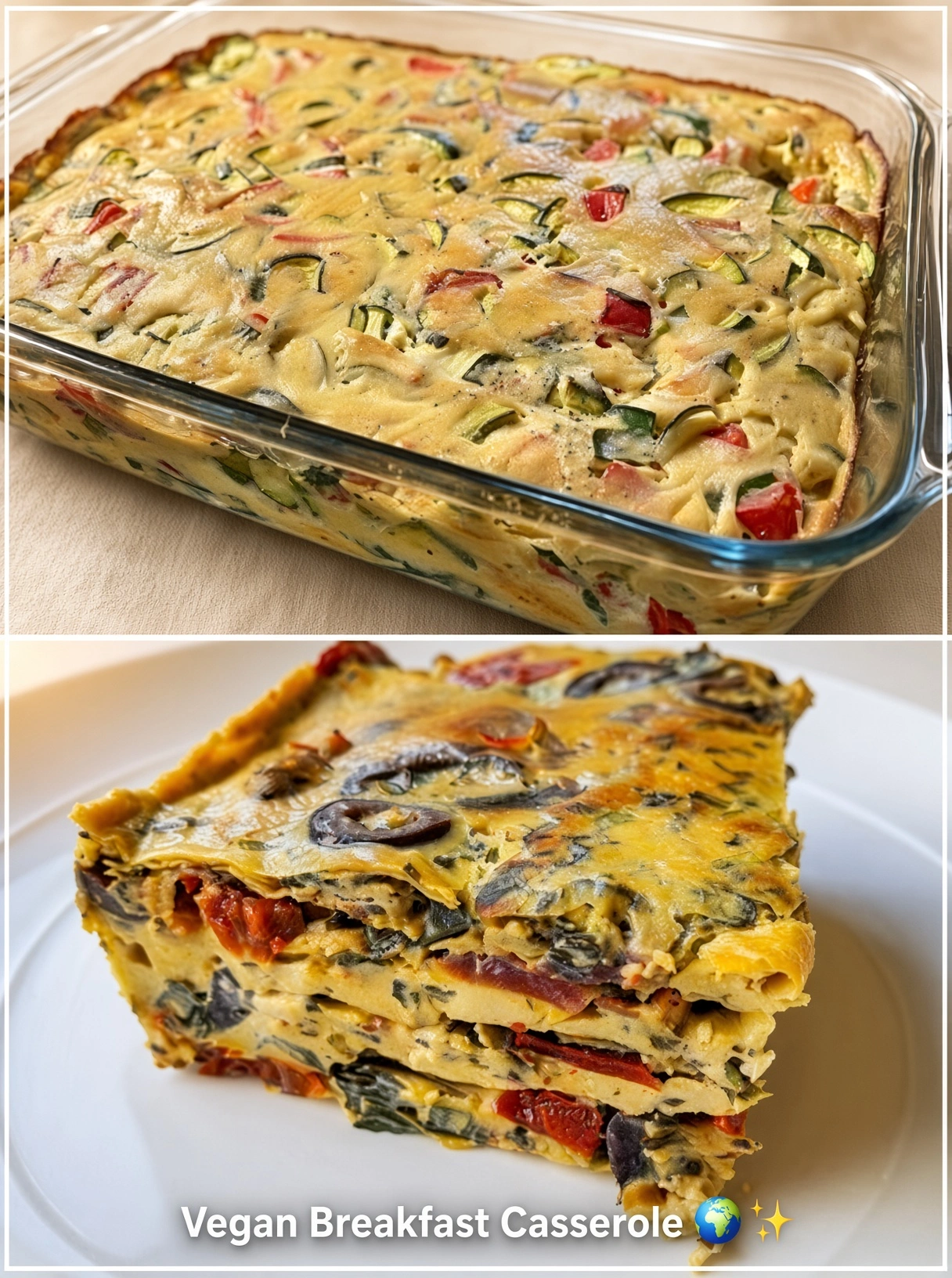
There is a particular category of cooking that exists for the specific purpose of feeding a group of people well without requiring the cook to stand at a stove managing individual portions — the category of bakes and casseroles designed to go into the oven, be left to cook unattended, and emerge as a single, substantial, shareable thing that serves everyone at once. Vegan Breakfast Casserole belongs to this category, and it makes weekend mornings, holiday breakfasts, and brunch gatherings significantly more relaxed than any other preparation approach could. The casserole builds in layers inside a single baking dish: a base of cubed sourdough or crusty bread that absorbs the surrounding liquid as it bakes and becomes custardy and tender in the interior while crisping at the exposed edges; a filling of sautéed vegetables — red pepper, mushrooms, and spinach — seasoned with garlic, smoked paprika, and black pepper; a generous amount of plant-based sausage, crumbled and browned; and a poured-over mixture of blended silken tofu, plant milk, nutritional yeast, black salt, and turmeric that mimics the flavor, texture, and color of a beaten egg custard — setting in the oven to a sliceable, cohesive consistency that holds the casserole together and gives every slice the richness and satisfaction of a classic egg bake. The black salt (kala namak) is the ingredient that makes the difference: its sulfurous, distinctively egg-like flavor transforms what would otherwise be a pleasant but clearly non-egg dish into something that genuinely reads as eggy, savory, and deeply satisfying. The casserole can be fully assembled the night before and refrigerated overnight; it goes directly from the refrigerator to the oven the next morning, meaning the most demanding part of a holiday or family breakfast is completed entirely the day before. It is 100% vegan, dairy-free, and egg-free. It serves 8. The technique is why the casserole sets to a clean, sliceable consistency rather than remaining wet or falling apart.
The technique is the pre-soak-and-press method. The structural challenge of any bread-based breakfast casserole is moisture balance: the bread must absorb enough of the egg or egg-substitute custard mixture to become tender and cohesive when baked, but if the ratio is wrong in either direction — too much liquid, or not enough bread to absorb it — the casserole either remains wet and custard-y at the center (underabsorbed) or dries out and becomes crumbly (overabsorbed). With a silken tofu custard rather than an egg custard, the challenge is compounded: silken tofu custard sets through heat but has a lower protein content than egg and requires a longer bake time and specific temperature management to firm adequately. The pre-soak-and-press method resolves both problems simultaneously. Stage one — pre-soak: once the casserole is assembled, it is pressed firmly with a spatula or the back of a large spoon so that the bread cubes are pushed down into the tofu custard rather than floating on top of it; a layer of cling film is then placed directly on the surface of the casserole, and a weight (a second baking dish, a heavy skillet, or a few tins) is placed on top to hold the bread submerged in the custard. The weighted casserole is then refrigerated for a minimum of 30 minutes, ideally overnight. During this rest, every bread cube fully absorbs the surrounding custard, becoming evenly saturated throughout rather than wet on the outside and dry in the center. Stage two — press before baking: the weight and cling film are removed, and the surface is pressed down firmly once more before the casserole goes into the oven, compacting it slightly so the layers are dense enough to hold together through baking and slicing. The result is a casserole with a uniform, cohesive internal texture — no dry pockets, no wet center — that slices cleanly, holds its shape on a spatula, and has the custardy, set consistency of a classic egg casserole.
This recipe serves 8.
Recipe Information
| Prep Time | Cook Time | Total Time | Servings | Calories |
|---|---|---|---|---|
| 25 mins + 30 min soak (or overnight) | 45 mins | ~1 hr 40 mins | 8 | ~345 kcal |
Ingredients
For the Casserole Base
- 450g (1 lb / approximately 8 thick slices) sourdough bread, ciabatta, or any sturdy, crusty bread — cut into 2–3cm (1 inch) cubes; stale bread that is 1–2 days old works better than fresh, as it is drier and absorbs the custard more readily without becoming mushy; if using fresh bread, spread the cubes on a baking tray and bake at 180°C for 8–10 minutes to dry them out slightly before using
- 1 tbsp olive oil or neutral oil — for sautéing the vegetables
For the Vegetables and Sausage
- 225g (8oz) plant-based sausages (2–3 links, depending on size) — sliced into coins or crumbled; use a firm-style vegan sausage such as Beyond Sausage, Richmond Plant-Based, or any vegan bratwurst-style sausage; avoid soft, spreadable vegan sausage styles
- 1 medium red bell pepper, diced (approximately 150g / 5oz)
- 200g (7oz) chestnut or button mushrooms, sliced — mushrooms must be cooked until all their released water has evaporated before adding to the casserole; mushrooms added raw or under-cooked release significant moisture during baking, which oversaturates the casserole
- 100g (3½oz) fresh baby spinach — wilted in the pan at the end of the sauté stage; spinach wilts to approximately one-third of its volume
- 1 medium yellow onion, finely diced
- 3 cloves garlic, minced
- 1 tsp smoked paprika
- ½ tsp dried thyme
- ½ tsp dried oregano
- ½ tsp black pepper
- ½ tsp fine salt
- Cherry tomatoes, halved — 150g (5oz), scattered over the top of the casserole before baking; the tomatoes roast and burst during baking, adding bursts of acidity that cut through the richness of the custard
For the Tofu Custard
- 600g (21oz) silken tofu — firm or extra-firm silken tofu produces the best custard consistency; do not substitute regular (water-packed) firm tofu, which blends grainier; silken tofu is sold in tetra-pak cartons in most supermarkets’ Asian food sections or ambient aisles and does not require refrigeration before opening
- 120ml (½ cup) unsweetened plant milk (oat milk or soy milk — use a neutral-flavored variety; almond milk can be used but its flavor is detectable)
- 3 tbsp nutritional yeast — adds a savory, cheese-adjacent depth and a slight golden color to the custard
- 1 tsp black salt (kala namak) — this is the essential egg-flavor ingredient; black salt is a volcanic sulfurous salt with a pronounced egg-like aroma and taste; it is widely available online and in Indian or South Asian grocery stores; it is used in small quantities and the package lasts months; do not substitute regular salt as the egg flavor will be entirely absent; add to taste at the blending stage as potency varies between brands
- ½ tsp turmeric — for the yellow egg-like color of the custard; without turmeric the custard bakes to a pale off-white; turmeric turns it golden-yellow
- ½ tsp garlic powder
- ½ tsp onion powder
- ½ tsp fine salt (in addition to the black salt — the two work together; fine salt seasons the custard overall while the black salt provides the egg flavor)
- ¼ tsp black pepper
Optional Toppings
- 60g (2oz) vegan cheddar-style shreds — scattered over the top before baking; they melt and bubble and form a slightly browned, cheesy crust
- Fresh chives or flat-leaf parsley, roughly chopped — scattered over the top just before serving
- Hot sauce or sriracha — served alongside
Instructions
- Prepare the bread. Cut the bread into 2–3cm cubes. If using fresh bread, spread on a baking tray and bake at 180°C (355°F) for 8–10 minutes until the surfaces are dry but not browned. Set aside. Grease a 23×33cm (9×13 inch) baking dish generously with oil or vegan butter.
- Sauté the vegetables and sausage. Heat 1 tablespoon of oil in a large skillet over medium-high heat. Add the sliced or crumbled plant-based sausage and cook for 4–5 minutes, turning occasionally, until browned on both sides. Remove the sausage to a plate. In the same skillet, add the diced onion and cook for 3–4 minutes until softened and translucent. Add the diced red pepper and cook for 2 minutes. Add the sliced mushrooms and cook for 5–6 minutes, stirring occasionally, until the mushrooms are fully cooked and any released liquid has evaporated — the pan should look dry. Add the minced garlic, smoked paprika, dried thyme, dried oregano, salt, and black pepper and cook for 1 minute until fragrant. Add the baby spinach and stir until fully wilted, about 1–2 minutes. Remove from heat. Return the browned sausage to the vegetable mixture and stir to combine.
- Make the tofu custard. Combine the silken tofu, plant milk, nutritional yeast, black salt, turmeric, garlic powder, onion powder, fine salt, and black pepper in a blender. Blend on high speed for 60–90 seconds until completely smooth — the custard should be pourable, uniformly yellow-golden, and free of any lumps. Taste and adjust the black salt — the custard should taste distinctly eggy and savory. Set aside.
- Assemble the casserole. Spread the bread cubes in an even layer in the prepared baking dish. Scatter the sautéed vegetable and sausage mixture evenly over the bread. Pour the tofu custard slowly and evenly over everything — pour from multiple points across the dish so the custard distributes evenly rather than pooling in one spot. Scatter the halved cherry tomatoes over the top, cut-side up. If using vegan cheese shreds, scatter over the tomatoes now.
- Pre-soak-and-press — the technique. Using a large spatula or the back of a spoon, press the surface of the assembled casserole firmly downwards, pushing the bread cubes into the custard. Every bread cube should be partially submerged. Place a sheet of cling film directly on the surface of the casserole, pressing it flat against the top. Place a weight on top — a second baking dish filled with a few tins works well. Refrigerate for a minimum of 30 minutes; overnight refrigeration (up to 12 hours) produces a significantly better result as the bread becomes fully saturated throughout.
- Bake. When ready to bake, preheat the oven to 180°C (355°F). Remove the weight and cling film from the casserole. Press the surface down firmly once more with a spatula. Bake uncovered for 40–45 minutes until the top is golden and slightly crisp at the edges, the custard is set (a knife inserted in the center comes out clean, not wet), and the casserole is pulling slightly away from the sides of the dish. If the top browns too quickly, cover loosely with foil for the final 10–15 minutes.
- Rest and serve. Allow the casserole to rest in the dish for 10 minutes before cutting — the custard continues to firm slightly during this rest, which is what enables clean slicing. Cut into 8 portions and serve with hot sauce, fresh herbs, and vegan sour cream alongside if desired.
Pro Tips
- The overnight soak is the most impactful single improvement you can make to this casserole — the difference between a 30-minute soak and an overnight soak is dramatic; the overnight version has a more uniform, custardy interior, a better set center, and a more cohesive slice. If making for a holiday morning, assemble entirely the night before, weight, refrigerate, and bake straight from the fridge the next morning with no additional preparation.
- Cook the mushrooms until completely dry in the pan — mushrooms can release 30–40% of their weight in water during cooking; mushrooms added to the casserole before this water has been cooked off will release it into the custard during baking, diluting the custard and preventing it from setting properly. The pan should look nearly dry around the mushrooms before you add the garlic and spices.
- Black salt (kala namak) is worth seeking out — it is the single ingredient that separates a vegan breakfast casserole that tastes like breakfast from one that tastes like a tofu bake. It is inexpensive, keeps indefinitely, and transforms scrambles, quiches, frittatas, and any dish where egg flavor is expected. Find it at any South Asian grocery store or online.
- The casserole reheats beautifully — individual slices reheat in a 180°C oven (8–10 minutes) or microwave (2 minutes) with no loss of texture. This makes it an excellent meal-prep dish that provides ready breakfasts for the first half of the week.
The American Breakfast Casserole: A Dish Born From the Church Potluck
The breakfast casserole — that deeply American institution of egg-soaked bread, sausage, and cheese baked together in a single dish for a crowd — has a surprisingly recent and specifically American cultural history. Unlike many baked egg dishes, which have centuries-old European predecessors in the form of quiches, frittatas, and stratas (the Italian term for layered bread-and-egg bakes), the American breakfast casserole as a genre coalesced in the mid-20th century, driven by two specific cultural forces: the rise of the church potluck and the expansion of the refrigerator into everyday American home life. The church potluck — a communal meal in which congregation members each bring a prepared dish to share after Sunday services — created demand for dishes that could feed large numbers, travel well, be assembled before Sunday morning services, and be served at room temperature or reheated easily. The overnight breakfast casserole met every one of these requirements with particular elegance: assembled on Saturday, weighted and refrigerated overnight, and slid into the oven before leaving for church, it emerged ready to serve exactly when the congregation returned home. The parallel development was enabled by the widespread domestic refrigerator, which by the 1950s was present in over 80% of American homes and made overnight food preparation a practical and safe option for the first time in culinary history. Early printed recipes for “breakfast casseroles,” “egg bakes,” and “overnight stratas” appear in American women’s magazines and church community cookbooks from the 1950s and 1960s, and the format proliferated through the 1970s and 1980s as a reliable, adaptable framework onto which any available filling ingredients could be mapped. The vegan version in this recipe preserves the original format — bread, custard, vegetables, sausage — with plant-based ingredients that maintain the function and satisfaction of the original while making it available to every person at the table, including those who no longer eat eggs or dairy.
Flavor Variations
- Southwest Vegan Breakfast Casserole: Replace the mushrooms and spinach with 1 cup of black beans (drained), 1 cup of corn kernels, 1 diced jalapeño, and 1 teaspoon of cumin added to the spice blend. Add 2 tablespoons of tomato paste to the tofu custard for a deeper, reddish color. Top with diced avocado, fresh coriander, and a drizzle of chipotle hot sauce after baking. This Southwest version is bolder, smokier, and spicier than the classic version and works equally well for brunch as a dinner dish.
- Mediterranean Vegan Breakfast Casserole: Replace the plant sausage with 200g of crumbled firm tofu sautéed with 1 teaspoon of smoked paprika and ½ teaspoon of cumin as a chorizo-style substitute. Add ½ cup of Kalamata olives (pitted and halved), ½ cup of sun-dried tomatoes (roughly chopped), and 1 teaspoon of dried rosemary to the vegetable layer. Scatter 60g of vegan feta over the top before baking. The Mediterranean version is saltier, more herby, and pairs particularly well with a simple green salad.
- Hash Brown Breakfast Casserole: Replace the bread base with 600g of frozen hash browns (thawed and squeezed dry) pressed into the base of the dish in a single layer. The hash brown base bakes to a crispy, potato-crusted bottom that is textually different from and arguably superior to the bread base — crunchy at the bottom, tender above. All other components remain the same. This version is naturally gluten-free if tamari is substituted for any soy sauce in the recipe.
Nutritional Highlights (Per Serving — Based on 8 Servings)
| Calories | Protein | Carbs | Fiber | Fat |
|---|---|---|---|---|
| ~345 kcal | 18g | 32g | 4g | 14g |
Storage
- Refrigerator: Store covered in the baking dish or in a sealed container for up to 4 days. The casserole holds its texture well on reheating — individual slices can be reheated in a 180°C oven for 8–10 minutes until heated through, or microwaved on medium power for 2 minutes. The flavor deepens slightly on day two as the spices continue to permeate the custard.
- Freezer: Individual slices freeze well for up to 2 months. Wrap each slice individually in cling film and then place in a freezer bag. Reheat from frozen in a 180°C oven for 20–25 minutes (covered with foil for the first 15 minutes), or thaw overnight in the refrigerator and microwave as directed above.
- Make-ahead assembly: The casserole can be assembled (through the pre-soak-and-press stage) up to 24 hours in advance and kept refrigerated under its weight. Beyond 24 hours, the bread may over-saturate and begin to break down slightly — still delicious but slightly less structured.
- Individual portions: The casserole cuts and stores as individual portions particularly well — remove slices to a container and refrigerate or freeze separately, providing single-serve breakfast portions for the week ahead.
Frequently Asked Questions
Can I make this casserole gluten-free?
Yes — substitute the sourdough bread with your preferred gluten-free sandwich bread or gluten-free crusty bread. Gluten-free bread has a different absorption rate than wheat bread and may absorb the custard slightly faster; reduce the soak time to 20 minutes minimum and monitor that the bread does not become over-saturated. Check that your plant-based sausage is also gluten-free, as many vegan sausages contain wheat gluten as a binding agent.
I can’t find black salt (kala namak). Can I leave it out?
You can leave it out, but the casserole will not taste egg-like — it will taste like a savory tofu and vegetable bake, which is still excellent in its own right. If you want to approximate the egg flavor without black salt, adding ½ teaspoon of English mustard and 1 extra tablespoon of nutritional yeast to the custard adds depth and a faint sharpness that partially fills the gap. Black salt is available on Amazon and in most South Asian grocery stores for a very small cost and keeps indefinitely — it is worth ordering if you plan to make vegan egg dishes regularly.
The center of my casserole is still wet after 45 minutes. What should I do?
A wet center means the casserole needs more baking time — cover the dish loosely with foil to prevent the top from over-browning and continue baking in 10-minute increments until a knife inserted in the center comes out clean. Wet centers are most commonly caused by too much liquid in the custard (measure the plant milk carefully), bread that was too fresh and released moisture back into the custard during baking, or insufficient soaking time before baking. Ensure the mushrooms were also fully cooked and dry before assembling — under-cooked mushrooms can add significant moisture.
Can I use a different protein instead of plant-based sausage?
Yes — the casserole is flexible with the protein component. Firm tofu (crumbled and sautéed with smoked paprika, soy sauce, garlic, and a pinch of cumin) works as a scrambled-egg-style protein substitute. Tempeh (crumbled and marinated in soy sauce and smoked paprika) adds a denser, nuttier texture. Chickpeas (drained, dried, and pan-roasted until slightly crisp) add protein without the processed-food component if preferred. Omit the protein entirely for a lighter, vegetable-forward version — the casserole remains filling and substantial from the bread and custard alone.
Tried this recipe? Leave a comment below and let us know how it turned out! Tag us on Instagram and Facebook — we love seeing your plant-powered creations. Looking for more addictive vegan snack and appetizer recipes? Browse all recipes on Easy Vegan Recipes — new recipes posted every single week!