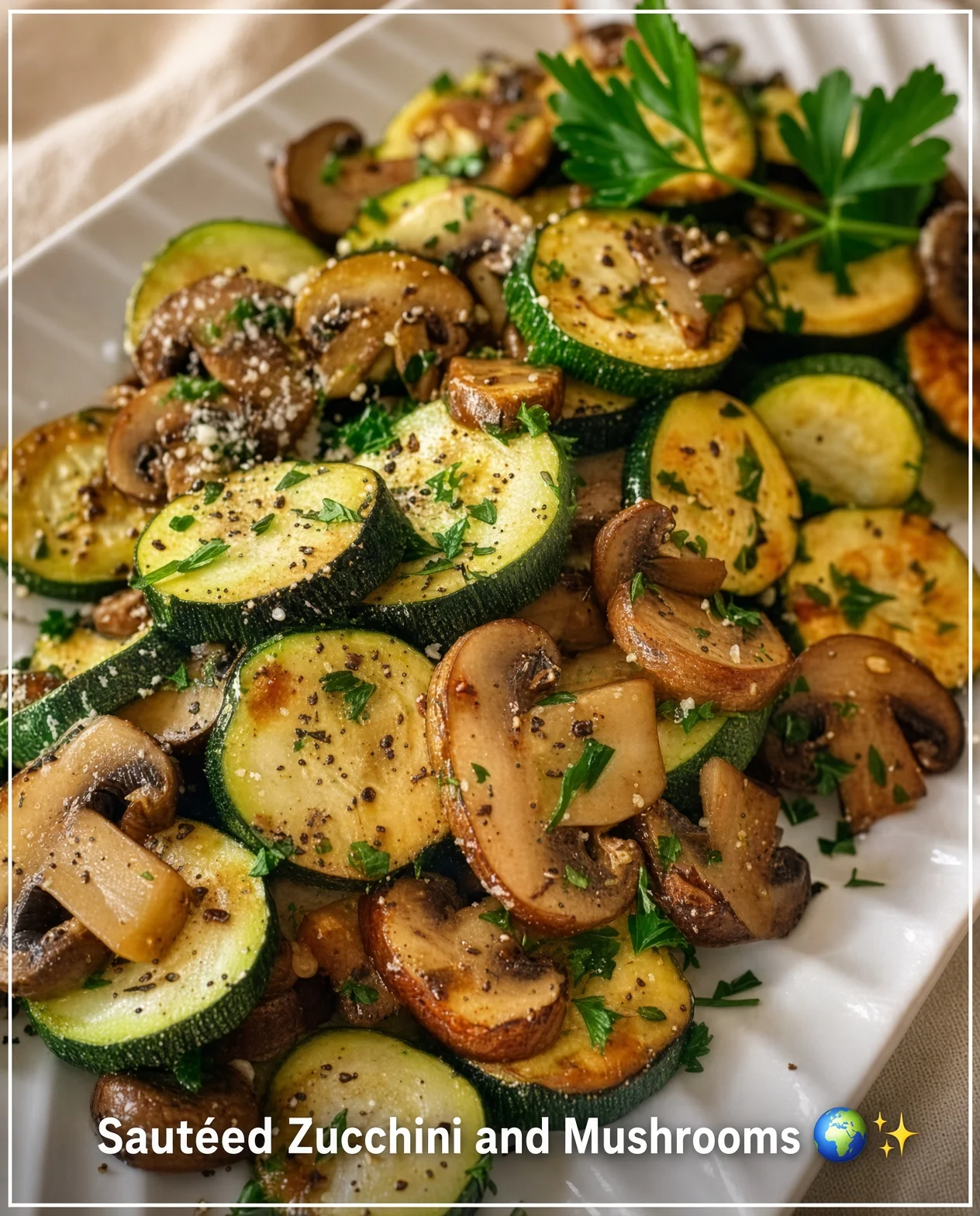
Some of the best things that happen in a kitchen happen quickly and without ceremony — a hot pan, a few good ingredients, and ten minutes of attentive cooking that produces something so much more flavorful than the sum of its parts that it becomes a staple by the second time you make it. Sautéed Zucchini and Mushrooms is exactly that kind of recipe. It is thin rounds of zucchini and thickly sliced mushrooms cooked together in a wide, hot skillet with olive oil, garlic, and a small but precisely deployed arsenal of pantry seasonings until the mushrooms are deeply browned and caramelized at the edges, the zucchini is tender and golden on both sides with a soft center that still holds its shape, and the whole skillet smells of garlic, thyme, and something rich and savory and deeply satisfying in the way that only well-cooked alliums and fungi can smell. It is finished with a small squeeze of lemon, a handful of fresh parsley, and — for those who want it — a scattering of chilli flakes that adds a gentle background heat without turning it into a spicy dish. It is served as a side alongside anything that needs it (pasta, rice, crusty bread, grilled protein, a bowl of lentils) or, frankly, eaten directly from the pan with a fork while standing at the hob, which is how most of it disappears in any household that makes it regularly. It is 100% vegan, naturally gluten-free, made in one pan in under 15 minutes, and one of those recipes that earns a permanent place in the weeknight rotation because it requires almost no thought and consistently produces excellent results. The technique is the secret.
The technique is the sequential sear and deglaze method. The fundamental problem with sautéing two vegetables together — particularly a high-moisture vegetable like zucchini and a high-moisture vegetable like mushrooms — is that if they are added to the pan simultaneously, they compete for the pan’s heat and release their moisture at the same time, creating a pool of liquid on the pan surface that brings the temperature below the Maillard reaction threshold (approximately 140–150°C / 285–300°F) and turns what should be a searing, caramelizing process into a steaming, braising process. Steamed mushrooms are pale, soft, and faintly rubbery; steamed zucchini is watery and collapses into itself. The sequential sear and deglaze method prevents this by treating each vegetable as a separate searing problem. Stage one — mushroom sear: the mushrooms go into the pan alone, in a single layer, in a very hot pan with enough oil to just coat the base, and they are not stirred or moved for a full 3 minutes. This uninterrupted contact time allows the moisture to escape from the mushrooms’ surface and evaporate away from the pan rather than pooling, and allows the direct contact between the mushroom surface and the hot pan to reach the temperature required for Maillard browning. Only once the underside is deeply golden are they turned. Stage two — deglaze and zucchini: once the mushrooms are browned and removed from the pan, the fond (the brown, caramelized deposits left by the mushrooms on the pan surface) is deglazed with a splash of vegetable stock or dry white wine, which lifts the concentrated flavor compounds off the pan base and turns them into a small amount of intensely flavored liquid. The zucchini is then added into this liquid and cooked over high heat until the liquid evaporates and the zucchini begins to take on golden color from the now-dry, flavor-coated pan surface. The mushrooms are returned in the final minute with the garlic, thyme, and lemon, and the whole skillet is tossed together over high heat. The result is a dish in which both vegetables have been individually seared to their optimal texture and then brought together in a combined, deglazing-enriched pan that makes the whole dramatically more flavorful than cooking them together from the start would produce.
This recipe serves 4 as a side dish, or 2 as a light main with crusty bread or over pasta.
Recipe Information
| Prep Time | Cook Time | Total Time | Servings | Calories |
|---|---|---|---|---|
| 5 mins | 12 mins | 17 mins | 4 | ~165 kcal |
Ingredients
- 400g (14oz) mushrooms — cremini (chestnut) mushrooms are the first choice for this recipe; their lower moisture content and deeper flavor compared to white button mushrooms means they brown more readily and taste more intensely savory. Portobello mushrooms, thickly sliced, are an excellent substitute for a meatier, more substantial result. Mixed wild mushrooms (shiitake, oyster, king oyster) produce an outstanding version with complex, layered savory depth. Avoid white button mushrooms if possible — they have the highest moisture content and are the hardest to get good browning on.
- 2 medium zucchini (courgette), approximately 400g / 14oz total — sliced into rounds approximately 5mm (¼ inch) thick; this thickness allows the cut surface to make good contact with the pan for color while the center stays tender rather than becoming mushy
- 3 tbsp olive oil, divided (2 tbsp for the mushrooms, 1 tbsp for the zucchini)
- 4 cloves garlic, thinly sliced (sliced rather than minced — thin slices of garlic go slightly golden and nutty in the final pan toss rather than burning or disappearing into the dish; minced garlic added at the same stage would burn)
- 1 tsp fresh thyme leaves (or ½ tsp dried thyme — fresh thyme is strongly preferred; its aromatic, slightly piney freshness lifts the whole dish in a way dried thyme only approximates)
- 3 tbsp vegetable stock or dry white wine (for the deglaze — vegetable stock keeps the dish alcohol-free and adds a small savory note; dry white wine adds acidity and depth; water works in a pinch but contributes no flavor)
- 1 tbsp lemon juice (fresh — added at the very end, off the heat; it brightens the whole dish and prevents the savory earthiness of the mushrooms from becoming heavy)
- ½ tsp fine salt, plus more to taste
- ¼ tsp black pepper, freshly ground
- ¼ tsp chilli flakes (optional — adds a gentle background warmth; increase to ½ teaspoon for a more assertive heat)
- A large handful of fresh flat-leaf parsley, roughly chopped (do not skip — the fresh green parsley provides color contrast, freshness, and herbal brightness that the dish genuinely needs as a counterpoint to all the rich, savory, umami notes)
- Flaky sea salt for finishing (optional but excellent — a pinch over the finished dish adds texture and a small burst of clean saltiness against the deeper flavors)
Instructions
- Prep the vegetables. Wipe the mushrooms clean with a damp cloth (do not wash under running water — mushrooms absorb water readily and wet mushrooms steam rather than sear). Slice thickly — approximately 5mm (¼ inch) for cremini, or into 1cm thick slices for portobello. Slice the zucchini into rounds approximately 5mm thick. Keep the two vegetables in separate piles — they go into the pan at different times.
- Mushroom sear — Stage 1. Heat a wide, heavy skillet (cast iron or stainless steel — both retain heat well; non-stick is acceptable but produces less fond for the deglaze) over high heat until the pan is visibly hot. Add 2 tablespoons of the olive oil and swirl to coat the base. Add the mushrooms in a single layer — do not crowd; if necessary, cook in two batches. The mushrooms should sizzle aggressively on contact with the pan. Do not stir, do not press, do not move them. Leave undisturbed for exactly 3 minutes. After 3 minutes, check the underside: it should be deeply golden-brown. Turn each mushroom and cook for a further 2 minutes on the second side. Transfer the browned mushrooms to a bowl. Season with a pinch of salt and pepper.
- Deglaze — transition step. With the pan still hot, add the vegetable stock or dry white wine. It will spit and steam vigorously. Use a wooden spoon or spatula to scrape up all the brown deposits (the fond) from the pan base — stir and scrape for 30 seconds until the liquid has reduced slightly and the fond is fully dissolved into it. This small amount of intensely flavored liquid is the foundation for the zucchini stage.
- Zucchini sear — Stage 2. Add the remaining 1 tablespoon of olive oil to the deglazing liquid in the hot pan. Add the zucchini rounds in a single layer (again, batches if the pan is crowded — each round needs direct pan contact). Cook over high heat, undisturbed, for 2 minutes until the underside is golden. Turn each round and cook for a further 1–2 minutes until the second side has color and the zucchini is just tender — it should still hold its shape; if it is collapsing, it is slightly overcooked.
- Combine and finish. Return the browned mushrooms to the pan with the zucchini. Add the sliced garlic, fresh thyme, chilli flakes (if using), and the remaining salt and pepper. Toss everything together over high heat for 1–2 minutes until the garlic is fragrant and just beginning to turn golden at the edges (not brown — golden). Remove from the heat. Add the lemon juice and fresh parsley and toss once more. Taste and adjust seasoning — add more salt, pepper, or lemon as needed.
- Serve. Transfer to a serving bowl or serve directly from the skillet. Finish with a pinch of flaky sea salt if desired. Serve immediately — this dish is best eaten hot, straight from the pan.
Pro Tips
- Dry mushrooms, hot pan — these are the two non-negotiable conditions for good mushroom searing. Wet mushrooms bring the pan temperature down immediately and produce steam; a pan that is not genuinely hot before the oil goes in will never catch up. The mushrooms should sizzle loudly on contact — if they go in with a gentle hiss rather than an aggressive spit, take them out, heat the pan for another minute, and try again.
- Do not stir the mushrooms — this is the instruction most home cooks find hardest to follow and most important to follow. Every time you stir or move a mushroom that is searing, you interrupt the continuous contact between the mushroom surface and the hot pan that is driving the Maillard reaction. 3 minutes of uninterrupted contact produces a deeply golden crust; 3 minutes of constant stirring produces pale, steamed mushrooms. Set a timer and leave them alone.
- Season the mushrooms when they come off the heat, not before — salt draws moisture out of mushroom cells rapidly. Seasoning raw mushrooms before they go into the pan draws out surface moisture that then pools in the pan and steams the mushrooms rather than them searing. Add salt only after the mushrooms are browned and in the bowl.
- The deglaze is where the dish’s depth comes from — do not skip this step or reduce it to a perfunctory scrape. The fond left by the mushrooms contains concentrated Maillard reaction compounds — proteins and sugars that have browned and caramelized at high heat — and dissolving them into the liquid and then cooking the zucchini in that liquid means the zucchini absorbs all of that flavor. A pan deglazed properly tastes as though it has been cooking for 40 minutes; a pan that is merely wiped and reused loses all of that.
Fungi Through History: Mushrooms, Mystery, and the Science of Umami
Mushrooms occupy one of the more unusual positions in human culinary history: they were eaten enthusiastically by some ancient civilizations and regarded with profound suspicion by others, a division that maps remarkably closely onto lines of cultural familiarity and ecological exposure rather than any intrinsic quality of the mushroom itself. Ancient Romans ate mushrooms extensively — the Emperor Claudius was said to have been poisoned via a mushroom dish — and ancient Chinese and Japanese medicinal and culinary traditions assigned mushrooms a prestigious, almost pharmacological status that made them central to elite cooking for centuries. In contrast, many Northern and Central European cultures historically treated wild mushrooms with deep suspicion (the English word “toadstool” — literally a stool for toads — reflects a longstanding folk belief in the poisonous or supernatural character of fungi), while some sub-Saharan African culinary traditions historically avoided mushrooms almost entirely as culturally coded inedible. The scientific explanation for the mushroom’s extraordinary savory quality — the quality that makes a browned cremini mushroom taste so deeply satisfying and “meaty” — is the same as for Parmesan and for fermented soy sauce: the high concentration of free glutamates in mushroom tissue, particularly in cremini and shiitake varieties. Mushrooms also contain two additional umami compounds — guanosine monophosphate (GMP) and inosine monophosphate (IMP) — that are synergistic with glutamate, meaning their combined effect on the palate’s umami receptors is dramatically greater than the sum of each compound alone. This synergistic effect is the scientific basis for the long-established culinary observation that adding mushrooms to a dish makes everything else in it taste deeper, richer, and more savory: the mushroom’s GMP and IMP are amplifying the glutamate in every other ingredient simultaneously. It is one of the most useful pieces of food science a cook can know, and it explains exactly why a handful of browned mushrooms in this pan makes even the zucchini taste more flavorful.
Flavor Variations
- Balsamic and Rosemary: Replace the lemon juice with 1 tablespoon of good balsamic vinegar, stirred in off the heat alongside the parsley. Replace the fresh thyme with 1 teaspoon of finely chopped fresh rosemary (added at the same point as the thyme in the recipe — rosemary added earlier can turn slightly bitter). The balsamic adds a sweet, tangy, slightly syrupy depth that transforms the dish from bright and lemony to rich and rounded. Excellent alongside roasted chicken-style seitan or a baked sweet potato.
- Soy and Ginger: Add 1 tablespoon of soy sauce and 1 teaspoon of freshly grated ginger to the pan when the garlic goes in (Stage 5), tossing to coat all the vegetables. Replace the fresh parsley with fresh coriander (cilantro) and the lemon with a squeeze of lime. Scatter with toasted sesame seeds. The soy-ginger version has a completely different flavor profile — savory, umami-forward, slightly Asian in character — and is excellent served over steamed rice with a drizzle of toasted sesame oil.
- Creamy Garlic: After the garlic and thyme have become fragrant in Stage 5, add 3 tablespoons of full-fat coconut cream (the solid layer from the top of a refrigerated can of coconut milk) or a good vegan single cream. Stir to coat all the vegetables and cook for 1 minute until the cream has thickened slightly and coated each piece. Add the lemon juice and parsley as usual. The creamy garlic version is richer, more sauce-like, and excellent tossed through pasta or spooned over polenta.
Nutritional Highlights (Per Serving — Based on 4 Servings)
| Calories | Protein | Carbs | Fiber | Fat |
|---|---|---|---|---|
| ~165 kcal | 5g | 9g | 3g | 12g |
Storage
- Refrigerator: Keeps well in a sealed container for up to 3 days. The flavors meld and deepen overnight and the refrigerated version is often more intensely flavored than the freshly made dish. The zucchini will soften further on refrigeration.
- Reheating: Reheat in a hot skillet over medium-high heat for 2–3 minutes, tossing occasionally, until heated through and any excess moisture has evaporated. Add a fresh squeeze of lemon and a pinch of salt before serving. Microwave reheating works but produces a steamed texture rather than a sautéed one — the skillet reheat is strongly preferred.
- Freezer: Not recommended. Both zucchini and mushrooms lose significant texture and become watery after freezing and thawing. This dish is fast enough to make fresh — there is little benefit to freezing.
- As a pasta sauce: Leftovers make an excellent quick pasta sauce — reheat in the skillet, add 3–4 tablespoons of pasta cooking water to loosen, and toss with freshly cooked pasta. The starchy pasta water emulsifies with the olive oil and creates a light sauce that coats each strand.
Frequently Asked Questions
Why do my mushrooms always come out pale and rubbery instead of golden?
Pale, rubbery mushrooms are almost always caused by one of three things: (1) the pan was not hot enough when the mushrooms went in; (2) the pan was crowded, causing mushrooms to steam in each other’s moisture rather than sear; or (3) the mushrooms were stirred too frequently. Review the three conditions: very hot pan, single layer with space between, no stirring for 3 full minutes. Get all three right and the mushrooms will be golden every time.
Can I use a non-stick pan?
A non-stick pan works but produces a noticeably inferior result for two reasons: non-stick coatings conduct heat less evenly than cast iron or stainless steel, reducing searing performance; and non-stick pans produce little to no fond for the deglaze, which means the deglaze step produces very little flavor benefit. If non-stick is all that is available, skip the deglaze (there will be nothing to deglaze) and proceed directly to the zucchini stage after removing the mushrooms.
Can I make this dish ahead of time?
This dish is fastest and best made to order, but it holds well in the refrigerator for up to 3 days and reheats quickly in a hot skillet. For a dinner party, the mushroom sear and deglaze can be done up to 2 hours ahead, with the zucchini and final combination done just before serving — the mushrooms will keep at room temperature for this window without any loss of quality.
What is the best mushroom variety for this recipe?
Cremini (chestnut) mushrooms are the best all-round choice: lower moisture than white button mushrooms, deeper flavor, readily available, and reasonably priced. For a more special occasion version, a mixture of shiitake and oyster mushrooms produces extraordinary results — the shiitake provides deep glutamate-rich umami, and the oyster mushrooms have a silky, slightly delicate texture that contrasts beautifully with the firmer zucchini. King oyster mushrooms, thickly sliced, are the single most visually dramatic option and develop a slightly meaty, scallop-like texture when well-seared.
Tried this recipe? Leave a comment below and let us know how it turned out! Tag us on Instagram and Facebook — we love seeing your plant-powered creations. Looking for more addictive vegan snack and appetizer recipes? Browse all recipes on Easy Vegan Recipes — new recipes posted every single week!