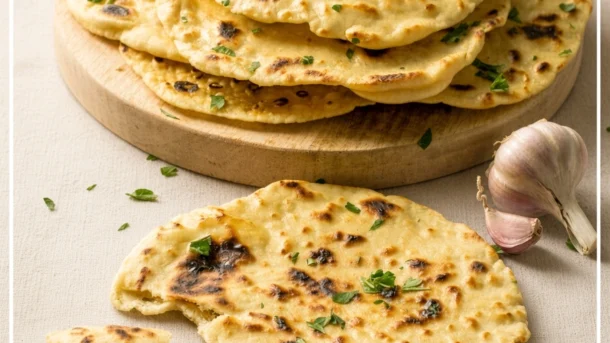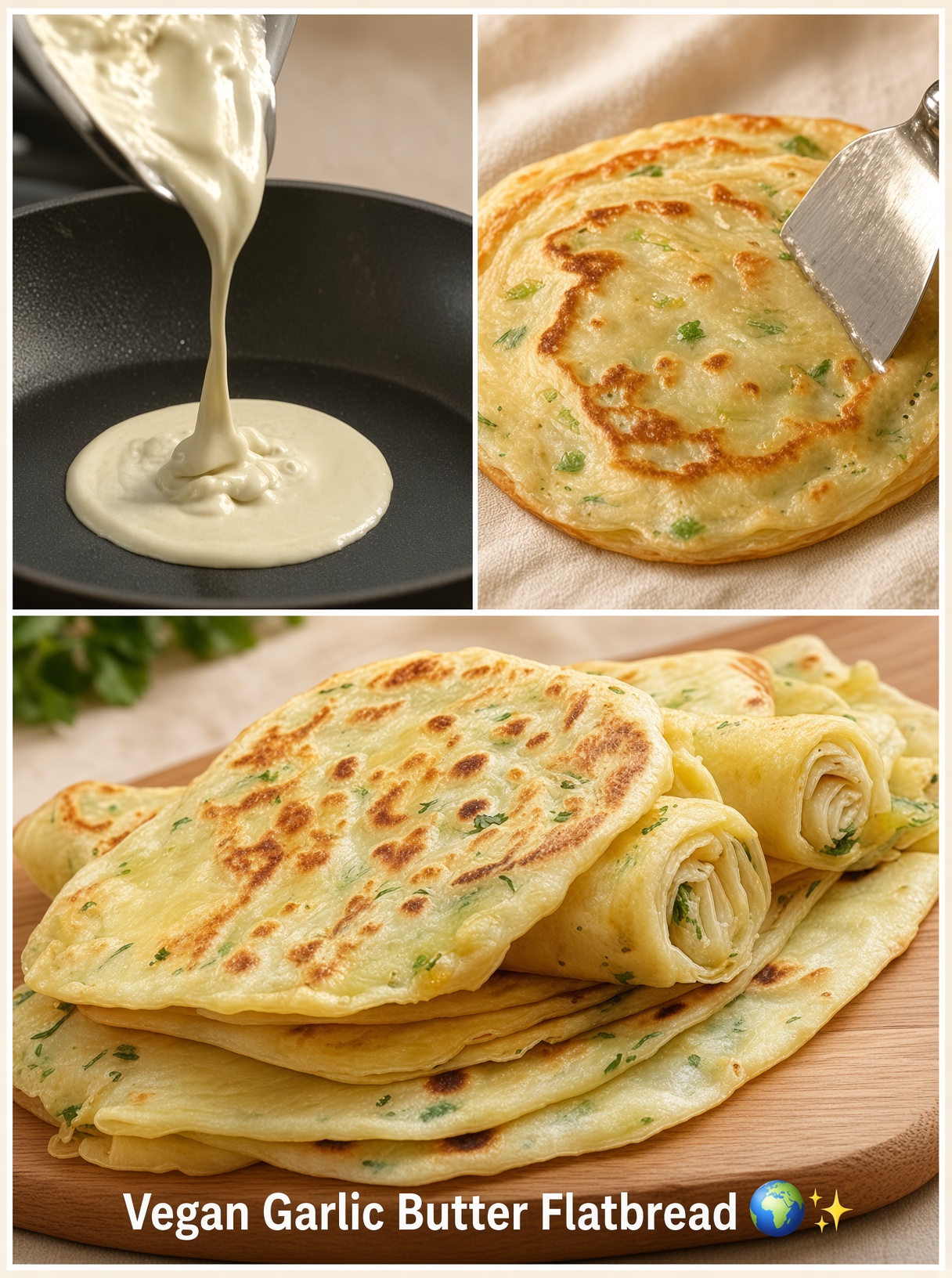
There are flatbreads and then there are flatbreads like this Vegan Garlic Butter Flatbread — the kind that comes off the hot skillet so blistered and so puffed and so impossibly soft that you brush the garlic butter on while it is still steaming and the butter soaks into the bread immediately and the kitchen fills with the smell of garlic and fresh parsley and warm dough and it is so completely and overwhelmingly the smell of comfort that whoever is nearest the stove reaches for a piece before you have finished the batch, and when they bite into it the interior is so pillowy and so layered and the garlic butter has soaked all the way through to the underside and the blisters on the top are golden and slightly crisp and the whole thing is so good and so simple and so satisfying that you wonder how something made from five pantry ingredients and cooked in a dry pan in under 3 minutes per flatbread became the thing that everyone asks you to make every single time. This is that flatbread. The one that goes with everything — soups, stews, dips, curries, grilled vegetables — and that is so good on its own that it needs nothing. The one that takes 30 minutes start to finish and tastes like something you spent the afternoon making. The one that is 100% vegan and so far beyond any store-bought flatbread that there is no comparison worth making.
The secret is the steam-pocket technique. Flatbread puffs — the dramatic inflation of the dough in the pan, which creates the air pockets that produce a soft, layered interior — occurs when a flatbread is rolled thin enough and cooked in a pan hot enough that the water in the dough converts to steam rapidly on contact with the heat, and the steam is trapped between the layers of gluten and forces the bread apart into a balloon. The technique requires two conditions: the dough must be rested long enough for the gluten to relax and become extensible (so the steam can push it apart rather than tearing it), and the pan must be preheated for at least 3 minutes over medium-high heat before the first flatbread goes in (so the heat is high enough to generate steam instantly on contact). A flatbread cooked in a pan that is not hot enough steams slowly and evenly and produces a bread that is cooked through but flat and dense; a flatbread cooked in a properly preheated pan generates steam fast enough to inflate the bread within the first 30 seconds of cooking. The puff is not only visually satisfying — it is the mechanical process that creates the light, layered, tender interior that distinguishes a great flatbread from a merely good one.
What makes this recipe so outstanding is the garlic herb butter — vegan butter melted with four cloves of minced garlic, a handful of fresh flat-leaf parsley, a pinch of flaky salt, and a squeeze of lemon — applied to each flatbread directly from the pan while it is still hot enough to absorb the butter completely. Butter applied to a warm flatbread sits on the surface and drips off; butter applied to a flatbread that is still steaming hot absorbs into the bread and becomes part of it, infusing every layer with garlic flavor and richness. This is the detail that separates a garlic flatbread from garlic bread made with garlic butter — in a great garlic flatbread, the butter is in the bread, not on it.
This recipe is 100% vegan, requires no yeast and no rise time, comes together in 30 minutes, and produces a flatbread that is the best thing on the table every single time it appears.
Recipe Information
| Prep Time | Cook Time | Total Time | Servings | Calories |
|---|---|---|---|---|
| 15 mins | 15 mins | 30 mins | 6 flatbreads | ~280 kcal |
Ingredients
For the Flatbread Dough
- 2 cups (250g) all-purpose flour, plus extra for dusting
- 1 tsp baking powder
- ½ tsp fine salt
- 1 tsp granulated sugar
- ¾ cup (180ml) warm water (not hot — about 40°C / 104°F)
- 2 tbsp olive oil (plus extra for the bowl)
- 2 tbsp unsweetened vegan yogurt (oat or soy — adds tenderness and a very slight tang; can substitute with an extra tablespoon of olive oil)
For the Garlic Herb Butter
- 4 tbsp vegan butter
- 4 cloves garlic, very finely minced or pressed through a garlic press
- 3 tbsp fresh flat-leaf parsley, very finely chopped
- 1 tbsp fresh chives, finely chopped (optional — adds a mild onion note)
- ½ tsp flaky sea salt (or fine salt)
- 1 tsp fresh lemon juice
- Pinch of chili flakes (optional)
Instructions
- Make the dough. In a large bowl, whisk together the flour, baking powder, salt, and sugar. Make a well in the center and add the warm water, olive oil, and vegan yogurt. Mix with a fork until a shaggy dough forms, then turn out onto a lightly floured surface and knead for 3–4 minutes until smooth, soft, and slightly tacky but not sticky. The dough should be softer than bread dough — if it feels stiff, add water one tablespoon at a time. A soft, yielding dough produces a tender flatbread; a stiff dough produces a tough one.
- Rest the dough. Shape the dough into a ball, place in a lightly oiled bowl, and cover with a clean kitchen towel or plastic wrap. Leave to rest at room temperature for 15 minutes. This rest period allows the gluten — which tightened during kneading — to relax, making the dough extensible enough to roll thinly without springing back and puffing dramatically in the pan. Do not skip the rest; a dough rested for 15 minutes rolls to 2mm with minimal resistance, while an unrested dough fights back to 5mm every time you lift the rolling pin.
- Make the garlic herb butter. While the dough rests, melt the vegan butter in a small saucepan over low heat. Add the minced garlic and cook for 60–90 seconds, stirring constantly, until the garlic is fragrant and just barely beginning to turn golden at the edges — it should not brown. Remove from the heat immediately and stir in the fresh parsley, chives if using, flaky salt, lemon juice, and chili flakes. Set aside — the butter should remain warm and liquid while you cook the flatbreads.
- Preheat the pan. Place a large cast iron skillet or heavy-bottomed frying pan over medium-high heat and leave it to preheat for a full 3 minutes. The pan is ready when a drop of water flicked onto the surface bounces and evaporates immediately. Do not add oil to the pan — these flatbreads are cooked dry, and oil in the pan prevents the blisters from forming.
- Divide and roll. While the pan heats, divide the rested dough into 6 equal pieces (about 75g each). Working one at a time, roll each piece on a lightly floured surface into a rough oval or round about 3mm (⅛ inch) thick and 20–22cm (8–9 inches) across. Roll as thinly and evenly as possible — thicker areas cook more slowly and produce a denser interior, while thinner areas blister more aggressively and produce more dramatic pockets.
- Cook the flatbreads. Place one rolled flatbread in the preheated dry pan. Cook for 60–90 seconds on the first side — the flatbread will begin to puff and blister within the first 30 seconds; the blisters should be golden to deep brown and the surface should be dry and matte rather than shiny and wet. Flip with tongs and cook for a further 60 seconds on the second side until blistered and golden. The entire cooking time per flatbread is under 3 minutes. Transfer to a plate and repeat with the remaining flatbreads, stacking them as they come off the pan to keep warm.
- Butter immediately. As each flatbread comes off the pan, brush it generously with the warm garlic herb butter — use a pastry brush to coat the entire surface, pressing lightly so the butter soaks into the blisters. The flatbread must still be steaming hot for the butter to absorb rather than pool on the surface. Stack the buttered flatbreads on a plate, covering loosely with a clean towel to keep warm while the remaining flatbreads cook.
- Serve immediately. Garlic butter flatbreads are best served within 10 minutes of cooking, while they are still warm, soft, and fragrant. Serve whole for tearing, or cut into strips or wedges. Excellent alongside hummus, baba ganoush, soups, stews, curries, or simply on their own as a snack.
Pro Tips
- Rest the dough — the 15-minute rest is not optional and is not about yeast activity (this dough contains no yeast). It is about gluten relaxation. Freshly kneaded dough is elastic and springy and will resist being rolled thin, snapping back to a thicker shape the moment the rolling pin is lifted. Rested dough is extensible and compliant — it rolls to any thickness you request and stays there. Roll thin, rest longer if needed, and the flatbread will puff reliably and consistently.
- Preheat the pan properly — 3 full minutes over medium-high heat is the minimum. An insufficiently hot pan produces flatbreads that cook slowly from the bottom without generating the rapid steam that inflates the bread. The blisters should begin forming within 20–30 seconds of the flatbread hitting the pan; if they take longer than a minute to appear, the pan is not hot enough. Increase the heat and wait another minute before the next flatbread.
- Apply the garlic butter while the bread is steaming hot — the window for absorption is approximately 60 seconds after the flatbread leaves the pan. After that, the surface cools and firms and the butter sits on top rather than soaking in. Keep the garlic butter warm in the saucepan over the lowest heat while you cook the flatbreads and brush each one as it comes off the pan.
- Do not cook in oil — a dry pan is essential for the blistering and charring that give these flatbreads their characteristic appearance and flavor. Oil in the pan creates a frying environment rather than a dry-cooking environment, which prevents blisters from forming, produces a fried rather than blistered surface texture, and creates a greasier flatbread that does not absorb the garlic butter as cleanly.
Flatbread: The Oldest Bread in the World
Flatbread is the oldest form of bread in the human culinary record, predating leavened bread by thousands of years and appearing independently in virtually every human civilization that has ever grown grain. The earliest flatbreads — unleavened, made from crushed grain and water, cooked on hot stones or in the ashes of a fire — have been identified in the archaeological record as far back as 30,000 years in Europe and at least 14,000 years in the Natufian culture of the ancient Levant, making flatbread one of the oldest continuously produced foods in human history. The form persists in an extraordinary range of regional varieties — the Indian roti and paratha, the Middle Eastern pita and lavash, the Mexican tortilla, the Ethiopian injera, the Scandinavian flatbrød, the Central Asian naan — because it solves the problem of turning grain into food with the minimum possible equipment and the maximum possible speed. A hot stone, a flat surface, and heat: the ingredients have not changed in 14,000 years, and the flatbread that comes off a cast iron skillet in a modern kitchen is recognizably the same object — in concept, in process, and in the satisfaction it produces — as the one cooked on a hearthstone in a Natufian camp in ancient Jordan. The garlic butter technique in this recipe is a specifically Mediterranean refinement — the marriage of flatbread with olive-oil-cooked garlic and fresh herbs is one of the oldest and most enduring flavor combinations in the world, and it remains compelling for exactly the same reason it always has been: because it is perfect.
Flavor Variations
- Za’atar Flatbread: Replace the garlic herb butter with a mixture of 3 tablespoons of vegan butter, 2 tablespoons of za’atar spice blend, and 1 tablespoon of olive oil for a Middle Eastern version where the thyme, sumac, and sesame in the za’atar create a tangy, herby, nutty flatbread that is outstanding alongside hummus, labneh, or a fattoush salad.
- Vegan Garlic Butter Flatbread with Roasted Garlic: Roast a full head of garlic (wrapped in foil at 400°F for 40 minutes) and squeeze the soft, sweet, caramelized cloves directly into the melted vegan butter in place of raw garlic. The roasted garlic version has a sweeter, deeper, more mellow garlic flavor with none of the sharpness of raw garlic — exceptional as a side to soups and stews.
- Herb and Olive Oil Flatbread: Skip the garlic butter entirely and brush the hot flatbreads with high-quality extra-virgin olive oil, a pinch of flaky salt, fresh rosemary finely chopped, and a squeeze of lemon for the simplest and most elegant version — one that tastes entirely of the olive oil and the bread itself, which is outstanding when both are good.
Nutritional Highlights (Per Flatbread)
| Calories | Protein | Carbs | Fiber | Fat |
|---|---|---|---|---|
| ~280 kcal | 6g | 38g | 1g | 11g |
Storage
- Room temperature: Flatbreads are at their absolute best within 30 minutes of cooking, when they are still soft, warm, and fragrant. Store cooled flatbreads in an airtight bag or wrapped in foil at room temperature for up to 2 days — they firm and lose their blisters but remain good for wraps, dipping, and reheating.
- Reheating: Reheat in a dry skillet over medium heat for 30–45 seconds per side until warmed through and the surface is slightly crisped. Alternatively, wrap in foil and warm in a 350°F (175°C) oven for 5 minutes. Microwave reheating works but produces a soft, slightly gummy texture. Apply fresh garlic butter after reheating for best results.
- Freezer: Freeze cooled, unbuttered flatbreads separated by parchment paper in a sealed bag for up to 2 months. Thaw at room temperature for 20 minutes and reheat in a dry skillet. Apply the garlic butter after reheating — frozen and reheated flatbreads absorb butter just as well as fresh ones when they are hot.
- Make-ahead dough: The dough can be made through Step 2, wrapped tightly in plastic, and refrigerated for up to 24 hours. The extended cold rest actually improves the dough, making it even more extensible and easier to roll. Bring to room temperature for 20 minutes before rolling and cooking.
Frequently Asked Questions
Why isn’t my flatbread puffing?
Three possible causes: the pan is not hot enough (the most common cause — the pan must be preheated for a full 3 minutes over medium-high heat); the dough was not rested long enough and is too elastic to be rolled thin enough to puff; or the dough was rolled too thick (thicker than 4mm rarely puffs dramatically — aim for 3mm or thinner). If the flatbreads are cooking through but not puffing, increase the heat and thin the rolling.
Can I make these with whole wheat flour?
Yes — replace up to half the all-purpose flour with whole wheat flour for a nuttier, more substantial flatbread. A full whole wheat replacement produces a denser, slightly coarser flatbread that puffs less dramatically than the all-purpose version but is excellent in flavor and holds up better to thick dips and stews. Increase the water by 1–2 tablespoons, as whole wheat flour absorbs more liquid than all-purpose.
Can I cook these in an air fryer?
Yes — preheat the air fryer to 200°C (400°F) for 3 minutes. Cook flatbreads one at a time for 3–4 minutes, flipping halfway. The air fryer produces a flatbread that is crispier and drier than the skillet version — excellent as a cracker-like flatbread for dipping but less soft and pillowy than the skillet version. Apply the garlic butter immediately after removing from the air fryer.
Can I add flavors directly to the dough?
Yes — add 1 teaspoon of dried herbs (thyme, rosemary, oregano), ½ teaspoon of garlic powder, or 2 tablespoons of finely chopped fresh herbs to the dry ingredients before mixing. Black sesame seeds, nigella seeds, or cumin seeds pressed into the surface of the rolled flatbread before cooking add texture and flavor. Any add-ins that are finely chopped or powdered integrate without affecting the puffing; large pieces or wet additions (like fresh garlic directly in the dough) can create hot spots and affect the roll.
Tried this recipe? Leave a comment below and let us know how it turned out! Tag us on Instagram and Facebook — we love seeing your plant-powered creations. Looking for more addictive vegan snack and appetizer recipes? Browse all recipes on Easy Vegan Recipes — new recipes posted every single week!