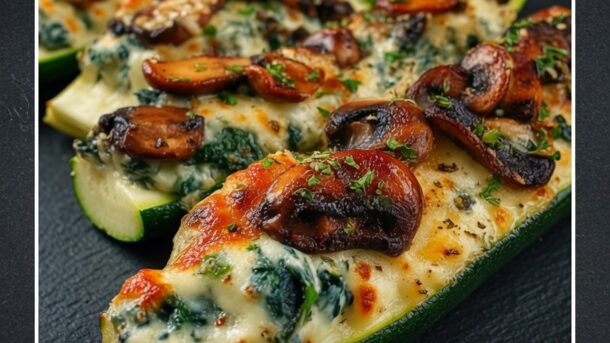
Tender roasted zucchini boats, filled with a creamy, bright green spinach and herb filling, topped with melted vegan cheese and golden garlic mushrooms: these Vegan Zucchini Boats Verde are rich, cheesy, and full of fresh flavor. “Verde” means green in Spanish and Italian, and these boats are green inside and out, with spinach, parsley, basil, and zucchini in every bite. They are ready in about 50 minutes, and they work as a satisfying dinner with a salad, or as an impressive side dish.
The star is the verde filling. It is made from creamy white beans, blended with wilted spinach, fresh parsley and basil, garlic, lemon juice, nutritional yeast, and a little olive oil into a thick, silky, herb-filled cream. White beans are the secret: they make the filling creamy without any cream or nuts, and they add protein and fiber. Because the beans are mild, the green herbs and lemon stand out. The filling is stirred together with the scooped zucchini flesh, so nothing goes to waste.
The boats are baked in two stages. First, the zucchini halves are scooped out and roasted for about 12 minutes, which removes some of the water. Zucchini is very watery, and without this step, the boats can turn soggy. Then they are filled, topped with vegan mozzarella, and baked again until the cheese melts and bubbles. A final minute under the broiler gives the golden, blistered top you see in the photo.
The mushrooms are what make this dish special. Sliced cremini or baby bella mushrooms are cooked in a hot, dry pan first, so they brown and release their water, and then they are finished with garlic, thyme, soy sauce, and a splash of lemon. They go on top of the cheese, and their deep, savory, meaty flavor contrasts with the fresh, creamy filling.
Choose medium zucchini, about 7–8 inches (18–20cm) long and about 2 inches (5cm) wide. Large ones are watery and seedy. Use a spoon to scoop out the center, leaving a ¼-inch (6mm) wall, so the boat holds its shape.
Allergen note: this recipe is dairy-free, egg-free, and nut-free as written. It contains soy if you use soy sauce, so use tamari or coconut aminos for a gluten-free version, and it may contain soy, coconut, or nuts depending on your vegan mozzarella, so check the label.
Recipe Information
Prep Time
Cook Time
Total Time
Makes
Calories
20 mins
35 mins
55 mins
8 boats (4 servings)
~260 kcal per serving (2 boats)
Ingredients
For the Zucchini Boats
4 medium zucchini (about 2 lb / 900g), halved lengthwise
2 tbsp olive oil, divided
½ tsp salt
¼ tsp black pepper
For the Spinach Herb Verde Filling
1 can (15 oz / 400g) white beans (cannellini or great northern), drained and rinsed
5 oz (140g) fresh baby spinach (about 5 packed cups)
8 oz (225g) cremini or baby bella mushrooms, sliced
1 tbsp olive oil
2 garlic cloves, minced
1 tsp fresh thyme leaves
1 tsp soy sauce or tamari
1 tsp lemon juice
To Finish
1 cup (115g) shredded vegan mozzarella
2 tbsp chopped fresh parsley
Flaky salt
Chili flakes, optional
Instructions
Heat the oven. Heat the oven to 400°F (200°C). Line a baking sheet with parchment.
Scoop the zucchini. Use a spoon to scoop out the center of each zucchini half, leaving a ¼-inch (6mm) wall. Chop the scooped flesh, and squeeze it in a clean towel to remove the water. Set aside.
Pre-roast. Brush the zucchini with 1 tablespoon of oil, and season with salt and pepper. Place cut-side up on the baking sheet. Roast for 12 minutes.
Wilt the spinach. While the zucchini roasts, place the spinach in a large skillet over medium heat with a splash of water. Cook for 2 minutes, until wilted. Cool slightly and squeeze out as much water as you can.
Blend the filling. In a food processor, combine the beans, spinach, parsley, basil, garlic, nutritional yeast, olive oil, lemon juice, salt, and pepper. Pulse until mostly smooth with a little texture. Add plant milk a tablespoon at a time if it is too thick. Stir in the chopped zucchini.
Cook the mushrooms. Heat a large skillet over medium-high heat. Add the mushrooms in a single layer, with no oil, and cook for 4–5 minutes, until they release their liquid and start to brown. Add 1 tablespoon of oil, garlic, and thyme, and cook for 2 minutes. Stir in the soy sauce and lemon juice. Remove from the heat.
Fill. Spoon the filling into the roasted zucchini boats, mounding it slightly. Sprinkle with the vegan mozzarella.
Bake. Bake for 15–18 minutes, until the cheese melts and the filling is hot and bubbling.
Broil. Broil on high for 1–2 minutes, until the top is golden and blistered. Watch closely.
Top and serve. Arrange the mushrooms on top. Finish with parsley, flaky salt, and chili flakes. Serve hot, being careful of the steam.
Pro Tips for the Best Zucchini Boats
Choose medium zucchini of even size, so they cook evenly.
Pre-roast the boats to remove water before filling.
Squeeze the scooped flesh and the spinach dry. This is the key to avoiding soggy boats.
Cook the mushrooms dry first so they brown instead of steaming.
Do not overblend the filling. A little texture is nice.
Taste the filling before filling the boats. It should be bright, savory, and lemony.
Mound the filling, since it will settle.
Use a vegan cheese that melts well, and broil briefly for color.
Serve right away, since zucchini releases water as it sits.
A Few Notes on Ingredients
White beans make the filling creamy and mild. Cannellini beans work best, but great northern or navy beans also work. Fresh spinach, parsley, and basil give the filling its green color and fresh flavor. Nutritional yeast adds a savory, cheesy flavor. Cremini mushrooms are meaty and brown well. Vegan mozzarella varies a lot in how well it melts, so check how yours behaves.
Flavor Variations
Cheese-Free: Skip the mozzarella and top with breadcrumbs mixed with olive oil and garlic powder.
Spicy: Add a chopped jalapeño or chili flakes to the filling.
Sun-Dried Tomato: Add chopped sun-dried tomatoes to the filling.
Kale: Use kale in place of spinach, and cook it for longer.
Pesto: Stir a spoonful of vegan pesto into the filling.
Eggplant: Use halved eggplants in place of zucchini, and roast for longer.
Mini Boats: Use small zucchini or cut the boats into halves for appetizers.
Nutritional Highlights (Per Serving, 2 Boats)
Calories
Protein
Carbs
Fiber
Fat
~260 kcal
12g
24g
8g
13g
Values are estimates and vary by vegan cheese and ingredient size.
Storage
Refrigerator: Store in an airtight container for up to 3 days.
Reheating: Reheat in a 375°F (190°C) oven for 12–15 minutes. The microwave makes them watery.
Make ahead: Make the filling and mushrooms a day ahead, and roast, fill, and bake just before serving.
Freezer: Freeze the filling for up to 2 months. Do not freeze the baked boats, as the zucchini turns soft.
Frequently Asked Questions
Why are my zucchini boats watery?
Zucchini holds a lot of water. Pre-roast the boats, squeeze the scooped flesh and spinach dry, and serve right away.
Can I make it without cheese?
Yes. Use the breadcrumb topping in the variations, or leave the boats plain with the creamy filling.
Can I make it gluten-free?
Yes. Use tamari in place of soy sauce, and skip the breadcrumb topping or use gluten-free breadcrumbs.
Can I use other beans?
Yes. Chickpeas or butter beans work, but cannellini beans give the creamiest result.
Can I use frozen spinach?
Yes. Use 10 oz (280g) of frozen spinach, thawed and squeezed very dry.
How is this different from your other zucchini boats?
These boats have a creamy white bean, spinach, and herb filling with garlic mushrooms. Our Vegan Stuffed Zucchini Boats have a quinoa, chickpea, and marinara filling with a breadcrumb topping.
Tried this recipe? Leave a comment below and let us know how it turned out! Tag us on Instagram and Facebook — we love seeing your plant-powered creations. Browse all recipes on Easy Vegan Recipes — new recipes posted every single week!
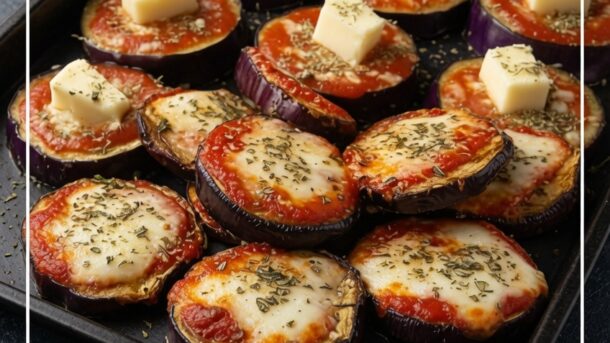
There is a particular kind of cooking achievement that happens when you take an ingredient that most people think of as a supporting player — a background vegetable, the kind that disappears into sauces and stews and casseroles — and build an entire dish around it in a way that makes it undeniably, convincingly the star. This is what happens with Vegan Eggplant Pizzas. Each pizza begins as a thick round slice of eggplant, cut from the widest part of the bulb where the flesh is most substantial — a cross-section approximately 2cm (¾ inch) thick that, after roasting, becomes something almost miraculous: the exterior slightly caramelized and gently crisped, the interior collapsed into a dense, meaty, deeply savory flesh that has shed nearly all its water and concentrated into something with genuine substance, genuine chew, and a richness of flavor that makes it a more satisfying pizza base than many bread-based alternatives. On top of this roasted eggplant base goes a spoonful of quick-cooked tomato sauce that is spiked with garlic and dried oregano and basil and a small amount of red pepper flakes; then a generous layer of cashew mozzarella or store-bought vegan mozzarella that melts across the surface and bubbles at the edges; then whatever toppings you choose — olives, sun-dried tomatoes, roasted peppers, capers, fresh basil, marinated artichoke hearts, thinly sliced red onion — and then a final 5 minutes under the highest heat of the oven or a 2-minute pass under the grill to blister the cheese and char the tomato sauce at the edges into those slightly caramelized, slightly sweet, slightly smoky dark spots that are the signature of a genuinely good pizza. The whole thing is on the table in 35 minutes, is naturally gluten-free, is completely plant-based, is low in carbohydrates, and delivers every element of a great pizza experience — sauce, melted cheese, layered toppings, herb fragrance, the slight char of the oven — on a base that is more flavorful, more nutritious, and more interesting than most pizza doughs.
The secret is the pre-roast salt-draw technique. Eggplant is approximately 92% water by weight, which means that an eggplant slice cooked without preparation releases an enormous amount of liquid during cooking — liquid that steams the base from below rather than allowing it to crisp, leaving the finished eggplant soft, slightly waterlogged, and too yielding to hold its toppings without collapsing. The pre-roast salt-draw technique solves this by drawing out a significant portion of that moisture before the oven ever gets involved: the eggplant slices are laid on a wire rack, salted generously on both sides, and left to stand for 20–30 minutes. The salt creates an osmotic gradient across the cell walls of the eggplant, drawing water out of the cells and onto the surface of the slice — visible as beads of grey-tinged liquid that accumulate on the surface and drip from the edges. After 20–30 minutes, the slices are pressed firmly with paper towels or a clean kitchen cloth to remove the drawn-out liquid, rinsed very briefly under cold water to remove the excess salt, and pressed again until as dry as possible. The difference in the roasting outcome is dramatic: a salted-and-pressed eggplant slice roasts into a dense, substantially firmer base with caramelized edges and a concentrated meaty interior; an unsalted slice softens and steams and produces a pizza base that is pleasant but unstructured. The salt-draw step adds 20–30 minutes of passive time (during which the tomato sauce can be made and the toppings prepared) and is the single most important technique decision in the recipe.
What makes this recipe so outstanding is the double-heat finish. After the first roast (20–22 minutes at high heat to cook the eggplant through and establish the base), the toppings are added and the pizzas go back into the oven at its highest setting — typically 220–230°C (430–445°F) — for 8–10 minutes, then the grill (broiler) is turned on for the final 2 minutes. This two-stage topping cook achieves two separate goals: the oven heat melts and integrates the cheese into the tomato sauce so the two components become one unified layer rather than sitting separately on the base; and the grill at the end provides the direct, intense top heat that blisters the cheese surface and chars the edges of the tomato sauce into those dark, caramelized spots that no amount of oven heat alone can fully replicate. Without the grill finish, the cheese is melted but pale; with it, the surface has the visual and flavor character of a pizza that has been cooked in a hot stone oven. It is a 2-minute step that makes the finished dish look and taste dramatically more like a real pizza than without it.
This recipe is 100% vegan, dairy-free, egg-free, and naturally gluten-free. It serves 2 as a main course (3–4 eggplant pizza rounds per person) or 4 as a substantial starter.
Recipe Information
Prep Time
Cook Time
Total Time
Servings
Calories
10 mins
30 mins
40 mins (+ 20 min salt-draw)
2–4 servings
~310 kcal
Ingredients
For the Eggplant Bases
2 large eggplants (aubergines), approximately 700g–800g total weight — choose the fattest, most evenly cylindrical eggplants available; a wider diameter means more usable pizza-round slices from the widest section of each eggplant; thinner eggplants produce rounds too small to function as a pizza base
1½ tsp fine salt, for the salt-draw
3 tbsp olive oil (for brushing before roasting — use a brush or your hands to coat both sides of each slice generously; an under-oiled eggplant slice roasts dry and tough)
Black pepper, to taste
½ tsp garlic powder (optional, brushed onto the slices with the olive oil before roasting — adds a subtle background savoriness to the base)
For the Quick Pizza Sauce
2 tbsp olive oil
3 garlic cloves, finely minced (or ½ tsp garlic powder if pressed for time — fresh garlic is significantly more aromatic but the sauce is quick enough that it doesn’t cook long enough to fully mellow)
1 can (400g / 14oz) crushed tomatoes or passata
1 tsp dried oregano
½ tsp dried basil
¼ tsp red pepper flakes (optional — adds warmth without making the sauce spicy)
1 tsp sugar or maple syrup (balances the acidity of canned tomatoes; omit if using a good-quality sweet passata)
Salt and black pepper, to taste
For the Vegan Cheese Layer
200g (7oz) store-bought vegan mozzarella (Violife, Sheese, Miyoko’s, or any brand that melts well — block-style vegan mozzarella, grated or sliced, melts more convincingly than pre-shredded; pre-shredded often contains anti-caking agents that inhibit melting); OR use the cashew mozzarella from this site’s Vegan Mozzarella recipe for a completely homemade version
Optional: 2 tbsp vegan parmesan (store-bought or nutritional yeast mixed with cashew powder and salt) for additional savory depth on top of the mozzarella
For the Toppings (Choose Any Combination)
A small handful of pitted black or green olives, halved
6–8 sun-dried tomato halves (oil-packed, drained) — these caramelize further under the grill and add an intensely concentrated tomato note
½ roasted red pepper (jarred is fine), sliced into thin strips
1 tbsp capers, drained and rinsed
¼ small red onion, very thinly sliced into rings
4–6 marinated artichoke heart halves
A small handful of fresh baby spinach leaves (added for the last 3 minutes of oven time only — they wilt quickly)
For Finishing
A generous handful of fresh basil leaves, torn (added after the grill — heat destroys basil’s volatile aromatics; it must be added at the very last moment)
Chilli flakes, to taste
A drizzle of extra-virgin olive oil
Optional: a drizzle of balsamic glaze
Instructions
Salt-draw the eggplant. Slice each eggplant crosswise into rounds approximately 2cm (¾ inch) thick, discarding the very top and bottom pieces (the cap end and the narrow tail, which are too small and too thin to function well as pizza bases). You should get approximately 6–8 usable rounds from two large eggplants — aim for the widest rounds from the center of each eggplant. Lay the rounds in a single layer on a wire rack set over a baking sheet (or directly on the baking sheet lined with paper towels). Sprinkle both sides generously with the fine salt — approximately ¼ teaspoon per side per slice. Leave to stand at room temperature for 20–30 minutes; you will see moisture bead on the surface and drip from the edges. After 20–30 minutes, press each slice firmly on both sides with paper towels or a clean kitchen cloth to absorb the drawn-out liquid, rinse very briefly under cold water to remove excess salt, and press again until as dry as possible.
Make the pizza sauce. While the eggplant draws, heat 2 tablespoons of olive oil in a small saucepan over medium heat. Add the minced garlic and cook for 60 seconds, stirring constantly, until fragrant and just barely turning golden — do not allow it to brown. Add the crushed tomatoes, dried oregano, dried basil, red pepper flakes, sugar or maple syrup, salt, and black pepper. Stir to combine and cook at a gentle simmer for 10–12 minutes, stirring occasionally, until the sauce has thickened slightly and the flavors have melded. The sauce should be thick enough to spread onto the eggplant base without running immediately off the edges — if it is too thin, simmer for 2–3 further minutes uncovered. Remove from heat and set aside.
Roast the eggplant bases. Preheat the oven to 220°C (430°F) fan, or 230°C (445°F) conventional. Line a large baking sheet with parchment paper. Arrange the dried eggplant rounds in a single layer on the baking sheet. Brush both sides of each round generously with olive oil (and garlic powder if using). Season with black pepper. Roast for 20–22 minutes, flipping once at the 12-minute mark, until the eggplant is completely cooked through, the cut surfaces are golden-caramelized, and the rounds feel dense and substantially firmer than raw eggplant — they should not be soft and waterlogged, but genuinely firm and concentrated. Remove from the oven.
Top the eggplant pizzas. Spoon 1–2 tablespoons of pizza sauce onto each eggplant round and spread to within 5mm of the edge using the back of the spoon. Top each round with a generous layer of vegan mozzarella (grated or sliced). Add your chosen toppings, distributing them evenly but not overcrowding — too many toppings prevent the cheese from melting properly and make the base collapse under the weight.
Double-heat finish. Return the topped eggplant pizzas to the oven at its highest setting (220–230°C / 430–445°F) and bake for 8–10 minutes until the cheese is melted and the sauce is bubbling around the edges. Then switch the oven to grill (broiler) mode and grill on high for 2–3 minutes, watching closely, until the cheese surface is blistered and spotted with golden-brown patches and the edges of the tomato sauce are dark and caramelized. Remove immediately — the grill finish happens quickly and the difference between perfectly charred and burnt is about 60 seconds.
Serve. Transfer the eggplant pizzas to a serving board or plates using a wide spatula. Scatter torn fresh basil generously over all the rounds. Add a pinch of chilli flakes, a drizzle of good extra-virgin olive oil, and a drizzle of balsamic glaze if using. Serve immediately — eggplant pizzas are best eaten hot from the oven.
Pro Tips
Choose the fattest eggplants you can find — the diameter of the eggplant determines the size of your pizza base, and a wide, substantial round is significantly more satisfying and more structurally stable than a narrow one. Farmer’s market eggplants are often fatter and firmer than supermarket specimens; in season (summer and early autumn), they are also less bitter and require less salt-drawing time.
Don’t skip the flip during roasting — flipping the eggplant rounds at the 12-minute mark ensures both cut surfaces caramelize evenly, producing a base that is equally firm and flavorful on the top and the bottom rather than browned on one side and pale on the other.
Keep the sauce thick — a sauce that is too thin will make the eggplant base soggy during the topping cook. The sauce should be spreadable but thick, closer to a paste than a pourable liquid. Cooking it for the full 10–12 minutes rather than just 5 makes a meaningful difference.
The grill finish is not optional — it is what distinguishes these from baked eggplant with cheese on top and makes them convincingly pizza-like. Watch them under the grill with the oven door slightly ajar and remove at the first sign of significant golden spotting on the cheese surface. The line between perfectly blistered and overcooked is approximately 90 seconds at the end.
Eggplant: From Ancient Persia to the Vegan Pizzeria
Eggplant (Solanum melongena) has one of the longest and most geographically sweeping cultivation histories of any vegetable in the modern kitchen — a plant that originated in the wild in the Indian subcontinent (where it still grows wild in several forms), was first cultivated in India and China at least 1,500 years ago, traveled westward through Persia and into the Arab world during the medieval period, and arrived in Mediterranean Europe via Moorish Spain and Arab Sicily in the eighth and ninth centuries, where it was received with spectacular suspicion. Medieval European scholars were deeply distrustful of the eggplant: it was classified in European botanical literature as a member of the nightshade family (correct — it is, alongside tomatoes, peppers, and potatoes), associated with madness and melancholy (the Italian name melanzana was popularly derived from mela insana, “mad apple,” though the actual etymology traces to the Arabic al-badingan), and largely avoided as a food until the sixteenth century, when improved cultivars and changing culinary attitudes began to bring it into southern Italian cooking. Its rehabilitation was rapid and thorough: by the eighteenth century, eggplant was a staple of Sicilian cooking (caponata, pasta alla norma), of Greek cooking (moussaka, imam bayıldı), of Turkish and Levantine cooking (where it appears in dozens of forms — stuffed, smoked into baba ganoush, fried, braised), and of the French Provençal tradition (ratatouille). The particular affinity between eggplant and tomato — the pairing at the heart of every eggplant pizza — is a historically recent combination that required the tomato’s own tortuous journey from South America to European tables (the tomato arrived in Europe in the sixteenth century, was treated with equal suspicion as a nightshade relation, and was not accepted as a cooking ingredient in most of southern Italy until the eighteenth century). The eggplant pizza in this recipe is therefore the product of ingredients that crossed the world, spent centuries being feared, and eventually found each other in the most satisfying possible way.
Flavor Variations
Vegan Margherita Eggplant Pizzas: Keep it simple — pizza sauce, vegan mozzarella, and fresh basil only. No additional toppings. The restraint focuses the dish entirely on the quality of the roasted eggplant base, the sauce, and the cheese, which is an excellent composition when each element is made carefully. A drizzle of the best extra-virgin olive oil you have and a grind of black pepper are the only finishes needed.
Vegan Greek-Style Eggplant Pizzas: Top with pizza sauce, vegan feta (crumbled over the mozzarella base), Kalamata olives, sliced cherry tomatoes, thinly sliced red onion, and fresh oregano instead of basil. The combination of tangy vegan feta, briny olives, and sweet roasted tomatoes against the eggplant base is a Mediterranean composition that feels completely cohesive and deeply satisfying.
Vegan Pesto and Roasted Vegetable Eggplant Pizzas: Replace the tomato sauce entirely with a layer of vegan basil pesto (store-bought or homemade), then top with vegan mozzarella, roasted courgette ribbons, roasted cherry tomatoes, and pine nuts. The pesto base gives the finished pizza a bright, herby, more intensely aromatic character than the tomato version and is particularly good in summer when basil is at its peak.
Nutritional Highlights (Per Serving — Based on 4 Servings)
Calories
Protein
Carbs
Fiber
Fat
~310 kcal
8g
22g
7g
21g
Storage
Refrigerator: Leftover eggplant pizzas keep in the refrigerator for up to 3 days, covered or in a sealed container. The base softens slightly overnight but the flavor deepens and the toppings meld together in a way that makes day-two eggplant pizzas genuinely delicious in their own right.
Reheating: Reheat in a hot oven (200°C / 390°F) for 6–8 minutes rather than in the microwave, which makes the eggplant base soggy. A few minutes under the grill at the end of reheating restores the blistered cheese surface almost to fresh-baked quality.
Meal prep: The roasted eggplant bases and the pizza sauce can both be prepared up to 2 days in advance and refrigerated separately. On the day of serving, add the toppings and do the double-heat finish — total time from refrigerator to table is under 15 minutes when the components are pre-made.
Freezer: The roasted (unsauced, untopped) eggplant rounds freeze well for up to 1 month. Freeze in a single layer on a baking sheet, then transfer to a bag. Reheat directly from frozen at 200°C (390°F) for 10 minutes before topping and finishing.
Frequently Asked Questions
Do I really need to salt the eggplant for 20–30 minutes? Can I skip it?
Technically yes, you can skip it — but the result will be noticeably inferior. Unsalted eggplant releases its water content during roasting, which steams the rounds from within and prevents the exterior from caramelizing properly, leaving a softer, less structured base. The salt-draw step is passive (it requires no active work), and the 20–30 minutes of waiting time is the perfect window to make the pizza sauce and prepare the toppings. Skipping it to save time costs you the texture that makes the recipe work.
Which vegan mozzarella melts best for this recipe?
Block-style vegan mozzarella, grated at home, consistently outperforms pre-shredded bags because the grating exposes more surface area (faster, more even melting) without the anti-caking agents that prevent pre-shredded cheese from flowing and stretching when hot. Violife block mozzarella, Miyoko’s Fresh Vegan Mozzarella, and Sheese Mozzarella Style are all reliable melters. Under the grill, any of these will blister and spot convincingly.
My eggplant base is still too soft — what went wrong?
Three common causes: the eggplant was not salted and pressed thoroughly enough before roasting (the salt-draw step is the primary safeguard against a waterlogged base); the oven was not hot enough (this recipe requires a genuinely hot oven — 220°C / 430°F fan at minimum; if your oven runs cool, it may need 230°C or an additional 3–4 minutes); or the rounds were too thick (rounds thicker than 2.5cm / 1 inch take significantly longer to cook through and may remain undercooked in the center even when the surface looks done). For thicker rounds, add 4–5 minutes to the first roasting time.
Can I cook these on a barbecue instead of in the oven?
Yes — eggplant pizzas are excellent on the barbecue. Grill the salted-and-pressed eggplant rounds directly on an oiled, hot grill for 4–5 minutes per side until clearly marked and cooked through, then add the toppings, close the barbecue lid, and cook for a further 4–5 minutes until the cheese melts. The barbecue smoke adds an additional layer of flavor that is particularly good with the olive and sun-dried tomato topping combination.
Tried this recipe? Leave a comment below and let us know how it turned out! Tag us on Instagram and Facebook — we love seeing your plant-powered creations. Looking for more addictive vegan snack and appetizer recipes? Browse all recipes on Easy Vegan Recipes — new recipes posted every single week!
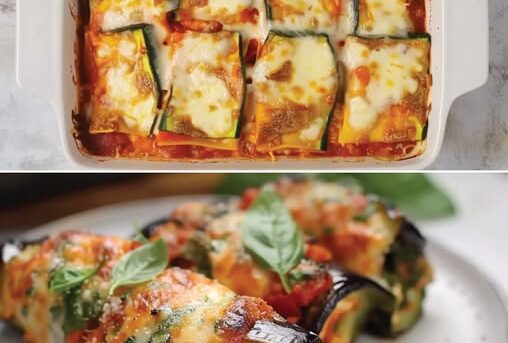
Tender roasted eggplant slices rolled around a creamy spinach and olive tofu ricotta, nestled in marinara, and baked until bubbly: this Vegan Spinach and Olive Eggplant Rollatini is an elegant Italian-American classic with no pasta, no dairy, and no frying. It looks impressive, tastes rich and savory, and is far easier to make than it looks.
Rollatini is traditionally made with breaded and fried eggplant, but this version roasts the slices instead, which keeps the dish lighter and removes a messy step. Long eggplant slices are brushed with olive oil and baked until soft and pliable, then spread with a filling, rolled up, covered in sauce, and baked again.
The filling is a nut-free tofu ricotta made from crumbled firm tofu, lemon juice, nutritional yeast, garlic, and basil, with wilted spinach and chopped Kalamata olives folded through. The olives add a briny, salty punch that makes the filling taste bold and Mediterranean, and a vegan parmesan topping bakes into a golden crust.
Serve two rolls per person with crusty bread or a green salad. They are naturally low in carbs, gluten-free (with a gluten-free parmesan), and make an excellent dinner-party dish that can be assembled a day ahead.
This recipe is 100% vegan, dairy-free, egg-free, and nut-free. It is gluten-free if your marinara and vegan parmesan are.
Recipe Information
Prep Time
Cook Time
Total Time
Servings
Calories
30 mins
45 mins
1 hr 15 mins
4 (12 rolls)
~340 kcal per serving of 3 rolls
Ingredients
For the Eggplant
2 large eggplants (about 2 lb / 900g total)
3 tbsp olive oil
½ tsp salt
¼ tsp black pepper
For the Spinach Olive Tofu Ricotta
1 block (14 oz / 400g) firm tofu, drained and pressed
5 oz (150g) baby spinach (about 5 cups)
½ cup (60g) pitted Kalamata olives, finely chopped
3 tbsp nutritional yeast
2 tbsp lemon juice
2 tbsp olive oil
3 garlic cloves, minced
¼ cup chopped fresh basil
1 tsp dried oregano
½ tsp salt (less if the olives are very salty)
¼ tsp black pepper
For Assembly
2½ cups (600ml) marinara sauce
¼ cup vegan parmesan
Fresh basil for garnish
To Serve
Crusty bread
Green salad
Extra warm marinara
Chili flakes
Optional Additions
Vegan mozzarella shreds on top
Capers in the filling
Sun-dried tomatoes
Fresh parsley
Instructions
Slice the eggplant. Heat the oven to 400°F (200°C). Trim the ends and slice each eggplant lengthwise into ¼-inch (6 mm) slices, aiming for 12 good slices. Use the end pieces for another dish.
Roast the slices. Brush both sides with olive oil and sprinkle with salt and pepper. Arrange in a single layer on two parchment-lined baking sheets. Roast for 15–18 minutes, flipping halfway, until soft, pliable, and lightly golden. Let them cool slightly. Reduce the oven to 375°F (190°C).
Wilt the spinach. In a skillet over medium heat, cook the spinach with a splash of water for 2 minutes until wilted. Cool, then squeeze out all the liquid and chop finely.
Make the filling. Crumble the tofu into a bowl and mash with a fork until it resembles ricotta. Stir in the spinach, olives, nutritional yeast, lemon juice, olive oil, garlic, basil, oregano, salt, and pepper. Taste and adjust.
Fill and roll. Spread 1 cup of marinara in the bottom of a 9×13-inch baking dish. Place about 3 tablespoons of filling at the wide end of each eggplant slice, then roll up tightly and place seam-side down in the dish.
Top. Spoon the remaining marinara over the rolls and sprinkle with vegan parmesan.
Bake. Cover with foil and bake for 15 minutes. Uncover and bake for 10–15 more minutes until bubbly and golden on top.
Serve. Let stand for 5 minutes, then garnish with fresh basil and serve.
Pro Tips for the Best Eggplant Rollatini
Slice evenly. Aim for ¼ inch so the slices are pliable but not tearing.
Roast until soft. Undercooked slices crack when rolled.
Squeeze the spinach dry. Wet filling makes the dish watery.
Chop the olives finely. They distribute the flavor without lumps.
Go easy on the salt. Olives are salty, so taste before adding.
Do not overfill. Too much filling makes the rolls hard to close.
Roll tightly and place seam-side down. This keeps them from unrolling.
Cover with plenty of sauce. It keeps the rolls from drying out.
A Few Notes on Ingredients
Eggplant is low in calories and provides fiber and antioxidants. Tofu adds plant protein and calcium, and spinach adds iron. Olives bring healthy monounsaturated fats and a Mediterranean flavor, and tomatoes provide lycopene.
This is a lighter alternative to lasagna and works well as a dinner for guests.
Flavor Variations
Mushroom Rollatini: Add sautéed mushrooms to the filling.
Spicy Rollatini: Add chili flakes to the marinara.
Nutritional Highlights (Per Serving of 3 Rolls)
Calories
Protein
Carbs
Fiber
Fat
~340 kcal
16g
24g
9g
21g
Storage
Refrigerator: Store covered for up to 4 days.
Freezer: Freeze unbaked rolls in the dish with sauce for up to 2 months. Bake from frozen, covered, for 45 minutes.
Reheat: Cover and warm at 350°F (175°C) for 15–20 minutes.
Make ahead: Assemble up to 24 hours ahead and bake when ready.
Frequently Asked Questions
What is rollatini?
Rollatini is an Italian-American dish of thin slices, often eggplant, rolled around a filling and baked in tomato sauce.
Do I need to salt the eggplant first?
Not for this recipe. Roasting removes the moisture, and modern eggplants are rarely bitter.
Why are my eggplant slices cracking?
They are probably undercooked or cut too thick. Roast them until soft and pliable.
Can I use store-bought vegan ricotta?
Yes. Use about 2 cups, and fold in the spinach and olives.
Can I make it gluten-free?
Yes, as long as your marinara and vegan parmesan are gluten-free.
How is this different from your other eggplant and lasagna recipes?
These are roasted eggplant slices rolled around a spinach and olive tofu ricotta, with no pasta. Our Vegan Eggplant Lasagna is a layered bake, and our Vegan Lasagna Roll Ups use lasagna noodles instead of eggplant.
Tried this recipe? Leave a comment below and let us know how it turned out! Tag us on Instagram and Facebook — we love seeing your plant-powered creations. Browse all recipes on Easy Vegan Recipes — new recipes posted every single week!
We use cookies on our website to give you the most relevant experience by remembering your preferences and repeat visits. By clicking “Accept”, you consent to the use of ALL the cookies.
This website uses cookies to improve your experience while you navigate through the website. Out of these, the cookies that are categorized as necessary are stored on your browser as they are essential for the working of basic functionalities of the website. We also use third-party cookies that help us analyze and understand how you use this website. These cookies will be stored in your browser only with your consent. You also have the option to opt-out of these cookies. But opting out of some of these cookies may affect your browsing experience.
Necessary cookies are absolutely essential for the website to function properly. These cookies ensure basic functionalities and security features of the website, anonymously.
Cookie
Duration
Description
cookielawinfo-checkbox-analytics
11 months
This cookie is set by GDPR Cookie Consent plugin. The cookie is used to store the user consent for the cookies in the category "Analytics".
cookielawinfo-checkbox-functional
11 months
The cookie is set by GDPR cookie consent to record the user consent for the cookies in the category "Functional".
cookielawinfo-checkbox-necessary
11 months
This cookie is set by GDPR Cookie Consent plugin. The cookies is used to store the user consent for the cookies in the category "Necessary".
cookielawinfo-checkbox-others
11 months
This cookie is set by GDPR Cookie Consent plugin. The cookie is used to store the user consent for the cookies in the category "Other.
cookielawinfo-checkbox-performance
11 months
This cookie is set by GDPR Cookie Consent plugin. The cookie is used to store the user consent for the cookies in the category "Performance".
viewed_cookie_policy
11 months
The cookie is set by the GDPR Cookie Consent plugin and is used to store whether or not user has consented to the use of cookies. It does not store any personal data.
Functional cookies help to perform certain functionalities like sharing the content of the website on social media platforms, collect feedbacks, and other third-party features.
Performance cookies are used to understand and analyze the key performance indexes of the website which helps in delivering a better user experience for the visitors.
Analytical cookies are used to understand how visitors interact with the website. These cookies help provide information on metrics the number of visitors, bounce rate, traffic source, etc.
Advertisement cookies are used to provide visitors with relevant ads and marketing campaigns. These cookies track visitors across websites and collect information to provide customized ads.