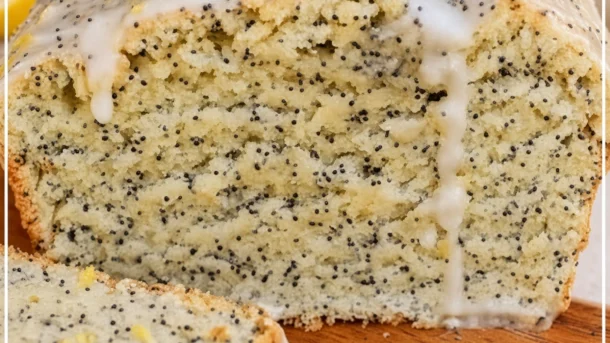
There is a category of baked goods that occupies the precise intersection of cake and bread — loaves that are sliced rather than plated, eaten with fingers rather than forks, and carry a flavor so clean and bright that a single slice feels like a small piece of weather. The Vegan Lemon Poppyseed Loaf is exactly that: a tall, golden, tender loaf with a crumb that is soft and yielding without being heavy, a lemon flavor that is genuinely sharp and citrus-forward rather than a distant lemon suggestion, and a fine scatter of poppy seeds throughout that add a gentle nutty crunch and a visual speckle that makes every slice look beautiful on a board. It is finished with a tart lemon glaze that soaks partially into the warm loaf and sets into a thin, slightly crackled sugar-lemon shell on top — the kind of glaze that catches the light and produces a barely audible crunch when the first slice is cut through it. It is 100% vegan, dairy-free, egg-free, and made from ingredients available in every supermarket. It is the kind of thing that is equally at home on a Sunday brunch table, in a lunchbox, on an afternoon tea board, or simply sliced directly on the counter and eaten standing up, which is how most of it actually gets eaten. One loaf makes 10–12 thick slices. None of them last as long as they should.
The technique is the dual-lemon extraction method. Most lemon loaves taste like lemon in the way that a lemon-scented candle smells like lemon — recognizably so, but not quite the real thing: a lemon flavor that is sweet and one-dimensional rather than bright, tart, and complex. The reason is that most recipes use lemon juice alone, which provides acidity but whose volatile aromatic compounds (primarily limonene and linalool — the molecules responsible for the fresh, bright, top-note quality of lemon scent and flavor) are largely water-soluble and evaporate significantly during baking, leaving behind the acid but losing much of the freshness. The dual-lemon extraction method captures both the acid and the aromatics through two parallel processes. Process one — zest-into-sugar rubbing: the finely grated zest of 3 lemons is added to the sugar before any liquid is incorporated and rubbed between the fingers for 60 seconds, pressing the zest against the sugar crystals. The mechanical friction breaks the oil sacs in the zest and releases the limonene directly into the sugar, which absorbs and holds the fat-soluble aromatic oil — protecting it from water-based dilution when the wet ingredients are added and from heat evaporation during the early baking stage. Process two — lemon juice added twice: two tablespoons of fresh lemon juice go into the batter before baking (providing tartness throughout the crumb), and three tablespoons go into the glaze (applied while the loaf is still warm, when the crumb is most porous and the glaze penetrates deepest into the surface). The result is a loaf whose lemon flavor arrives in three notes — the zest oil protected by the sugar rubbing (bright, aromatic top note), the baked juice (tart midrange), and the fresh glaze (sharp, immediate finish) — producing the full, complex, genuinely citrus-forward flavor that lemon deserves.
This recipe makes one standard 900g (2lb) loaf tin — 10–12 slices.
Recipe Information
| Prep Time | Cook Time | Total Time | Servings | Calories |
|---|---|---|---|---|
| 15 mins | 50–55 mins | 70 mins (+ 15 min cooling before glazing) | 10–12 slices | ~310 kcal |
Ingredients
For the Lemon Poppyseed Loaf
- 1½ cups (180g) all-purpose flour, plus extra for dusting the tin
- 1 cup (200g) caster sugar (or granulated sugar — caster dissolves slightly more easily in the rubbing step but granulated works equally well)
- Zest of 3 large lemons (this is the most important single measurement in the recipe — do not reduce; the zest is the primary source of the loaf’s brightness and complexity)
- 2 tbsp fresh lemon juice (from the same lemons after zesting)
- ¾ cup (180ml) plant milk, unsweetened (oat milk or soy milk — both work; oat milk produces a very slightly more tender crumb)
- ½ cup (120ml) neutral oil (sunflower, vegetable, or refined coconut oil)
- 1 tsp apple cider vinegar (reacts with the baking soda to produce lift, and adds a very faint tartness that reinforces the lemon without being detectable as vinegar)
- 2 tsp baking powder
- ½ tsp baking soda (bicarbonate of soda)
- ½ tsp fine salt
- 2½ tbsp poppy seeds (this quantity produces a well-distributed scatter of seeds visible in every slice; add up to 3 tablespoons for a more prominent poppy seed presence)
- 1 tsp vanilla extract
For the Lemon Glaze
- 1 cup (120g) icing sugar (powdered sugar), sifted
- 3 tbsp fresh lemon juice (from the lemons — this amount produces a tart, genuinely lemon-forward glaze rather than a sweet one; reduce to 2 tablespoons for a sweeter, thicker glaze)
- ½ tsp lemon zest, finely grated (optional — adds visible zest flecks to the glaze surface and intensifies the lemon note)
For Finishing
- Extra poppy seeds scattered over the glaze before it sets (optional but very attractive)
- Thin strips of lemon zest laid over the set glaze (optional)
Instructions
- Preheat and prepare the tin. Preheat the oven to 175°C (350°F). Grease a 900g (2lb) loaf tin thoroughly with vegan butter or oil, then dust with flour, tapping out the excess. Alternatively, line with parchment paper, leaving an overhang on the long sides to act as handles for lifting the finished loaf. A well-prepared tin is important — the loaf’s high sugar content means it can stick aggressively if the tin is inadequately greased.
- Zest-into-sugar rubbing. In a large mixing bowl, add the caster sugar. Grate the zest of 3 large lemons directly into the sugar. Using your fingertips, rub the zest into the sugar with firm pressure for a full 60 seconds — the sugar will turn slightly yellow, feel slightly damp, and smell intensely of fresh lemon. This step is the heart of the dual-lemon extraction method; do not skip or rush it. Set aside. Juice the zested lemons and measure out 2 tablespoons for the batter and 3 tablespoons for the glaze; set both aside.
- Add the wet ingredients. To the lemon sugar, add the plant milk, neutral oil, vanilla extract, the 2 tablespoons of lemon juice, and the apple cider vinegar. Whisk vigorously for 30 seconds until thoroughly combined and slightly emulsified.
- Add the dry ingredients. Sift the flour, baking powder, baking soda, and salt directly into the wet mixture. Add the poppy seeds. Using a spatula or wooden spoon, fold gently until just combined — stop folding as soon as no dry flour streaks remain. Do not overmix: once the flour is wet, gluten begins developing, and overmixing produces a dense, tough crumb rather than a tender one. A few very small lumps in the batter are entirely acceptable.
- Bake. Pour the batter into the prepared loaf tin and smooth the top with a spatula. Optionally, run a knife or the tip of a spatula down the center of the batter (creating a very shallow groove) — this encourages the loaf to crack neatly down the center during baking, which is both visually appealing and indicates the loaf has risen fully through the center rather than only at the edges. Bake for 50–55 minutes, until a wooden skewer or toothpick inserted into the center comes out clean with no wet batter (a few moist crumbs are fine; wet batter is not). If the top of the loaf begins to over-brown before the center is baked through, tent loosely with foil from around the 35-minute mark.
- Cool briefly. Remove from the oven. Leave the loaf in the tin for 10–15 minutes — this cooling time allows the structure to set enough that the loaf can be removed without crumbling. Then turn out carefully onto a wire rack. The loaf should be still warm but not hot when the glaze goes on: warm enough that the glaze soaks partially into the surface, but not so hot that it runs off entirely before setting.
- Make the glaze. While the loaf cools, whisk together the sifted icing sugar, 3 tablespoons of fresh lemon juice, and optional zest until completely smooth with no lumps. The glaze should be thick enough to coat the back of a spoon but pourable — if too thick, add ½ teaspoon of lemon juice; if too thin, add 1 tablespoon of icing sugar. Taste: it should be sharp, bright, and intensely lemony.
- Glaze the loaf. Pour the lemon glaze slowly over the top of the warm loaf, allowing it to run down the sides naturally. Do not spread with a spatula — pouring and allowing the glaze to find its own level produces a more natural, slightly pooled glaze around the edges that looks beautiful and penetrates the sides as well as the top. Scatter extra poppy seeds and/or thin strips of lemon zest over the wet glaze. Allow the glaze to set for 15–20 minutes before slicing — the glaze should be set to a slightly tacky, slightly crackled shell before the first slice is cut.
- Slice and serve. The loaf slices cleanest with a long, sharp, serrated knife. Cut into slices approximately 2cm (¾ inch) thick — thinner slices can crumble at the glaze layer; this thickness maintains the full textural structure of each slice.
Pro Tips
- The zest-into-sugar rubbing step requires the full 60 seconds of pressure — a brief, casual toss of zest into sugar does not rupture the oil sacs in the zest and does not release the limonene effectively. The 60-second rubbing should be vigorous enough that the sugar feels slightly moist and warm when done. The color change (from white to pale yellow) and the intensification of the lemon scent are the indicators that the step has worked.
- Do not reduce the zest quantity — three lemons’ worth of zest is not excessive; it is the quantity needed to produce a genuinely citrus-forward loaf rather than a mildly lemon-flavored one. Many bakers’ instinct is to reduce zest for fear of bitterness; the rubbing step actually mitigates bitterness by releasing the sweeter aromatic oils and distributing them evenly through the sugar rather than leaving concentrated pockets of zest in the batter.
- Glaze on a warm — not hot — loaf — the window between too-hot (glaze runs completely off) and too-cold (glaze sits on the surface without soaking in) is approximately 10–15 minutes after the loaf comes out of the tin. A loaf that is warm to the touch but not burning when held is at the correct temperature for glazing: the crumb is still slightly open and porous from baking heat, allowing the glaze to penetrate 2–3mm into the surface rather than sitting entirely on top.
- For a layered glaze effect, apply the glaze in two pours: pour half the glaze, let it set for 5 minutes, then pour the remaining half. The double pour builds a thicker glaze layer and produces a more dramatic crackled surface on the finished loaf.
Lemon and Poppy Seed: A Pairing With Deep Culinary Roots
The pairing of lemon and poppy seed in baked goods is so established in the modern bakery repertoire that it functions almost as a single unit — lemon poppyseed muffins, lemon poppyseed pancakes, lemon poppyseed cake — but the history of how these two ingredients ended up together is worth considering, because their geographic origins are about as far apart as two ingredients can be. The lemon (Citrus limon) originated in Northeast India or possibly Southern China, was brought westward to Persia and the Arab world by roughly the 10th century CE, and arrived in the Mediterranean (Spain, Italy, and eventually further north) via Arab traders and the spread of Islamic cultivation techniques during the medieval period. By the 17th and 18th centuries, lemon cultivation was firmly established in the Mediterranean, and lemon-flavored confectionery and desserts were a well-established category in French and Italian pastry. Poppy seeds (from Papaver somniferum) have a completely separate origin story: their culinary use is documented in ancient Egypt and Mesopotamia, and they became particularly embedded in Central and Eastern European baking traditions — specifically in Polish, Czech, Hungarian, and German baking, where poppy seeds feature prominently in pastries, strudels, breads, and cakes from at least the medieval period onward. The combination of lemon and poppy seed is not, as far as food historians can determine, an ancient or traditional pairing in any single cuisine; it appears to be a 20th-century American combination, most likely emerging from the meeting of Mediterranean citrus flavors and Central/Eastern European seed-baking traditions in the immigrant communities that shaped American baking between the 1890s and the 1960s. The pairing works because the sharp brightness of lemon and the subtle, earthy nuttiness of poppy seed occupy different sensory registers and amplify each other rather than competing — a balance that, once discovered in an American bakery sometime in the mid-20th century, turned out to be so obviously right that it has never been questioned since.
Flavor Variations
- Lemon and Lavender Poppyseed Loaf: Add 1 teaspoon of culinary dried lavender (finely ground in a pestle and mortar — unground dried lavender in a baked good is unpleasantly floral and slightly woody; ground lavender distributes evenly through the crumb) to the zest-sugar mixture at the rubbing stage. Reduce the vanilla extract to ½ teaspoon. The lavender adds a floral, slightly herbal note that pairs beautifully with lemon and is particularly sophisticated when served alongside afternoon tea. Replace the plain lemon glaze with a lavender glaze: steep 1 teaspoon of culinary lavender in 3 tablespoons of warm water for 10 minutes, strain, and use the lavender water in place of lemon juice in the glaze (add 1 tablespoon of lemon juice for tartness).
- Orange and Poppyseed Loaf: Replace the 3 lemons entirely with 2 large oranges — zest, juice in the batter, and juice in the glaze. Add ¼ teaspoon of cinnamon to the dry ingredients. The orange version is warmer, sweeter, and slightly more autumnal in flavor than the lemon; it is particularly good sliced thickly and eaten alongside a cup of black tea. For an intensified citrus flavor, use blood oranges when in season — they produce a beautifully pink-tinted crumb.
- Lemon Poppyseed Loaf With Blueberry: Fold 150g of fresh blueberries (tossed lightly in 1 tablespoon of flour before folding in — the flour prevents them from sinking to the bottom of the batter during baking) into the completed batter as the final step before pouring into the tin. The blueberries burst during baking, creating pockets of jammy fruit throughout the crumb that contrast with the lemon brightness. Reduce the glaze quantity by one-third as the loaf is already sweet and fruity.
Nutritional Highlights (Per Slice — Based on 11 Slices)
| Calories | Protein | Carbs | Fiber | Fat |
|---|---|---|---|---|
| ~310 kcal | 3g | 49g | 1g | 11g |
Storage
- Room temperature: The glazed loaf keeps wrapped tightly in plastic wrap or in an airtight container at room temperature for up to 3 days. The glaze softens slightly after the first day as it absorbs moisture from the crumb, transitioning from a crackled shell to a softer, stickier top — the flavor is equally good both ways, just texturally different.
- Refrigerator: The loaf keeps in the refrigerator for up to 5 days. Remove from the refrigerator 15–20 minutes before eating to allow the crumb to return to room temperature — cold lemon loaf loses some of its aromatic brightness, which returns as it warms.
- Freezer: Freeze un-glazed (the glaze does not freeze well — it becomes sticky and wet on thawing). Cool the un-glazed loaf completely, wrap tightly in plastic wrap and then foil, and freeze for up to 2 months. Thaw at room temperature for 2–3 hours, then make and apply the glaze fresh. A freshly glazed, thawed loaf is indistinguishable from freshly baked.
- Individual slices: Slices can be individually wrapped and frozen for up to 1 month — useful for a weekday lunch or a single-serving treat. Thaw a slice at room temperature for 30 minutes or microwave from frozen for 25 seconds.
Frequently Asked Questions
My loaf sank in the center — what went wrong?
A sunken center is almost always caused by one of three things: the oven door was opened before the loaf had fully set in the center (the sudden drop in temperature causes the unbaked center to collapse — do not open the oven before 40 minutes); the loaf was underbaked (test with a skewer in the very center of the loaf, not the edge); or too much leavening was used (too much baking powder causes a rapid initial rise that the structure cannot sustain, leading to collapse as the loaf cools). Measure baking powder carefully and use a properly calibrated level measurement.
Can I make this gluten-free?
Yes — replace the all-purpose flour with a 1:1 gluten-free baking flour blend (one specifically designed for direct substitution in baking, with xanthan gum already included). The texture of the gluten-free version is slightly denser and less springy than the original but still pleasant and well-flavored. Do not use almond flour or coconut flour as a direct substitution; they require different liquid ratios and produce an entirely different product.
Can I use bottled lemon juice instead of fresh?
Fresh lemon juice is strongly recommended for both the batter and the glaze. Bottled lemon juice lacks the volatile aromatic compounds that evaporate during processing and that are responsible for the fresh, bright quality of lemon flavor. The zest-into-sugar rubbing step is entirely dependent on fresh lemons for the zest; for the juice element, bottled juice produces a functional but noticeably flatter, less vibrant result. If fresh lemons are unavailable, bottled juice in the batter is acceptable; use fresh lemon juice at minimum in the glaze, where it is served uncooked and its full aromatic quality is most apparent.
Why does my glaze soak in and disappear rather than setting on top?
A glaze that soaks in entirely means the loaf was too hot when the glaze was applied — a very hot crumb is maximally porous and absorbs liquid rapidly, pulling the glaze in before it has time to set. Wait until the loaf is warm to the touch but not burning (approximately 10–15 minutes out of the tin) before glazing. If the glaze has already been absorbed, make a second, slightly thicker batch of glaze (increase the icing sugar by 2 tablespoons) and apply it once the loaf has cooled further — the second layer will sit more on the surface.
Tried this recipe? Leave a comment below and let us know how it turned out! Tag us on Instagram and Facebook — we love seeing your plant-powered creations. Looking for more addictive vegan snack and appetizer recipes? Browse all recipes on Easy Vegan Recipes — new recipes posted every single week!