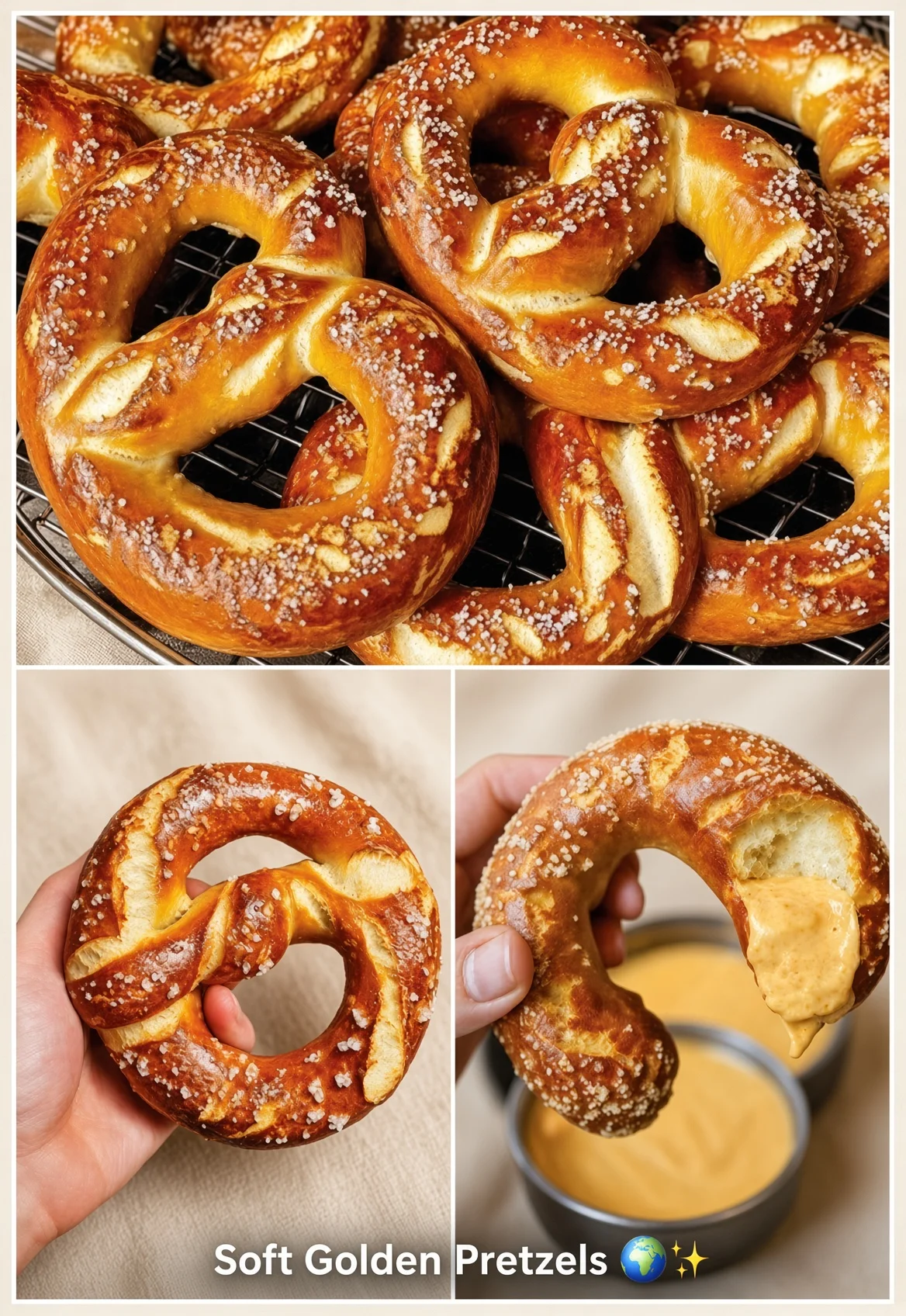
There is a version of the soft pretzel that most people know from airport food courts and stadium concession stands — warm, doughy, aggressively salted, eaten too quickly with a small pot of yellow mustard while standing up. It is a perfectly good thing. And then there is a soft pretzel made at home, pulled from the oven still hot, with a crust that is genuinely dark and glossy and slightly brittle, a crumb that is chewy and dense in the deeply satisfying way that only a properly worked yeast dough can be, and a salt crystal on every surface that dissolves into the warm bread and produces a burst of clean, savory flavor with every bite — and there is really no comparison between the two. Soft Golden Pretzels are made with a simple enriched yeast dough of flour, instant yeast, a small amount of sugar, salt, vegan butter, and warm water, shaped into the classic pretzel form, and dipped before baking in a baked baking soda solution — a homemade approximation of the traditional lye bath that gives the pretzel its defining dark, glossy, slightly chewy crust. They are scattered with coarse pretzel salt before baking and emerge from the oven burnished to a deep amber-brown that is hard to achieve with any other baking technique. The interior is soft, pillowy, and genuinely chewy — not bread-roll chewy, but pretzel chewy: dense and elastic and with a faint, distinctive alkaline tang at the back of the palate that is the flavor fingerprint of a real pretzel and that cannot be replicated without the alkaline dipping solution. They are 100% vegan. They take approximately 90 minutes from start to finish, including rise time. The technique is the reason they have that crust.
The technique is the baked-soda alkaline dip method. The defining characteristic of a soft pretzel — the dark, glossy, slightly brittle crust, the deep brown color, the faint alkaline tang, the chewiness — is not produced by the dough itself. It is produced by the pretzel’s brief immersion in a highly alkaline solution before baking. Traditional Bavarian soft pretzels are dipped in a sodium hydroxide (lye) solution — a caustic alkali that raises the pH of the dough’s surface dramatically (to approximately pH 13–14), causing the proteins on the surface to gelatinize and brown at oven temperatures far more rapidly than they would in an untreated dough, producing the characteristic mahogany color and glossy, lacquered surface. Working with food-grade lye at home is possible but requires chemical-resistant gloves and careful handling — it is a strong caustic that causes skin burns on contact. The baked-soda alkaline dip method produces results that are approximately 90% equivalent to lye dipping, using a substance that is safe, easy to prepare at home, and produces from widely available baking soda. The key transformation: ordinary baking soda (sodium bicarbonate, pH approximately 8.3) is spread on a baking sheet and baked at 120°C (250°F) for 1 hour. During baking, the sodium bicarbonate loses carbon dioxide and water and converts into sodium carbonate (washing soda, pH approximately 11.6) — a significantly stronger alkali. The baked baking soda can be made days in advance and stored in an airtight container. On pretzel day, it is dissolved in water to create a dipping solution with a pH of approximately 11–12. The shaped pretzel dough is dipped in this solution for 30 seconds, coating the entire surface in a thin layer of highly alkaline liquid. When the dipped pretzel enters the oven, the alkaline surface undergoes Maillard browning dramatically faster than untreated dough — achieving the deep brown color and glossy, lacquered crust in 15–18 minutes that would take an untreated dough 30+ minutes of baking to approach, by which point the interior would be overdone. The result is a pretzel with the defining visual and textural qualities of a traditional lye-dipped pretzel, made safely and easily at home.
This recipe makes 8 standard soft pretzels.
Recipe Information
| Prep Time | Rise Time | Cook Time | Total Time | Makes | Calories |
|---|---|---|---|---|---|
| 20 mins | 45 mins | 15 mins | 80 mins | 8 pretzels | ~290 kcal |
Ingredients
For the Baked Baking Soda (Make in Advance)
- 100g (7 tbsp) baking soda (sodium bicarbonate) — baked at 120°C for 1 hour to convert to sodium carbonate; can be made several days ahead and stored in a sealed jar. Handle baked baking soda with dry hands and avoid prolonged skin contact — while significantly safer than lye, sodium carbonate is moderately alkaline and can cause mild irritation with prolonged skin exposure; brief contact is harmless.
For the Pretzel Dough
- 480g (4 cups) strong bread flour or all-purpose flour — bread flour produces a chewier, more elastic pretzel (higher protein = more gluten development = more chew); all-purpose flour produces a slightly softer, less chewy result; both are good. Do not use self-raising flour.
- 7g (1 packet / 2¼ tsp) instant yeast (also called fast-action or rapid-rise yeast — instant yeast can be added directly to dry ingredients without pre-activation in liquid; do not substitute with active dry yeast without first activating it separately in warm water for 5–10 minutes)
- 1 tbsp sugar (feeds the yeast and contributes a small amount of browning through caramelization; do not omit)
- 1½ tsp fine salt
- 30g (2 tbsp) vegan butter, softened to room temperature (adds a small amount of richness and tenderness to the dough without significantly reducing the chew; refined coconut oil works as a substitute — use the same quantity, melted and slightly cooled)
- 300ml (1¼ cups) warm water — the water temperature matters; it should be warm to the touch but not hot (approximately 38–43°C / 100–110°F). Water that is too hot will kill the yeast; water that is too cold will slow the yeast’s activity and produce a dough that rises very slowly.
For the Alkaline Dipping Solution
- 1 litre (4 cups) water
- 60g (4 tbsp) baked baking soda (from above)
For Topping
- Coarse pretzel salt or flaky sea salt — pretzel salt (large, flat crystals that do not dissolve quickly in the dough’s surface moisture) is traditional and produces the best result; flaky sea salt (Maldon-style) is an excellent substitute. Do not use fine table salt — it dissolves immediately against the dough surface and produces a salty flavor without the visible, textural salt crystal that is part of the pretzel experience.
Optional Dipping Sauces for Serving
- Yellow mustard (the classic)
- Vegan cheese sauce (cashew cream blended with nutritional yeast, garlic, and a pinch of turmeric)
- Vegan honey mustard (equal parts yellow mustard and maple syrup)
Instructions
- Bake the baking soda (do this in advance). Preheat the oven to 120°C (250°F). Spread the baking soda in a thin, even layer on a foil-lined baking sheet. Bake for 1 hour. Remove, allow to cool completely, and store in a sealed glass jar until needed. The baked baking soda looks identical to regular baking soda but is noticeably more caustic — keep it labeled and away from children. It keeps indefinitely stored dry.
- Make the dough. In a large mixing bowl, whisk together the flour, instant yeast, sugar, and salt. Add the softened vegan butter and use your fingertips to rub it into the flour until no visible butter pieces remain and the mixture resembles a slightly enriched flour. Add the warm water and mix with a spoon or your hand until a rough, shaggy dough forms. Turn out onto a lightly floured surface.
- Knead. Knead the dough for 8–10 minutes until it is smooth, elastic, and no longer sticky. The dough is ready when it passes the windowpane test: stretch a small piece between your fingers — it should stretch thin enough to become translucent without tearing. Kneading develops the gluten network that gives the pretzel its characteristic chew; do not under-knead. If the dough tears immediately when stretched, continue kneading for 2–3 more minutes. A stand mixer with a dough hook can do this in 5–6 minutes on medium speed.
- First rise. Shape the kneaded dough into a ball, place it in a lightly oiled bowl, cover with a damp cloth or cling film, and leave in a warm place for 45 minutes until doubled in size.
- Prepare for baking. Preheat the oven to 220°C (430°F). Line two baking sheets with parchment paper and brush lightly with oil (parchment alone can stick to alkaline-dipped dough — the oil layer prevents this). Make the dipping solution: in a wide, shallow bowl or pan large enough to submerge a pretzel, dissolve the baked baking soda in 1 litre of warm water. Stir until completely dissolved.
- Shape the pretzels. Divide the risen dough into 8 equal portions (weigh them if precision is desired — approximately 100g each). Working with one portion at a time, roll each piece on an unfloured surface (a lightly damp surface provides more traction for rolling) into a long rope approximately 60–65cm (24 inches) long, keeping the ends slightly thinner than the center. To shape: hold the rope at each end, cross the ends over each other to form an X approximately 20cm from the ends, twist the X once, and fold the twisted section back down onto the thick loop of the rope, pressing the ends firmly against the dough at the 4 o’clock and 8 o’clock positions. Press firmly at the adhesion points — a pretzel that is not pressed firmly will open up in the oven.
- Alkaline dip. Using two slotted spatulas or your hands, carefully lower one shaped pretzel into the baking soda solution. Leave for 30 seconds, turning once halfway through to ensure all surfaces are coated. Lift out, allow the excess solution to drip off for a few seconds, and place on a prepared baking sheet. Repeat for all 8 pretzels. Scatter coarse pretzel salt generously over each dipped pretzel immediately — the alkaline surface coating is the adhesive that makes the salt stick; it is most effective in the 2–3 minutes immediately after dipping.
- Bake. Bake at 220°C (430°F) for 14–16 minutes until the pretzels are a deep amber-brown across the entire surface — not golden, not light brown, but genuinely dark. The color is what carries the flavor; a pale pretzel is an under-flavored pretzel. Rotate the baking sheets halfway through if the oven has hot spots.
- Serve. Eat warm. Soft pretzels are best within 30 minutes of baking, while the crust is still slightly brittle and the interior is still soft and steaming. Serve with mustard, vegan cheese sauce, or whatever dipping accompaniment is preferred.
Pro Tips
- An unfloured surface is better for rolling the pretzel ropes — flour reduces friction, and friction is what allows you to roll the dough into a long, even rope rather than a short, fat log that springs back. A lightly damp (not wet) work surface provides the traction needed to roll a 60cm rope without the dough resisting. This is the single most common point of difficulty for first-time pretzel makers; if the rope is springing back and will not extend, cover it with a cloth for 5 minutes (allowing the gluten to relax) and try again.
- The dip time of 30 seconds is the maximum — longer dipping produces a more intensely alkaline surface that tastes excessively of baking soda in the finished pretzel. 20–30 seconds is the right window. The solution does not need to be hot — room temperature works perfectly.
- Press the adhesion points firmly when shaping — a pretzel that opens in the oven is almost always one where the end pieces were not pressed firmly enough into the base loop. After shaping, press the adhesion points with two fingers with genuine downward pressure, not a light touch. The dough should visibly deform and flatten at the adhesion points.
- Dark is correct — first-time pretzel bakers often pull their pretzels too early because the deep brown color looks like burning. A properly baked soft pretzel should be a rich, genuine brown — the color of dark caramel or a roasted coffee bean — across its entire surface. This color is the Maillard reaction products and the alkaline crust working together, and it is where most of the pretzel’s flavor lives. A pretzel that looks light brown at 14 minutes needs 2 more minutes.
The Pretzel’s History: Medieval Monks, Bavarian Tradition, and a Knot With a Thousand Theories
The soft pretzel is one of the most ancient continuously made baked goods in the Western world, and it is also one of the most mythologized — surrounded by a body of origin stories that are almost entirely unverifiable, reflect the cultural priorities of the people who told them rather than historical evidence, and persist in popular food writing despite the absence of any documentary support. The most widely repeated origin story places the pretzel’s invention in a southern French or northern Italian monastery in the 7th century CE, where a monk supposedly shaped leftover bread dough into a form representing folded arms in prayer and gave the resulting bread to children as a reward for learning their catechism — the pretzel’s characteristic three holes said to represent the Christian Trinity. The word “pretzel” (German: Brezel) does appear in a Bavarian monk’s list of foods from 1111 CE, making it one of the earliest documented references to a named bread in the European record, but the earlier Carolingian-era origin is anecdotal. What is not disputed is that the pretzel was strongly associated with Bavarian, Austrian, and Alsatian baking culture from the medieval period onward, where it appears in guild emblems of German bakers’ associations — the bakers’ guild sign of a pretzel above the door was the primary means by which illiterate customers identified a bakery in medieval German cities, and the Brezel-form became so identified with the baker’s trade that it remains a bakery symbol in German-speaking Europe today. The lye-dipping technique that defines the authentic pretzel’s crust and color is not documented until the 19th century, and its origin is subject to an equally apocryphal story: that it was invented accidentally when a Bavarian baker’s assistant dropped unfinished pretzels into a bucket of caustic soda used for cleaning, and the baker chose to bake them anyway. Whatever its origin, the lye pretzel was standardized in Bavarian baking by the mid-19th century and remains the regional food most closely associated with Bavaria and the Oktoberfest tradition.
Flavor Variations
- Cinnamon Sugar Pretzels: After the baking soda dip and before adding salt, brush each shaped pretzel with a thin layer of melted vegan butter instead of topping with coarse salt. Bake as directed. Immediately after removing from the oven, brush again with melted vegan butter and roll in a mixture of 50g (¼ cup) of sugar and 1½ teaspoons of ground cinnamon until fully coated. The alkaline-dipped crust under the cinnamon sugar coating produces a slightly chewy, caramelized exterior that is extraordinary — the cinnamon sugar sticks to the alkaline surface and partially caramelizes during baking in a way it would not on an untreated dough.
- Everything Pretzel: Replace the coarse salt with an everything bagel seasoning blend — a mix of sesame seeds, poppy seeds, dried garlic flakes, dried onion flakes, and coarse salt. Press the seasoning gently into the surface of the dipped pretzels so it adheres well. The everything seasoning produces a more complex, savory, deeply flavored pretzel that is excellent eaten plain without any dipping sauce.
- Pretzel Bites: Instead of shaping into traditional pretzel loops, roll each dough portion into a rope and cut into 2.5cm (1 inch) pieces. Dip and salt in batches (the small pieces are easier to dip using a slotted spoon). Bake at 220°C for 10–12 minutes — bites bake faster than full pretzels. Pretzel bites are an excellent party snack, particularly served with a vegan beer cheese dipping sauce.
Nutritional Highlights (Per Pretzel — Based on 8 Pretzels)
| Calories | Protein | Carbs | Fiber | Fat |
|---|---|---|---|---|
| ~290 kcal | 8g | 54g | 2g | 4g |
Storage
- Same day: Soft pretzels are at their absolute best within 30–60 minutes of baking, while the crust is still slightly crisp and the interior is warm and steaming. The crust softens significantly as the pretzel cools and the surface moisture redistributes — this is normal and the pretzel is still delicious, but the distinct brittle-exterior/soft-interior contrast is a fresh-from-the-oven quality.
- Room temperature: Store in an airtight bag or container at room temperature for up to 2 days. The pretzels will soften significantly but retain their flavor. To refresh a room-temperature pretzel: place in a 180°C (355°F) oven for 4–5 minutes until warmed through and slightly re-crisped.
- Freezer (baked): Baked pretzels freeze well for up to 2 months. Allow to cool completely, then wrap individually in cling film and freeze in a bag. Reheat from frozen in a 180°C oven for 10–12 minutes until heated through and re-crisped. Do not microwave frozen pretzels — microwaving makes the crust rubbery and the interior gummy.
- Freezer (dough): Shaped, unbaked pretzels can be frozen before the alkaline dip. Place shaped pretzels on a tray and freeze until solid (2–3 hours), then transfer to a freezer bag. When ready to bake: dip frozen pretzels in the baking soda solution (still frozen — no thawing needed), salt immediately, and bake at 220°C for 18–20 minutes (slightly longer than fresh due to the frozen starting temperature).
Frequently Asked Questions
Can I use regular baking soda instead of baked baking soda?
You can, but the result will be noticeably less good — regular baking soda produces a much weaker alkaline dip (pH approximately 8–9 versus 11–12 for baked baking soda), and the pretzels will be paler, less glossy, and have a less pronounced pretzel flavor. If baked baking soda is not available, increase the regular baking soda to 100g per litre of dipping water to partially compensate. The baked baking soda step is 1 hour of unattended oven time and makes a significant difference — it is worth doing in advance.
My pretzels came out pale and soft instead of dark and glossy. What went wrong?
Pale, soft pretzels are almost always caused by one of three things: regular baking soda used instead of baked baking soda (too weak an alkaline solution); insufficient dip time (less than 20 seconds); or oven temperature too low. Check that the oven is fully preheated to 220°C — an underheated oven cannot produce the rapid Maillard browning that the alkaline surface is designed to trigger.
The dough keeps springing back when I try to roll it into ropes. What should I do?
Dough that springs back during rolling has tight, tense gluten from recent kneading. Cover the dough piece with a cloth and leave it to rest for 5–10 minutes — the gluten relaxes during this rest and the dough will roll into a long rope much more easily afterwards. Do not add more flour to the work surface in an attempt to reduce sticking; a slightly tacky, unfloured surface provides the friction that makes rope-rolling possible.
Can I make the dough the night before?
Yes — after kneading, place the dough in an oiled bowl, cover tightly, and refrigerate overnight rather than leaving it to rise at room temperature. The cold slows the yeast activity dramatically, producing a long, slow rise overnight. The next day, remove from the refrigerator, shape the pretzels immediately (the cold dough is actually easier to shape than room-temperature dough), dip, salt, and bake as directed. The overnight cold-fermented dough also has a slightly more complex flavor than same-day dough.
Tried this recipe? Leave a comment below and let us know how it turned out! Tag us on Instagram and Facebook — we love seeing your plant-powered creations. Looking for more addictive vegan snack and appetizer recipes? Browse all recipes on Easy Vegan Recipes — new recipes posted every single week!