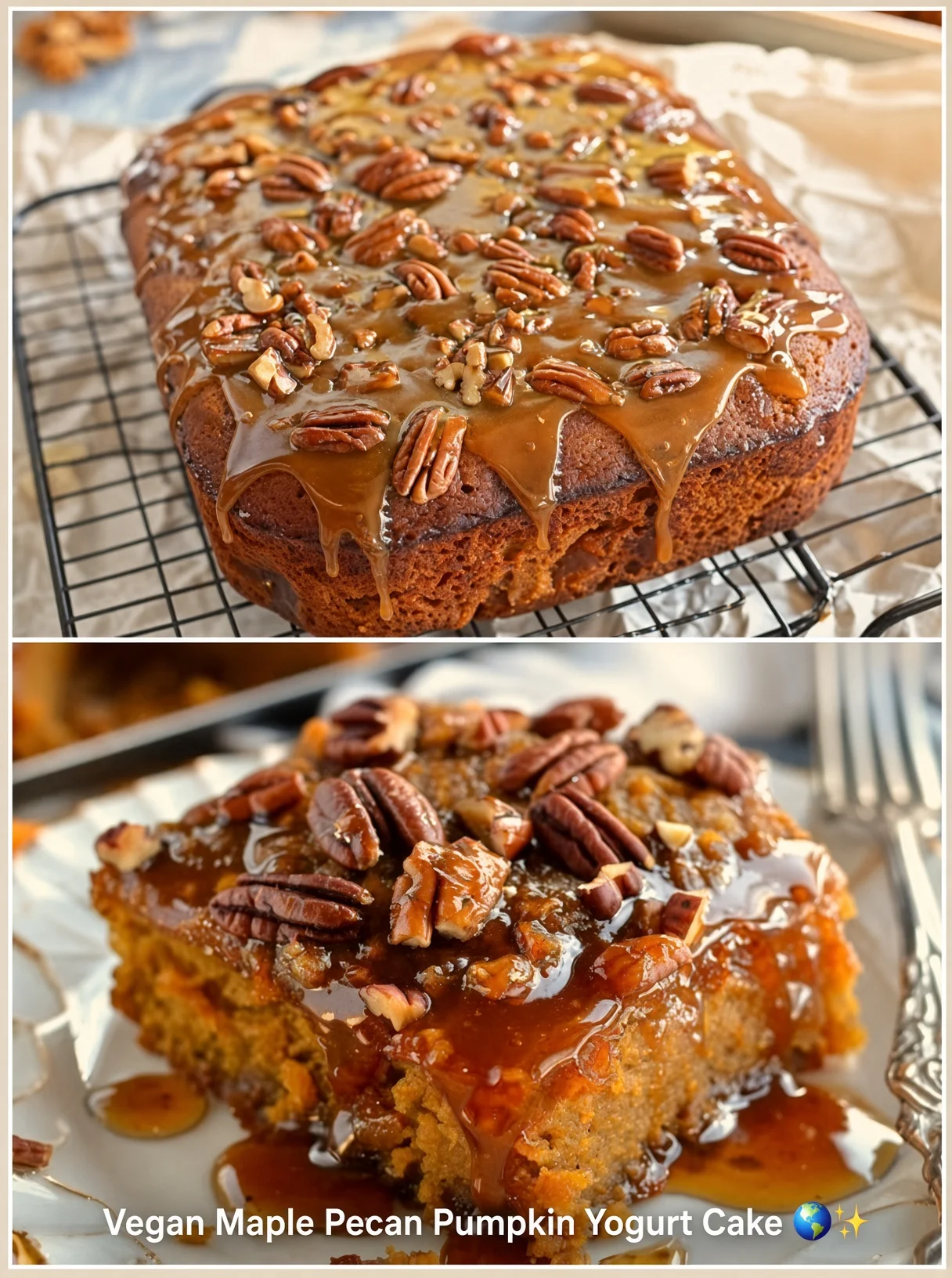
There are cakes that taste of a season so specifically and so completely that eating a slice of them in the wrong month feels almost like a violation of some natural order — cakes whose combination of flavor and warmth and spice belong so entirely to autumn that they cannot be separated from it. Vegan Maple Pecan Pumpkin Yogurt Cake is that kind of cake. It is a tall, deeply spiced loaf cake made with pumpkin purée, vegan yogurt, maple syrup, and a warm spice blend of cinnamon, ginger, nutmeg, and a pinch of clove, crowned with a crunchy maple-glazed pecan topping that caramelizes against the top of the cake during baking and sets into a brittle, glossy, intensely nutty crust that shatters when cut through. The interior of the cake is the defining thing about it: it is extraordinarily moist — not in the slightly wet, under-baked way that some pumpkin cakes are moist, but in the way of a cake that is fully baked all the way through and yet retains a tender, yielding, almost fudge-like crumb that pulls apart in long, soft strands and melts on the palate without any dryness whatsoever. The pumpkin purée and vegan yogurt together provide a quantity of moisture that ordinary fat-and-egg cake batters cannot replicate, and the technique manages that moisture so it distributes through the crumb rather than pooling at the base. It is 100% vegan, dairy-free, and egg-free. It keeps for four days and is, many people find, better on the second day than the first — the spices deepen overnight in a way that makes a slice cut cold from the refrigerator the next morning one of the genuinely great simple pleasures of autumn baking. The technique is the reason it is not wet.
The technique is the yogurt-temper and fold method. The central challenge of a pumpkin cake — particularly a vegan one without eggs to provide structural protein — is managing the large volume of water that pumpkin purée introduces into the batter. Pumpkin purée is approximately 90% water by weight, and adding a full cup of it to a standard cake batter creates a liquid-heavy mixture that, if not handled correctly, produces one of two failure modes: a cake that is dense and gummy in the center (the starch network never properly sets because the excess moisture kept the interior temperature below the gelatinization threshold throughout baking) or a cake that rises well but collapses inward as it cools (the structure was set by the outer crust but the wet interior contracts as it cools, pulling the top down). The yogurt-temper and fold method addresses the moisture problem at the mixing stage rather than the baking stage. Stage one — temper the yogurt: the pumpkin purée and vegan yogurt are combined first and left to stand for 5 minutes. During this time, the yogurt’s natural acidity (lactic acid, pH approximately 4.0–4.5) begins to interact with the pumpkin’s cell structure, drawing some of the pumpkin’s free water into the thicker yogurt matrix and producing a combined mixture that is denser and more viscous than either ingredient alone — essentially, the yogurt is pre-absorbing some of the pumpkin’s water before it enters the batter, reducing the volume of free moisture available to interfere with the starch network during baking. Stage two — fold, not mix: the pumpkin-yogurt mixture is folded into the dry ingredients using a spatula with the minimum number of strokes required to just combine them — never whisked, never beaten, never stirred vigorously. Over-mixing a high-moisture batter develops the gluten network excessively, producing a tough, chewy crumb; under-mixing leaves dry pockets. The fold method — large, sweeping strokes, stopping the moment no dry flour is visible — produces a batter with adequate gluten development for structure and minimal excess gluten for tenderness. The result is a cake that is fully baked, properly structured, and yet so moist in its crumb that it seems to defy the rules of what a vegan loaf cake is supposed to be able to achieve.
This recipe makes one standard 900g (2lb) loaf cake, serving 10–12 slices.
Recipe Information
| Prep Time | Cook Time | Total Time | Makes | Calories |
|---|---|---|---|---|
| 15 mins | 55–65 mins | 80 mins | 10–12 slices | ~325 kcal |
Ingredients
For the Cake
- 240g (2 cups) all-purpose flour
- 1½ tsp baking powder
- ½ tsp baking soda
- 1½ tsp ground cinnamon
- 1 tsp ground ginger
- ½ tsp ground nutmeg (freshly grated nutmeg is noticeably more fragrant and pungent than pre-ground; if using pre-ground, increase to ¾ tsp)
- ¼ tsp ground cloves (a small quantity only — cloves are very powerful and a heavy hand overwhelms the other spices; ¼ tsp is enough to add depth without dominating)
- ½ tsp fine salt
- 240g (1 cup) pumpkin purée — use canned pumpkin purée (100% pumpkin, not pumpkin pie filling, which contains added sugar and spices and would make the cake too sweet and differently spiced). If making your own from roasted pumpkin or butternut squash, drain the purée through a fine sieve or a muslin cloth for 30 minutes to remove excess water — homemade purée is often significantly wetter than canned and can overwhelm the batter without this step.
- 180g (¾ cup) vegan plain yogurt — coconut yogurt or oat milk yogurt both produce excellent results; soy yogurt is also good. Full-fat yogurt is preferred over low-fat for moisture and richness. The yogurt should be plain and unsweetened.
- 120ml (½ cup) maple syrup (the primary sweetener — maple syrup contributes both sweetness and a distinctive caramel-woody depth that complements the pumpkin and spices in a way that plain sugar does not)
- 80ml (⅓ cup) neutral oil (sunflower, vegetable, or refined coconut oil — do not use olive oil, which has a strong flavor that competes with the warm spices)
- 1 tsp vanilla extract
- 1 tbsp apple cider vinegar (reacts with the baking soda to provide additional lift; also helps the cake’s tender crumb by inhibiting excess gluten development)
For the Maple Pecan Crown
- 100g (1 cup) pecan halves
- 2 tbsp maple syrup
- 1 tbsp vegan butter or refined coconut oil, melted
- ¼ tsp ground cinnamon
- Pinch of fine salt (a pinch of salt in the pecan crown is essential — it sharpens the maple sweetness and makes the caramelized nuts taste far more complex and interesting than unsalted would)
Instructions
- Preheat and prepare. Preheat the oven to 175°C (350°F). Grease a standard 900g (2lb) loaf tin thoroughly and line with a parchment paper sling (a single strip of parchment that lines the base and two long sides, with enough overhang to lift the cake out easily after baking). Greasing the unlined short ends prevents the cake from sticking there.
- Make the pecan crown. In a small bowl, toss the pecan halves with the maple syrup, melted vegan butter or coconut oil, cinnamon, and salt until all the pecans are well coated. Set aside — these go on top of the batter just before it enters the oven.
- Mix the dry ingredients. In a large mixing bowl, whisk together the flour, baking powder, baking soda, cinnamon, ginger, nutmeg, cloves, and salt. Whisk thoroughly until the spices are evenly distributed through the flour — unevenly distributed spices can produce a cake with pockets that taste very strongly of one spice and others that taste bland.
- Yogurt-temper — Stage 1. In a medium bowl or large jug, combine the pumpkin purée and vegan yogurt. Stir well to fully combine. Leave to stand for 5 minutes — the yogurt’s acidity will begin drawing some of the pumpkin’s free water into the yogurt matrix during this time. After 5 minutes, add the maple syrup, neutral oil, vanilla extract, and apple cider vinegar to the pumpkin-yogurt mixture and whisk until smooth.
- Fold — Stage 2. Pour the wet ingredient mixture into the bowl of dry ingredients. Using a large spatula, fold the batter together with deliberate, sweeping strokes — cut through the center of the batter, fold up from the bottom, and turn the bowl as you go. Count your strokes and aim to stop at the point where no dry flour is visible — approximately 12–15 strokes. The batter will be thick and slightly lumpy; small lumps are fine and will bake out. Do not whisk, do not beat, do not stir in circles.
- Transfer and top. Pour the batter into the prepared loaf tin and smooth the top gently with the spatula. Arrange the maple-glazed pecans evenly over the surface of the batter, pressing each one very gently into the surface so it sits flush rather than perching on top (pecans that are not slightly embedded in the batter may shift or fall off when the cake rises). Pour any remaining maple glaze from the bowl over the pecan layer — it will sink slightly into the batter and caramelize during baking.
- Bake. Place in the preheated oven and bake for 55–65 minutes. The cake is done when a skewer inserted into the center comes out clean or with just a few moist crumbs attached (not wet batter). The maple pecan crown should be deeply golden-brown and the sides of the cake should be pulling away from the tin slightly. Check at 50 minutes — if the pecan crown is browning too quickly, tent the tin loosely with foil for the remaining baking time.
- Cool. Remove from the oven and allow to cool in the tin for 15 minutes before using the parchment sling to lift the cake onto a wire rack. Allow to cool for a minimum of 30 minutes before slicing — cutting into a hot loaf cake breaks the crumb structure before it has set fully, producing a collapsed, gummy slice. For the best slicing results and the deepest spice flavor, allow to cool completely (1–2 hours) before cutting.
Pro Tips
- The 5-minute yogurt-temper stand is not just a waiting period — actively stir the pumpkin and yogurt together before the stand and again at the end of it. The stirring helps the yogurt’s proteins and acids interact with the pumpkin’s cell structure more effectively than leaving them unstirred. The combined mixture should look noticeably thicker and denser after 5 minutes than it did at the start.
- Line the tin generously — pumpkin cakes are more prone to sticking than butter-based cakes because their high moisture content can create a steam layer between the cake and the tin during cooling that makes the cake bond to ungreased or underlimed sections. The parchment sling that lines the base and long sides makes removal effortless; grease the short ends thoroughly as a backup.
- The cake is better on day two — this is one of the clearest examples in baking of a cake that improves with a resting period. On the day of baking, the spices are present but slightly raw-edged; after one night wrapped and stored at room temperature or in the refrigerator, the spices have bloomed and mellowed into each other, the crumb has settled into a more cohesive texture, and the maple flavor has deepened throughout. If making for guests, bake the day before.
- Test doneness with a skewer, not a visual check — the maple pecan crown and the deep amber color of the spiced batter mean this cake looks done on the outside long before the interior has fully baked. A visual check is unreliable; always use a skewer at the center of the thickest part of the cake. A few moist crumbs are acceptable (the pumpkin means this cake will never have a completely dry skewer even when fully cooked); wet batter means more time is needed.
Pumpkin in America: Squash, Colonialism, and the Making of an Autumn Icon
The pumpkin — in its modern culinary incarnation as the defining flavor of autumn in the United States and, increasingly, in the global food culture that American food trends have come to influence — is the result of a cultural transformation so thorough that it has almost completely obscured the vegetable’s origins and its actual historical relationship with the people who cultivated it first. Pumpkins and other members of the Cucurbita genus were domesticated in Mesoamerica at least 10,000 years ago, making the pumpkin one of the oldest cultivated plants in the Americas and among the first crops in what became one of the most important agricultural systems in the pre-Columbian world: the Three Sisters (corn, beans, and squash grown in combination, where the corn provides a trellis for the bean, the bean fixes nitrogen for the corn, and the squash’s broad leaves shade the soil and suppress weeds — a companion planting system of remarkable ecological sophistication). Indigenous peoples of North America cultivated, ate, and traded pumpkins long before European contact, using the flesh, seeds, flowers, and dried rind in ways that the European settlers who adopted the pumpkin in the 17th century largely did not. The English Puritan settlers of New England in the 1620s–1640s adopted pumpkin as a survival food during difficult early years when grain harvests failed, and the association between pumpkin and the autumn harvest — formalized in the American Thanksgiving tradition — was cemented in the 19th century as both a nostalgic national myth and a genuine reflection of pumpkin’s seasonal calendar. The modern “pumpkin spice” flavor profile — cinnamon, ginger, nutmeg, clove, and allspice — bears almost no relationship to how Indigenous peoples prepared pumpkin; it is a European spice blend applied to an American vegetable, a product of the colonial moment in which settlers took a new ingredient and flavored it with what they had brought from home. The extraordinary commercial expansion of pumpkin spice since Starbucks introduced the Pumpkin Spice Latte in 2003 has turned what was a regional autumn tradition into a global flavor season, and the cake on this board — warmly spiced, maple-sweet, and deeply autumnal — is one small expression of that story.
Flavor Variations
- Chocolate Chip Pumpkin Cake: Add 120g (4oz) of vegan dark chocolate chips to the batter at the end of the fold stage, stirring in gently with 2–3 additional strokes. The chocolate chips melt into small pools through the cake during baking and provide a rich, slightly bitter contrast to the sweet, warmly spiced pumpkin crumb. Omit the pecan crown and replace with a simple scatter of additional chocolate chips over the top of the batter if preferred — or keep the pecan crown alongside the chocolate chips for a triple-texture result (crunchy pecans, melted chocolate, soft spiced crumb).
- Cream Cheese Swirl Pumpkin Cake: Soften 120g (4oz) of vegan cream cheese to room temperature and beat with 2 tablespoons of icing sugar, ½ teaspoon of vanilla extract, and 1 tablespoon of plant milk until smooth. Pour half the pumpkin batter into the prepared tin, dollop the cream cheese mixture in spoonfuls over the top, pour the remaining batter over, and use a skewer to swirl through the cream cheese layer with 4–5 figure-eight strokes. Top with the pecan crown as directed and bake. The cream cheese swirl creates a tangy, creamy ribbon through the spiced crumb that adds a cheesecake-like quality to the finished cake.
- Orange and Cardamom Pumpkin Cake: Add the finely grated zest of 1 large orange and ½ teaspoon of ground cardamom to the dry ingredients. Replace the vanilla extract with ½ teaspoon of orange extract in the wet mixture. The orange-cardamom variation gives the cake a lighter, more fragrant, slightly more exotic character than the classic cinnamon-ginger combination, and pairs beautifully with a simple orange glaze (3 tablespoons of icing sugar, 1 tablespoon of fresh orange juice, whisked and drizzled over the cooled cake) rather than the pecan crown.
Nutritional Highlights (Per Slice — Based on 11 Slices)
| Calories | Protein | Carbs | Fiber | Fat |
|---|---|---|---|---|
| ~325 kcal | 4g | 47g | 3g | 13g |
Storage
- Room temperature: Keep wrapped tightly in cling film or in an airtight container at room temperature for up to 2 days. The high moisture content of pumpkin cakes means they stay softer for longer than most loaf cakes at room temperature, but they are also more prone to mold after 2–3 days, particularly in warm or humid conditions.
- Refrigerator: Refrigerate wrapped for up to 5 days. The cake is, as noted in the Pro Tips, often better from the refrigerator on day 2 or 3 than on the day of baking — the spices deepen and the crumb settles. Allow to come to room temperature for 20–30 minutes before serving, or serve cold (which many people prefer with a warm-spiced autumn cake).
- Freezer: Freezes extremely well for up to 3 months. Slice the cooled cake, wrap each slice individually in cling film, and store in a sealed freezer bag. Defrost individual slices at room temperature for 1 hour or overnight in the refrigerator. The pumpkin’s high moisture content means the crumb survives freezing and thawing better than many cakes — the texture of a properly thawed slice is nearly identical to a freshly baked one.
- Pecan crown after storage: The pecan crown loses its brittleness after 24 hours in an airtight container or the refrigerator, becoming sticky and chewy rather than crunchy. This is normal and entirely pleasant — the pecans remain deeply flavored and the sticky-maple quality is very good. The crunch is a fresh-from-the-oven quality; the stickiness is the storage quality.
Frequently Asked Questions
Can I use butternut squash instead of pumpkin purée?
Yes — butternut squash purée works very well in this recipe and produces a slightly sweeter, more delicate flavor than pumpkin. Roast a halved butternut squash at 200°C (390°F) for 40–45 minutes until completely tender, then scoop and mash or blend the flesh until smooth. Drain through a fine sieve for 20 minutes to remove excess water before using — homemade squash purée is wetter than canned pumpkin and the draining step is important for the correct batter consistency.
My cake sank in the middle. What went wrong?
A sunken center in a pumpkin cake is almost always caused by one of three things: the oven door was opened too early (before 45 minutes), the batter was over-mixed (excess gluten development followed by collapse as the structure couldn’t hold), or the cake was underbaked (the interior was still liquid when the oven heat stopped and the structure collapsed as it cooled). For the next bake: do not open the oven door before 50 minutes, use the fold method as described, and test with a skewer before removing — not by appearance.
Can I make this as muffins instead of a loaf?
Yes — the batter works well as muffins. Divide among 12 lined muffin cups (fill each about ¾ full) and top each with 2–3 maple-glazed pecans. Bake at 190°C (375°F) for 20–24 minutes until a skewer comes out clean. Muffins bake significantly faster than a loaf — check at 20 minutes and do not overbake. The pecan crown caramelizes beautifully on individual muffins.
Is there a gluten-free version?
Yes — replace the all-purpose flour with a certified gluten-free plain flour blend that contains xanthan gum (or add ½ teaspoon of xanthan gum yourself if the blend does not include it — xanthan gum provides the structural binding that gluten would normally supply). The gluten-free version may need an additional 5 minutes of baking time. The texture will be very slightly denser than the all-purpose version but still very moist and well-spiced.
Tried this recipe? Leave a comment below and let us know how it turned out! Tag us on Instagram and Facebook — we love seeing your plant-powered creations. Looking for more addictive vegan snack and appetizer recipes? Browse all recipes on Easy Vegan Recipes — new recipes posted every single week!